

You can deduct the ordinary and necessary costs of traveling away from your tax home for business: transportation, lodging, meals (usually at 50%), and a handful of smaller items. The trip has to be for business, you have to be away longer than a normal workday and need rest, and you need records that prove it. Most employees can’t deduct unreimbursed travel, but self-employed owners and business entities generally can.
This guide walks through each of those rules in plain terms, with the exceptions that trip people up and a checklist you can use before your next trip.
The IRS defines travel expenses as the ordinary and necessary costs of traveling away from home for your business, profession or job. You are “away from home” when your work requires you to be gone substantially longer than an ordinary day’s work and you need sleep or rest to meet the demands of your work while away. That definition comes straight from IRS Publication 463, and it is narrower than many owners assume. A long day trip with no overnight stay generally does not qualify as travel, although other costs, such as car mileage, may still be deductible.
Two words carry most of the weight:
Generally, your tax home is your regular place of business or post of duty, including the entire city or general area, regardless of where you keep your family home (IRS Publication 463). If you run a practice in Red Bank, New Jersey, your tax home is the Red Bank area. A trip to a client in Denver is travel away from home. A drive to a client across town is not.
This matters for owners who work from several locations. If you have no regular place of business, the rules get more complicated, and it is worth a conversation with a CPA before you assume anything.
Travel to a temporary work location is deductible. Employment away from your tax home that lasts more than one year is generally treated as indefinite, and the lodging and meals there are generally not deductible, as the IRS instructions for Form 2106 explain. If a project keeps growing, watch the one-year mark. A job that starts as a six-month engagement and gets extended can change how the entire stay is treated.
According to IRS Publication 463 and IRS Topic no. 511, deductible business travel costs can include:
| Expense | What qualifies | Watch for |
|---|---|---|
| Transportation to the destination | Airfare, train, bus, or the cost of driving your car | Personal side trips and upgrades for non-business reasons |
| Local transportation | Taxis, rideshare, rental car, transit between the airport, hotel, meetings | Keep the business purpose for each trip |
| Lodging | Hotel or short-term rental while you are away | A receipt is required for all lodging |
| Meals | Meals while traveling, not entertainment | Generally 50% of the unreimbursed cost; no lavish or extravagant meals |
| Car costs | Actual expenses or the standard mileage rate | Choose a method and keep a mileage log |
| Other business costs | Dry cleaning and laundry, business phone calls, tips on deductible services | Must be tied to the trip |
Each of these has to be ordinary, necessary and directly related to your business. Here is how the biggest ones work in practice.
Fares to and from your destination are deductible when the trip qualifies. If you drive, you can generally deduct either your actual car expenses or the standard mileage rate. For 2026, the IRS lists the business rate as 72.5 cents per mile for January 1 through June 30 and 76 cents per mile from July 1 through December 31, on its standard mileage rates page. The rate is updated by the IRS, so check that page for the year you are filing.
If you drive a vehicle that is mostly used for business, there are larger planning opportunities beyond the mileage rate. We cover those in our posts on vehicle tax deductions after OBBBA and converting a personal vehicle under the 2025 rule.
Lodging is deductible for the nights you are away on business. Keep the folio, not just the card statement, because the receipt is required for every lodging expense. The nights you add for personal reasons are a different story, covered below.
Business travel meals are generally subject to a 50% limit on the unreimbursed cost. You, or your employee, generally need to be present, and the meal cannot be lavish or extravagant (IRS Publication 463). The IRS repeats the same limit for unreimbursed non-entertainment business meals in its small business FAQ.
In practice, that means:
The IRS also allows a standard meal allowance in place of actual costs in some cases. Look up the current rates in Publication 463 before you choose that method.
Owners often forget cleaning and laundry on a long trip, business calls from the road, tips to baggage handlers, and fees for business services such as a short-term conference room. They are all listed as deductible when tied to the trip. Capture them in your expense app the day they happen.
This is where most travel deductions get challenged, so it deserves care.
For a trip that combines business and personal purposes, the cost of getting to and from the destination is deductible only if the trip is related primarily to your trade or business. If it is primarily personal, those transportation costs are not deductible even if you do some business while there. The rule is in 26 CFR 1.162-2.
Two points follow from it:
Say you fly from New Jersey to Phoenix for three days of client meetings and a conference, then stay two more days to play golf with your family. The trip is primarily business, so the round-trip airfare is deductible. The hotel nights and meals for the three business days are deductible (meals at 50%). The two personal nights and their meals are yours to pay.
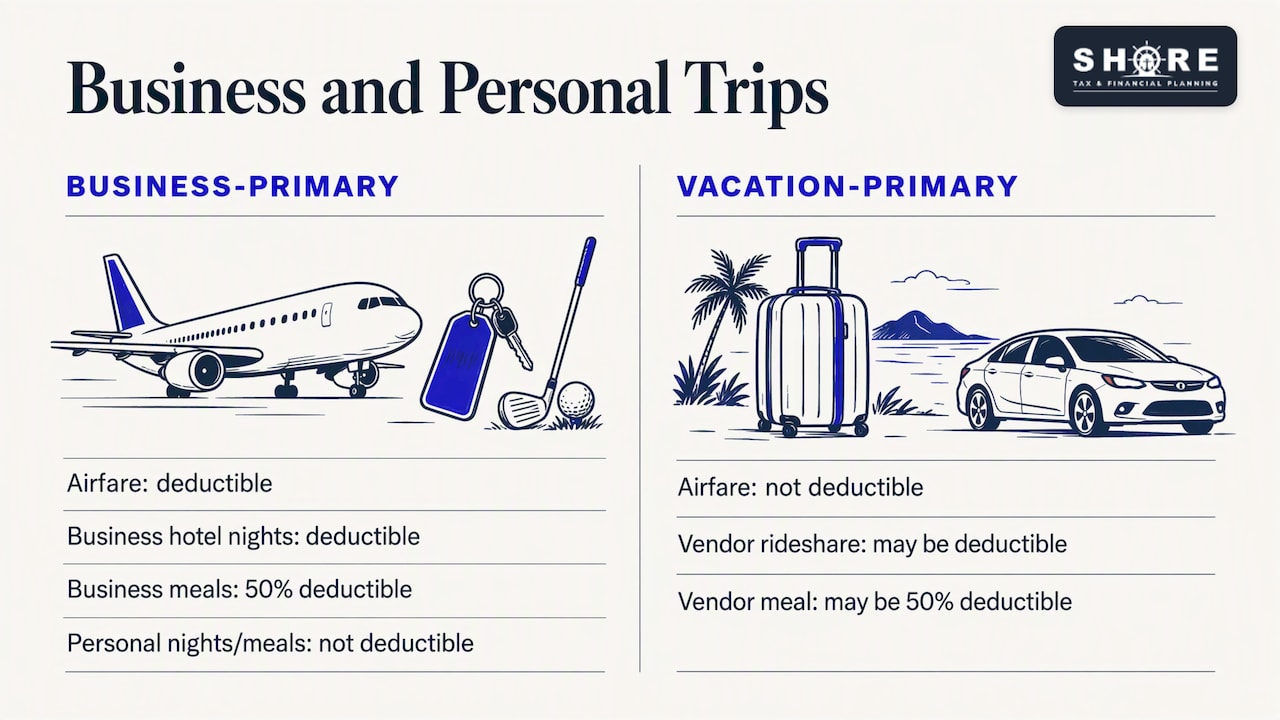
Now flip it. You take a ten-day vacation in Phoenix and spend one afternoon meeting a vendor. The trip is primarily personal, so the airfare is not deductible. The cost of the vendor meeting, such as a rideshare there and back and that meal at 50%, may be.
The weekend question comes up often too. Travel on weekends to your family home is not deductible when it is not for your work (IRS Topic no. 511). Staying over a Saturday to extend a trip is a facts-and-circumstances call, so document why you stayed.
A spouse’s or other family member’s travel expenses aren’t deductible unless their presence has a bona fide business purpose, and performing incidental services does not satisfy that test (26 CFR 1.162-2). If your spouse is a real employee or officer of your business and attends to do actual business work, such as running a booth or meeting clients, their expenses can qualify, provided the role is documented. If they come along for company, the extra cost is personal. Note that when you share a hotel room, the single-room rate is generally the figure to think about, so keep the rate your room would have cost alone.
Personal expenses and lavish or extravagant business meals aren’t deductible (IRS Topic no. 511). Common examples of what falls on the wrong side:
It is also worth remembering that a deduction only helps if the business has taxable income to offset, so it works best alongside a broader plan rather than as a last-minute scramble.
The rules look different depending on how you earn income.
If you are a high-earning employee who also travels, the better route is often a reimbursement policy from your employer, or, if you also run a side business, a properly separated business with its own records. If you pay your own company’s travel, our post on employee reimbursement versus company cards explains how each setup affects your records.
You must keep records that prove the time, place, business purpose and amount of each expense. Receipts are required for all lodging expenses and any other single expense of $75 or more, and logs, diaries or other written records can support the rest (IRS instructions for Form 2106).
A workable system looks like this:
If your employer pays a fixed travel allowance similar to the federal per diem, an employee is treated as having accounted for those expenses when they verify the time, place and business purpose of the travel (IRS instructions for Form 2106). Owners paying themselves from their own company should set up the same discipline in writing, with a short travel policy that states what is reimbursed and how.
For more ideas on this topic, see our top travel expense deduction tips and overlooked small business deductions.
Run through this before you book:
We see the same pattern with business owners and high earners: travel is rarely the problem, the paperwork is. The rules in Publication 463 are not mysterious. What costs people money is a trip that was legitimately for business but can’t be shown that way a year later.
Our view is that travel deductions work best as one part of a year-round plan. When we look at a client’s calendar, entity structure and reimbursement setup together, travel stops being a line item you scramble to find in March. It becomes a predictable, defensible cost that fits how the business actually operates.
We are fee-only, so we don’t earn commissions on products. That means the only thing we have to gain from a recommendation is your tax result. We would rather help you set up a clean travel policy and log in January than defend an ambiguous one later.
Joseph
If you travel for work and want to know how your entity, reimbursement policy and records fit together, we can help. Our tax reduction planning is built for business owners and high-income professionals who want strategies that are in place during the year, not just at filing time.

If you are a business owner, our year-round advisory and CFO services cover your bookkeeping, tax planning and compliance together. If you are a high W-2 earner, start with our page for high-income professionals. To see how planning differs from filing, read tax prep versus tax planning.
Most employees can’t deduct unreimbursed travel expenses, though some employee groups qualify for exceptions (IRS Topic no. 511). The practical fix is to ask your employer to reimburse travel under a written policy. Self-employed taxpayers deduct these costs on Schedule C.
Generally no. Business travel meals are usually limited to 50% of the unreimbursed cost, and they can’t be lavish or extravagant (IRS Publication 463). Check the current Publication 463 for any exception before you deduct more than half.
Yes, if the trip is primarily for business. Then your transportation to and from the destination is deductible, along with lodging and meals for the business days, but not the personal days. If the trip is primarily personal, the travel to get there is not deductible (26 CFR 1.162-2).
Only when your spouse’s presence has a bona fide business purpose, and incidental help doesn’t count. If they are a legitimate employee doing real work on the trip, their expenses may qualify, with documentation. Otherwise the extra cost is personal.
Keep receipts for all lodging and for any other single expense of $75 or more, plus a record of the time, place, business purpose and amount of each expense (IRS instructions for Form 2106). A daily log or diary fills in the smaller items.