

A calendar year runs January 1 through December 31. A fiscal year is any 12 consecutive months that end on the last day of a month other than December. Most U.S. businesses use the calendar year because it is simple and, for many entity types, required. A fiscal year earns its place when your income is seasonal or your books need to line up with a natural business cycle.
The choice looks like paperwork, but it decides when your income is reported, when your deductions land and how clearly you can see your cash. Below you will find the definitions, the entity rules, the process for changing, and how your year-end shapes the cash flow forecasts you build.
The IRS defines a calendar tax year as 12 consecutive months beginning January 1 and ending December 31. It defines a fiscal tax year as 12 consecutive months ending on the last day of any month except December. A July 1 through June 30 year is a typical example.
The IRS also recognizes a 52-53-week tax year. It is a fiscal year that varies between 52 and 53 weeks and does not have to end on the last day of a month. Retailers and restaurant groups often use it so every period contains the same number of weekdays and weekends.
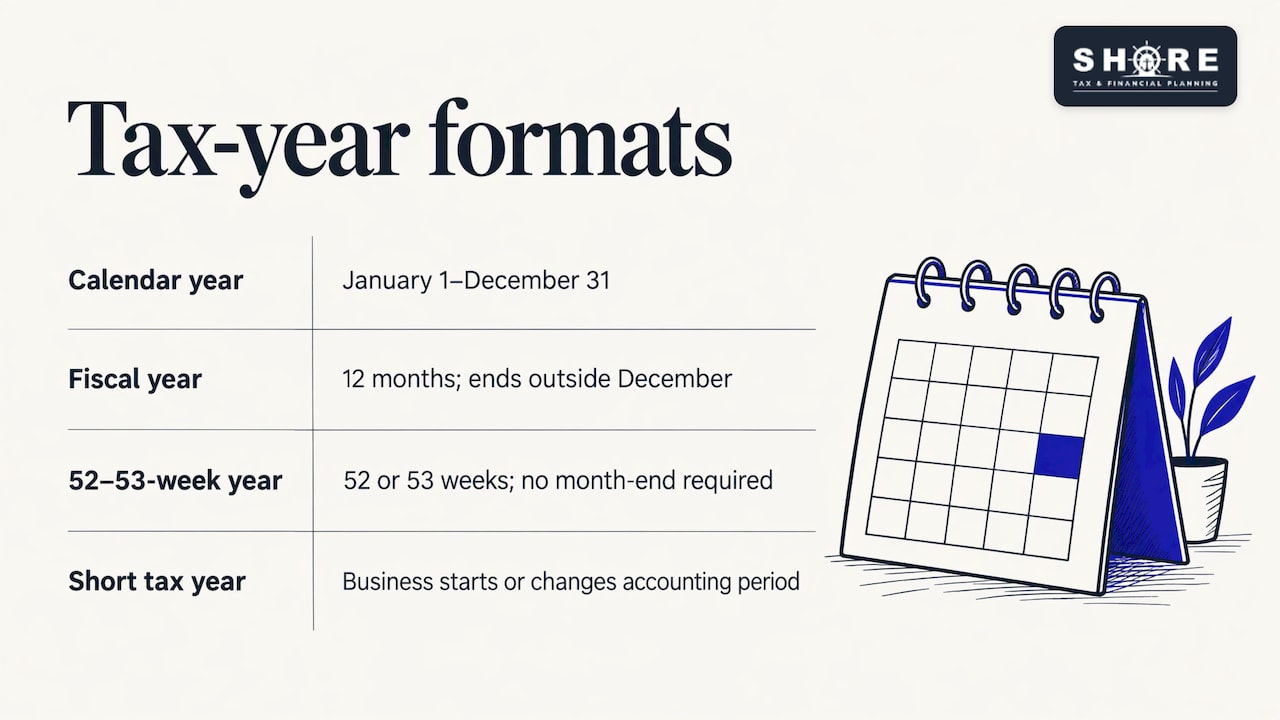
There is a fourth category, the short tax year. The SBA’s guidance on paying taxes points to it when a business was not in existence for an entire tax year or when it changed its accounting period.
Quarters follow your year-end, not the calendar. A calendar-year business has Q1 from January through March. A business with a June 30 year-end has Q1 from July through September and finishes Q4 in June. When a lender, investor or partner says “Q2,” confirm whose Q2 they mean.
| Factor | Calendar year | Fiscal year |
|---|---|---|
| Dates | Jan 1 to Dec 31 | Any 12 months ending on a month-end other than December |
| Who commonly uses it | Most sole proprietors, S corporations, personal service corporations | Seasonal businesses, some C corporations, some partnerships |
| Alignment with owner’s personal return | Matches an individual calendar-year filer | Can create a mismatch between business and personal reporting |
| Best fit | Steady income, simple books | Income and expenses concentrated in a cycle that straddles December |
| Changing | Needs IRS approval in most cases | Needs IRS approval in most cases |
Before you weigh pros and cons, check whether the decision is already made for you. IRS Publication 538 says that, unless you have a required tax year, you adopt one by filing your first income tax return with it. Generally anyone can adopt the calendar year, but certain circumstances require it.
A first-time filer can choose either type, though IRS Publication 583 notes that some partnerships and S corporations must use a particular tax year.
By entity type, a Wolters Kluwer overview of tax year choices summarizes the usual pattern:
How entity type and owners’ tax years interact is laid out in this practical small business tax guide. If you are weighing an entity change, the tax year is one more reason to look at the whole picture before you elect anything.
Publication 538 is specific. You adopt a tax year by filing the first income tax return that uses it. Filing an extension, applying for an EIN on Form SS-4, or paying estimated taxes does not adopt a tax year. That matters for a new company: you can plan a fiscal year while you set up, but nothing is locked in until the first return is filed.
If you incorporate in California, this walkthrough of corporate fiscal year documentation covers how a corporation records its accounting period.
The SBA’s rule of thumb is straightforward. If you have no special accounting needs, choose the calendar year. If you want your 12-month cycle to end in a month other than December, choose a fiscal year.
Three situations are where a fiscal year does real work.
Wolters Kluwer gives the example of a ski resort open December through March. A calendar year splits the season in two, so a profit at December 31 can turn into a loss once the full season is counted. A fiscal year that contains the whole season matches revenue to the expenses that produced it.
The same logic applies to a landscaper, a summer camp or a tax-season-driven business. Pick a year-end shortly after your peak, when receivables are collected and inventory is low.
The same Wolters Kluwer article notes that a C corporation starting operations mid-year may benefit from a fiscal year that extends beyond the end of the first calendar year. That lets more income be offset by opening expenses and early losses.
AICPA & CIMA lists reasons entities change their fiscal year, including seasonal fluctuations, cash management, matching industry peers and a switch to S-corporation status. Peer alignment helps when investors or lenders compare you against others in your sector.
For most owners, the calendar year wins on simplicity. Your business year matches your personal return, your W-2s and 1099s arrive on the same schedule, and your year-end planning window is the same as everyone else’s. Your bookkeeper, payroll provider and CPA all work from the same rhythm.
There is a planning benefit too. Many of the best tax moves are tied to December 31: equipment purchases, retirement plan contributions and compensation planning. If you are a calendar-year business owner, our year-end deduction guide for business owners and our piece on retirement tax strategies before year-end show how those deadlines work. The point of year-round tax planning is that you do not meet them for the first time in December.
Once you have adopted a tax year, you generally need IRS approval to change it. Publication 583 points to Form 1128, Application To Adopt, Change, or Retain a Tax Year, and notes you may have to pay a fee. Publication 538 adds that an automatic approval request does not require a user fee.
Timing is set in the Instructions for Form 1128. You file by the due date, not counting extensions, of the federal income tax return for the first effective year. You cannot file earlier than the day after that first effective year ends.
For partnerships, LLCs taxed as partnerships and S corporations, Nolo explains that the IRS will generally allow a change when there is a sufficient business purpose. Examples include moving to the required calendar year or to a natural business year.
Then comes the catch. Wolters Kluwer warns that, except in unusual cases, the IRS will not allow you to change again within 10 years of an approved change. Treat the decision as long-term.
A short checklist before you file:
A change can also pull income into a short period and create an unexpected bill. That is a modeling job, not a guess.
Your year-end tells you when taxes come due and when your books close. It does not tell you whether you will have cash on those dates. That is a separate question, and it is where forecasting comes in.
A profit and loss statement shows profitability. A cash flow forecast shows timing. Investopedia quotes a CFP who says the key assumptions are sales, payment timing, payroll, taxes, recurring expenses and major purchases, reviewed monthly, because timing combined with profitability determines whether cash is available.
Taxes belong in that list for a reason. Estimated tax payments, payroll tax deposits and your year-end tax bill all land on dates driven by your tax year. A fiscal-year business has a different tax calendar than a calendar-year owner, so the forecast has to reflect it.
The FDIC’s Money Smart for Small Business guide walks through a small shop called Party Central. Its cash flow statement for August shows beginning cash of $2,500, customer receipts of $15,000 and ending cash of $7,750. The projection for September starts with that $7,750 and, with receipts of $14,000, ends at $4,200.
The mechanics are the same at any size. Expensify’s template states them plainly: net cash flow equals total inflows minus total outflows, and closing cash equals opening cash plus net cash flow. The closing balance of one period becomes the opening balance of the next.
The Wells Fargo sample projection adds realism through collection assumptions. It assumes 75% of sales are collected the month after the sale and 25% the month after that, with payables due in 25 days. Under those assumptions it projects a deficit of $21,200 in November. The lesson is that a business can be profitable and still be short of cash at a specific point.
The two horizons answer different questions.
| 13-week forecast | 12-month forecast | |
|---|---|---|
| Cadence | Weekly, refreshed often | Monthly |
| Question it answers | When will I run short? | Can I afford the hire, the equipment or the financing? |
| Typical method | Direct: actual cash receipts and payments | Indirect: starts from net income and adjusts for non-cash items |
| Tax-year link | Catches the week a tax deposit or payroll lands | Maps your full tax year, including year-end planning |
The Expensify guide describes the 13-week view as a weekly check for near-term visibility and the 12-month view as better for planning hires, capital purchases or financing. Nilus notes the 13-week model uses the direct method on real transactions, while longer forecasts typically use the indirect method starting from net income. It recommends running both so the weekly signals feed the strategic model.
The 13 weeks line up with one quarter. That is handy for fiscal-year owners, whose quarter-end falls on a different date than the standard calendar quarter.
The Association for Financial Professionals describes the receipts and disbursements method. It builds separate schedules of projected receipts and disbursements on a cash basis, then combines them with the beginning balance. It works best for short-term forecasts and is only as reliable as its data. The bank data approach starts from the current bank position and suits very short horizons, such as the daily cash position.
For most owner-run businesses, the practical setup is simple:
A useful signal for when to start the 13-week version: HighRadius lists warning signs such as less than three months of runway, trouble meeting payroll and uncertainty about large upcoming payments.
We see the calendar year versus fiscal year question go wrong in one of two ways. Owners either never think about it, or they treat it as the main lever. It is neither. The tax year is a structural choice. Most of the savings come from what you do inside whatever year you have.
For most of the profitable business owners and high W-2 earners we work with, the calendar year is the right answer, and often the required one, especially once an S corporation is in the picture. The real opportunity is using the calendar well: electing S corporation status at the right time, setting up retirement plans, timing equipment purchases and planning compensation before the year closes, not after.
That is why our work is year-round, not a tax-season exercise. Our lead advisor holds both CPA and CFP credentials and has run a business, so we look at your tax return and your cash together. A strategy that saves tax but starves your cash does not help you. We are fee-only and take no commissions on products, so the only thing we have to recommend is the plan that fits you.
If you are thinking about changing your tax year, bring us in before you file anything. Form 1128, the transition period and the 10-year lookout deserve modeling first.
Joseph
If you are choosing a tax year for a new entity, considering a change, or wondering whether an S corporation election fits your income, we can help. Our tax reduction planning is built around year-round strategy for business owners and high earners, with CPA-level return preparation and cash-aware planning behind it.

If an entity change is on the table, start with our S-corp conversion services. If you want ongoing guidance on cash, taxes and growth, see our year-round advisory and CFO services. To talk through your situation, reach us at shorefp.com.
Not always. A fiscal tax year must end on the last day of a month other than December, or follow the 52-53-week rules, according to the IRS. Your entity type may also require the calendar year. S corporations and personal service corporations generally must use it.
A fiscal year has fixed start and end dates and is the period used for tax and financial reporting. A rolling year, such as a 12-month rolling forecast, moves forward one period at a time so it always looks 12 months ahead. Rolling views are for planning, and the fiscal year is the reporting frame.
No. Per calendar year means the limit or count resets on January 1 and runs to December 31, whatever your business year-end is. Per year can mean any 12-month period. Check the wording on contribution limits, contracts and benefit plans.
It depends on whether you qualify for automatic approval or need a ruling. The Form 1128 instructions set the filing deadline by reference to the return for the first effective year. Ask your CPA to confirm the route for your entity and plan for the short tax year it creates.