

A cash flow forecast is a forward-looking estimate of the cash your business will hold at future dates, built from what you expect to collect and pay. For a profitable owner or high earner, the version that matters is a weekly, rolling forecast of about 13 weeks that includes tax payments as scheduled outflows. Profit does not tell you whether you can cover payroll and a quarterly tax payment in the same month. A forecast does. If you want a CPA and CFP to build that picture around your tax strategy, our year-round advisory and CFO services are set up for it.
A forecast estimates future cash receipts, payments and the resulting cash position. Xero’s 2026 guide separates it from the cash flow statement: the statement records what already moved, while the forecast looks ahead to cash available at future dates.
It is also different from a profit forecast. IBM’s tutorial explains that cash forecasting focuses on when money is received and paid, while profit forecasting focuses on revenue, expenses and net income. You can book a strong profit in March and still be short in April if the customer pays in May.
What you use it for:
The math is simple: starting balance plus total inflows minus total outflows equals closing balance. Business.com names the four weekly rows: opening balance, total inflows, total outflows and closing balance. Each week’s closing balance becomes the next week’s opening balance.
OpenStax’s finance text uses the same logic: begin with cash on hand, add anticipated inflows, deduct anticipated outflows, and the result shows a surplus or shortage.
A simple example for a contracting company with an opening balance of $60,000:
| Week | Opening | Inflows | Outflows | Closing |
|---|---|---|---|---|
| 1 | $60,000 | $45,000 | $52,000 | $53,000 |
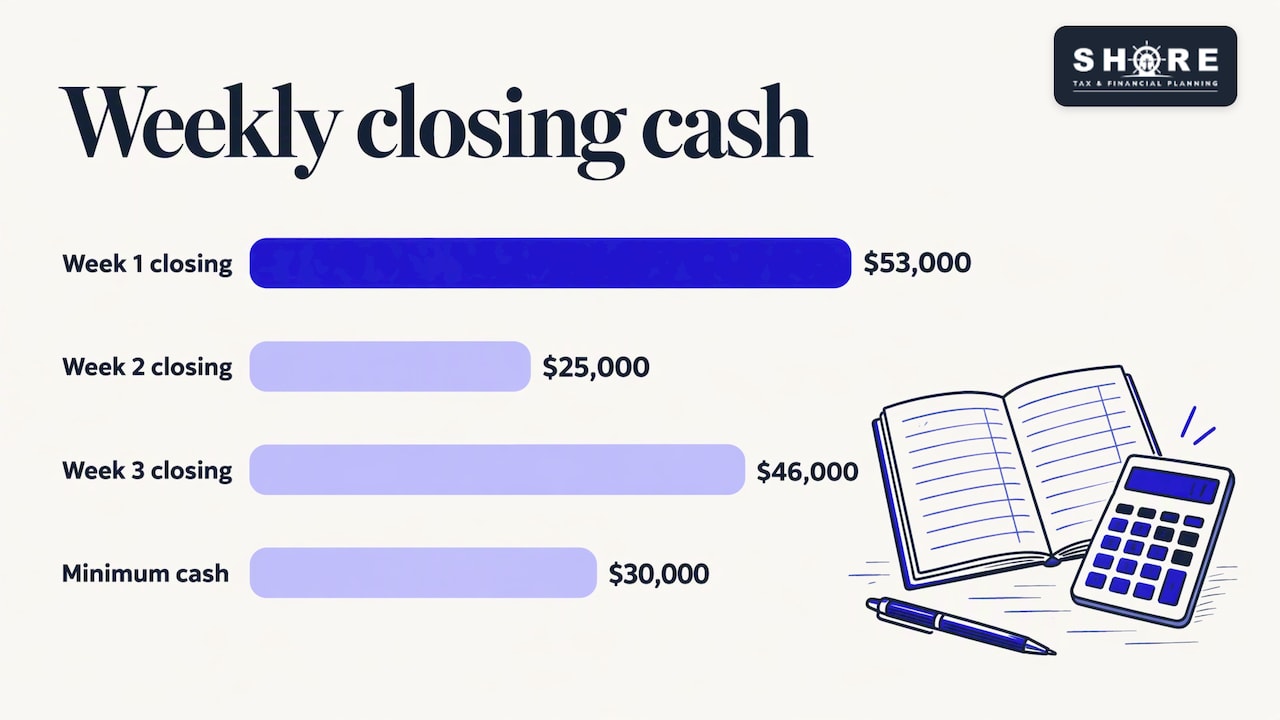
| 2 | $53,000 | $30,000 | $58,000 | $25,000 |
| 3 | $25,000 | $62,000 | $41,000 | $46,000 |
The figures are illustrative. Week 2 is the lesson: the business is profitable over three weeks, yet the closing balance falls to $25,000 because payroll and materials land before customer payments. If your minimum operating cash is $30,000, week 2 is the week to fix now, by speeding up an invoice or moving a purchase.
Per Xero, inflows can include customer receipts, loans, grants, refunds and owner contributions. Outflows can include payroll, rent, inventory, debt payments, taxes and marketing. List each by the date cash is expected to move, not the date you invoice or book it. OpenStax’s worked example does exactly this: receipts follow customer payment terms, and payables, salaries, rent, utilities and interest follow their payment dates.
The weak point in most forecasts is step 2. If your books are months behind or categories are mixed, the forecast inherits the errors. Current monthly bookkeeping is the foundation, which is why we offer monthly bookkeeping and accounting cleanup for owners whose records are not ready to forecast from.
There are two main ways to build a forecast.
Direct method. You list individual transactions line by line: sales receipts, bills, loan payments. Xero says this is more precise for short-term cash timing. NetSuite describes it as a bottom-up build of expected transactions that tends to be the most accurate for short-term forecasts.
Indirect method. You start with net income and adjust for depreciation, changes in receivables and inventory, and similar items. Xero says it is faster when current financial statements exist and better suited to medium- and long-term forecasts.
| Direct | Indirect | |
|---|---|---|
| Starts from | Expected receipts and payments | Net income |
| Best horizon | Days to about 13 weeks | Quarters to years |
| Effort | Higher, needs transaction detail | Lower, uses financial statements |
| Best for | Liquidity, payroll, tax dates | Strategy, financing, planning |
The Association for Financial Professionals says the method you choose depends on data quality and forecast timeframe. For most owner-managed companies, the practical answer is both: direct for the next quarter, indirect for the year ahead.
A three-way forecast links the income statement, balance sheet and cash flow statement, so a change in one flows through to the others. Phocas defines it that way. It helps when you are weighing a large purchase, a new location or a financing decision. If you are modeling debt or growth capital, a financing-focused forecast guide walks through the working-capital side of building one.
The 13-week forecast is the standard short-term tool. AICPA & CIMA describe it as 13 weekly columns starting with the current cash position. Each week holds opening cash, expected receipts such as customer collections and financing, expected payments such as payroll, vendors, rent, debt, taxes and planned purchases, and a closing balance.
Thirteen weeks matches a quarter, which is also the rhythm of estimated taxes. It is far enough out to give you time to act and near enough that the direct method stays reliable. If you want a worksheet to start from, a 13-week cash flow forecast example shows the layout.
A practical layout:
A rolling forecast keeps a constant window. When a week closes, you remove it, add a new week at the far end and update the assumptions. Business.com recommends reconciling forecast to actuals every week, investigating variances, dropping the closed week and adding a new week 13. J.P. Morgan favors rolling forecasts over static monthly or quarterly ones because they absorb the latest information.
The weekly routine takes about an hour once the model exists:
Today CFO treats variance review as what turns a spreadsheet into a forecasting system: actual outcomes have to change future assumptions.
This is where forecasting meets tax planning, and where most generic guides stop short. Tax is a large, predictable, lumpy outflow. If it is missing from your forecast, your cash picture is wrong by the amount of the check.
Federal estimated taxes. If you have business income, you generally pay through the year. The IRS Form 1040-ES package shows four payments for a calendar-year taxpayer: April 15, June 15, September 15 and January 15 of the following year. Put each in the week it is due. The IRS notes late or insufficient payments can bring an underpayment penalty.
Taxes follow profit, not revenue. SECU’s small business guide says quarterly planning can use prior-year taxes, Form 1040-ES calculations, or projected revenue less expenses. Its guidance is to move projected tax savings regularly into a separate account. A weekly transfer shows up in the forecast as an ordinary outflow and keeps April and June from becoming cash events.
Payroll tax deposits. Rubric Financial advises tracking both quarterly estimates and payroll tax deposits as cash uses, and treating the lowest projected weekly balance as a runway warning.

Tax planning changes the numbers. An S-corp election, a retirement plan contribution, a cost segregation study or equipment purchases change both your tax bill and when cash moves. Forecast with the tax plan, not around it. A $50,000 plan contribution is a cash outflow you choose the timing of. A depreciation deduction reduces tax without costing cash that year. Seeing both on one timeline is how you decide with confidence.
For more on reading your numbers, see our posts on cash flow analysis and the financial reports that support business decisions.
A spreadsheet answers “what will my balance be.” It does not answer “what should I do about it” in tax terms. Should you convert to an S-corp this year? Should the retirement plan contribution come before or after the slow season? Those questions sit between your forecast and your tax return.
Shore Tax & Financial Planning is a fee-only firm: we do not earn commissions on products. Our lead advisor holds both CPA and CFP credentials and has run a business. We work with profitable business owners and high-income professionals year-round rather than only at filing time, through tax reduction planning, business tax return preparation and S-corp conversion. If you want your cash forecast tied to a tax plan, start at our business owner page.

For high W-2 earners and accredited investors, the same logic applies to investment and estimated-tax cash needs; see our high earner services.
Most owners we talk to treat the forecast and the tax plan as two separate chores. The forecast lives in a spreadsheet, the tax plan shows up in March. They belong together.
A forecast tells you when cash is tight. A tax plan tells you which levers you have: entity structure, retirement contributions, depreciation, timing of purchases. When both sit on the same calendar, you stop reacting to a quarterly payment and start choosing the best moment for each move.
That is why we work year-round and why we are fee-only. Our advice is aimed at saving you tax, not at selling a product. Our strategies are built to be defensible, and our low audit rate of 0.01% reflects that.
If you take one thing from this article, build the 13-week forecast, put your tax dates in it and review it every week. Then bring the numbers to someone who can act on them with you.
Joseph
Starting balance plus total inflows minus total outflows equals closing balance. Repeat it for every period, and let each closing balance become the next period’s starting balance. Date every item by when cash actually moves.
Weekly is the working standard for a 13-week forecast. Replace last week’s projection with actual results, review variances, drop the closed week and add a new week at the end. Update your timing assumptions when actuals differ.
Use the direct method for short horizons, such as the next 13 weeks, because it works from individual receipts and payments. Use the indirect method, which starts from net income, for medium- and long-term planning. Many businesses use both.
Yes. Include each federal estimated payment on its due date, plus payroll tax deposits. Because taxes are based on profit, not revenue, estimate them from projected profit and set the money aside regularly. A CPA can help you set the amounts for your situation.