

The controller looks backward and the CFO looks forward. A controller runs accounting: the books, the monthly close, the financial statements, compliance and internal controls. A CFO uses those numbers to decide what the business does next: how to fund growth, where cash goes, which risks to take, and when to raise money or sell. Most owner-led businesses need the controller’s work first. They add CFO-level thinking when a big decision depends on numbers nobody in the company owns.
This guide shows how the two roles split the work and where they overlap. It also covers the order most companies hire in, how a fractional CFO fits, and how both compare with the accountant you may already have.
The controller is the senior accounting professional in the company. NetSuite describes the controller as the lead accountant, responsible for accurate books, records and day-to-day accounting. In practice that covers:
The controller also manages the people who do that work. The OpenStax finance textbook says the controller relies heavily on accounting knowledge and oversees financial reporting, including payroll, receivables, payables, taxes and inventory control. A managerial accounting text from LibreTexts adds that the controller manages the staff who produce internal management information, external financial reports and tax accounting information.
The Corporate Finance Institute says the controller prepares the income statement, balance sheet and cash flow statement. It says they should be accurate, audit-ready and GAAP-compliant, and that the controller is the point of contact for tax authorities and auditors.
The Controllers Council says the controller’s work is the foundation for financial planning and analysis. If the controller’s numbers are wrong, everything built on them is wrong too.
The CFO is the top financial executive. The Controllers Council says the CFO focuses on strategic financial management, including forecasting, risk management and funding strategies. NetSuite’s guide lists budgeting, forecasting, treasury, capital structure, investments, growth, risk and scenario planning.
Trullion’s comparison frames the CFO’s side as cash runway, growth scenarios, capital allocation, fundraising, investor relations and M&A. A textbook view from OpenStax is more concrete: the CFO sets working-capital policy, determines the optimal capital structure and makes final capital-budgeting decisions.
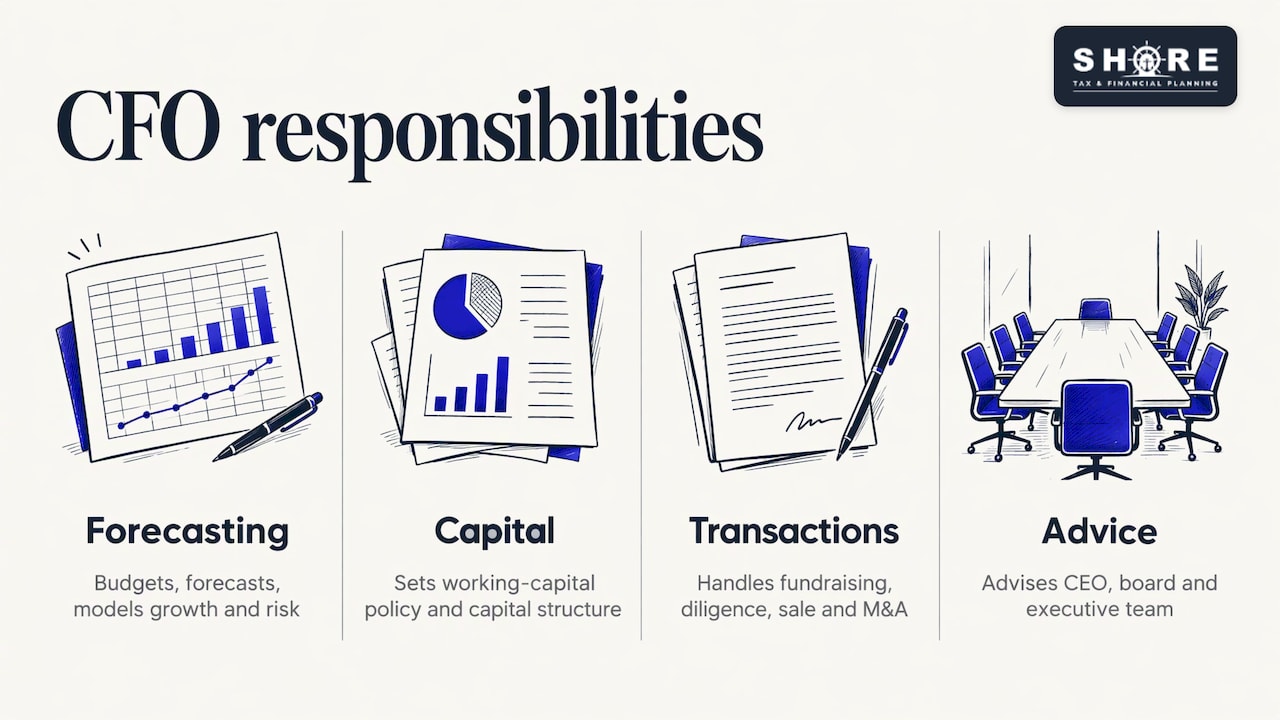
A CFO also sits in the room where the owner makes decisions. They advise the CEO, the board and the executive team. When you are raising money, preparing for diligence or negotiating a sale, the CFO’s job gets practical quickly. Even data room costs become a finance-leadership question once a transaction is on the table.
| Controller | CFO | |
|---|---|---|
| Time focus | Past and present: what happened and whether it is recorded correctly | Present and future: what to do with the numbers |
| Core question | Are the books right, closed on time and compliant? | Where should capital and cash go, and what could go wrong? |
| Typical work | Close, reconciliations, GAAP statements, payroll, AP/AR, tax compliance, audit support, controls | Budgeting, forecasting, cash strategy, financing, risk, scenario planning, M&A |
| Audience | Accounting staff, auditors, tax authorities, management | Owner, CEO, board, lenders, investors |
| Reports to | Usually the CFO, or the owner when there is no CFO | The CEO or owner |
| Success looks like | Clean, timely, audit-ready numbers | Better decisions, funded growth, fewer financial surprises |
Two useful shorthand descriptions come from CFO Selections: the CFO is outward-facing and forward-looking, while the controller is inward-facing and looks at historical information.
In a small or mid-sized company the line blurs. Trullion notes that controllers often take on CFO-adjacent work such as cash management and board reporting. In public companies, controllers typically own much of the SOX control environment, while the CFO attests to it.
The Corporate Finance Institute also describes a pipeline. The controller ensures the accuracy of past results. Financial planning and analysis (FP&A) uses that data to forecast and model the future. The CFO synthesizes both to decide and lead financial strategy. When the pieces work together, the business sees its financial picture across past, present and future.
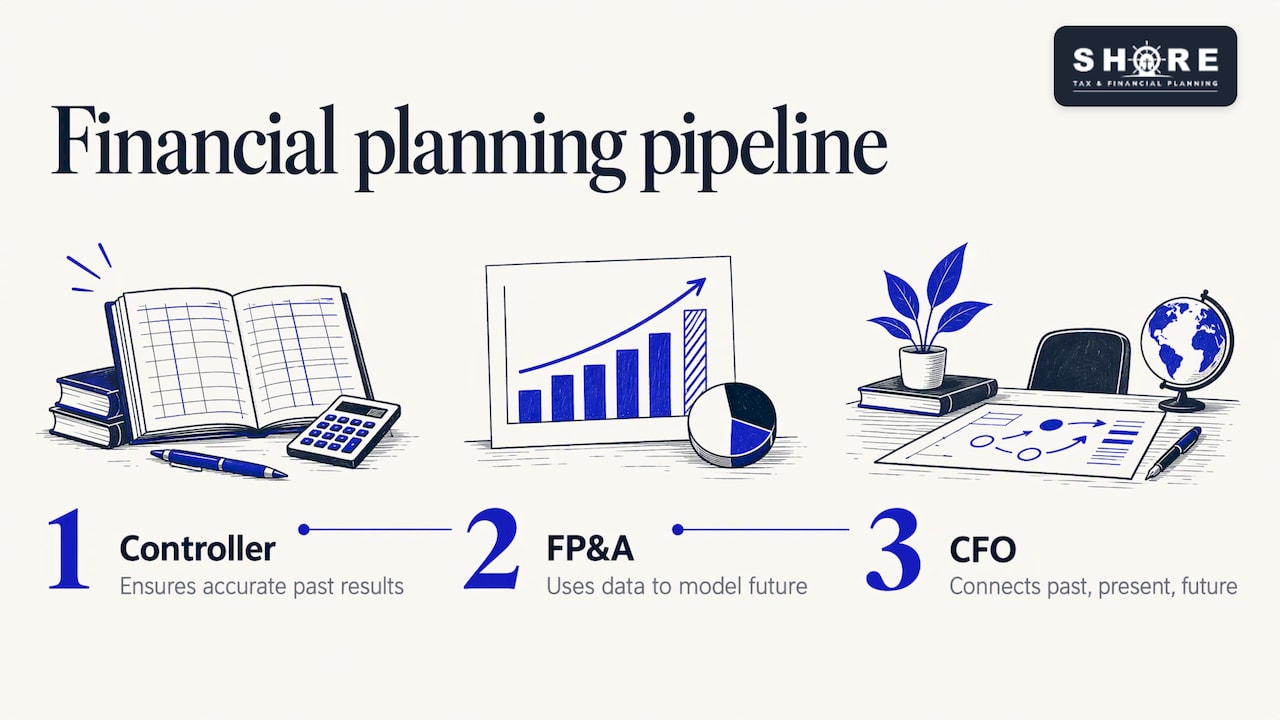
That pipeline explains why hiring a CFO before you have reliable books rarely works. A forecast built on unreconciled accounts is a guess with a spreadsheet around it.
Yes. In companies with both roles, the controller usually reports to the CFO. The controller runs accounting operations, close, reporting, compliance and controls. The CFO leads the whole finance function and owns strategy, capital, treasury and external financial matters.
So the CFO outranks the controller. Ramp’s guide states that a financial controller is not higher than a CFO and typically reports to one.
A controller does sit above the accountant. NetSuite lists the controller above the accountant in the finance-role hierarchy, and the controller supervises staff accountants and bookkeepers.
Hire a controller when the questions are about accuracy and control rather than strategy. Common triggers:
Ramp describes the usual staffing sequence as bookkeeper first, then a controller when GAAP financial statements become necessary, then a CFO when strategy, fundraising or M&A demands it. Small businesses usually solve transaction recording first, accounting control second and strategic finance third. Hiring by title alone skips steps.
If the books are the problem, start there. Our accounting cleanup and monthly bookkeeping services exist for this stage. For a view of which reports to rely on once the books are clean, see our post on essential financial reports for your business.
Hire CFO-level help when an upcoming decision depends on numbers that nobody inside the company owns. Examples:
A full-time CFO fits when there is a finance team to run daily, several entities, or a public offering ahead. Most owner-led businesses are not there yet. Strategy matters to them well before a full-time executive makes economic sense.
A fractional CFO is a part-time senior finance leader. SCORE describes the role as a contractor chosen when the work does not require a full-time engagement and the budget cannot support a full-time CFO. The value it lists includes financial modeling, valuation and fundraising support. The scope can expand from accounting and reporting into managing banking, insurance and tax planning.
The two do different jobs, so the question is which gap you have. A fractional CFO does not close your books, process payroll or reconcile accounts. A controller does not build your funding strategy or model your next expansion. Many growing companies use an outsourced accounting team for the controller-level work and a fractional CFO for the strategy.
An accountant, especially a CPA who prepares your return, records and reports what happened and keeps you compliant. A fractional CFO uses that record to plan. If your accountant only talks to you at tax time, you have compliance but not planning. In our firm the two are combined, because the biggest tax savings come from decisions made months before a return is filed.
Fractional CFO fees are set by scope, not by a fixed rate card. Four factors move a quote most:
The Bureau of Labor Statistics counts CFOs among chief executives, one of the best-paid occupational groups. That is why a part-time engagement usually costs far less than a full-time hire of equal seniority. We do not publish a fixed price for our advisory work, because scope varies. Pricing is set in a consulting agreement after we review your situation.
| Your situation | Start with |
|---|---|
| Books are behind, mixed, or unreconciled | Accounting cleanup, then monthly bookkeeping |
| You have bookkeeping but no review or GAAP statements | A controller or outsourced controller-level service |
| Statements are reliable, but decisions rely on instinct | A fractional CFO |
| A raise, sale or major expansion is coming | A fractional CFO, with the controller work already in place |
| You pay more in taxes each year despite growing profit | Year-round tax planning alongside CFO-level advice |
| You run a finance team and several entities daily | A full-time CFO, with a controller reporting to them |
If you are unsure, look at the failure you feel most. Late or doubtful numbers point to a controller. Good numbers and unclear decisions point to a CFO.
We see this question most from profitable owners who have outgrown a once-a-year accountant but are not ready for a full finance department. Our view is that the title matters less than whether somebody owns both halves of the job: accurate numbers and what to do with them.
For most owner-led businesses, the money is in the planning half. Entity structure, owner compensation, retirement plans, cost segregation and timing decisions are usually made during the year, not at filing. That is why we keep CFO-style advisory and tax work together, with a CPA and CFP leading the engagement and owner experience behind the advice.
We are fee-only and take no commissions, so our recommendation is not tied to a product. Fix the books first, then plan the tax and growth moves on top of them, then add more finance headcount only when the work justifies it.
Joseph
Our Year-Round Advisory and CFO Services are for profitable business owners who want a finance leader and tax planner in one relationship. We start with the books if they need work, through accounting cleanup, bookkeeping and payroll. Then we build the forecasting, tax strategy and cash plan that make the numbers useful.
We are fee-only, take no commissions, and our lead advisor is both a CPA and a CFP. If you are a high-income W-2 professional, our year-round tax advisory applies the same approach to your personal situation. To talk through which role your business needs first, start at shorefp.com.
No. The CFO outranks the controller, and in companies with both the controller typically reports to the CFO. The controller manages accounting operations, while the CFO leads the full finance function and advises the CEO and board.
Yes. The controller supervises staff accountants and bookkeepers and is responsible for the accuracy of the financial statements they produce. An accountant does the work inside that structure, while the controller owns the result.
Yes, and larger companies usually do. The controller runs accounting, the close, reporting and controls. The CFO builds strategy, manages capital and cash, and advises leadership. Smaller companies often combine the two jobs, or bring in a fractional CFO above an existing controller or accounting team.
Hire one when a decision such as a raise, a loan, a hiring plan or a sale depends on forecasts and analysis that no one in the company owns, but the work does not fill a full week. Your books should already be reliable, since forecasts depend on them.