

A cost segregation study breaks the price of a building into its parts, so that some of those parts can be depreciated over a much shorter period than the building itself. The result is larger depreciation deductions in the early years of ownership, which lowers your taxable income now instead of decades from now. It works for rental property, commercial buildings and properties used in your own business, and it is most valuable when you have income to offset.
Below, you will see how a study is built, what gets reclassified, how it applies to rentals (including passive-loss rules), what to do if you bought the property years ago, and how to judge whether a study is worth commissioning.
When you buy or build a property, the tax code generally treats the whole structure as one asset with a long recovery period. A cost segregation study challenges that default. An analyst separates the total cost into components and sorts each one by the type of property it is.
The IRS describes the key split in its audit guide: components may be classified as § 1245 tangible personal property, which has a shorter life, or § 1250 real property, which has a longer one. Anything that lands in the shorter-life group depreciates faster, and that is where the tax benefit comes from.
The total depreciation over the life of the property does not change. What changes is timing. You take more of it early, when the money is worth the most to you.
The incentive is straightforward. The IRS notes that the benefit comes from shorter recovery periods and accelerated methods, including bonus depreciation under § 168(k) and § 179 deductions.
Here is the logic in three steps:
Bonus depreciation matters more than it used to. Treasury and the IRS issued Notice 2026-11 on the permanent 100% additional first-year depreciation deduction created by the One, Big, Beautiful Bill. Eligibility depends on when the property was acquired and placed in service, so confirm the rules for your specific asset. We walk through the details in our guide to bonus depreciation in 2026.
The IRS audit guide gives examples of items a study may classify as § 1245 property, including carpeting, wall coverings, partitions, millwork and lighting fixtures. Whether any item qualifies depends on the facts and circumstances of your building.
To see how it plays out, take a hypothetical. You buy a small apartment building and the depreciable basis is $1,000,000. Without a study, the entire amount sits on the long schedule for residential rental property. A study might find that 20% of the basis, or $200,000, belongs to shorter-life components. If bonus depreciation applies to those components, the $200,000 becomes a first-year deduction rather than a slow trickle. At a 35% combined tax rate, that is a $70,000 reduction in current tax, brought forward from future years.
That is an illustration, not a forecast. The real percentage depends on the property type, its finishes, site improvements and how the purchase price is supported. A study done by qualified people tells you the actual number.
Typical categories a reviewer looks at include:
The process typically involves four stages, according to the IRS audit guide and industry practice: a feasibility analysis, data collection, a site inspection (often by engineers) and an audit-ready report.
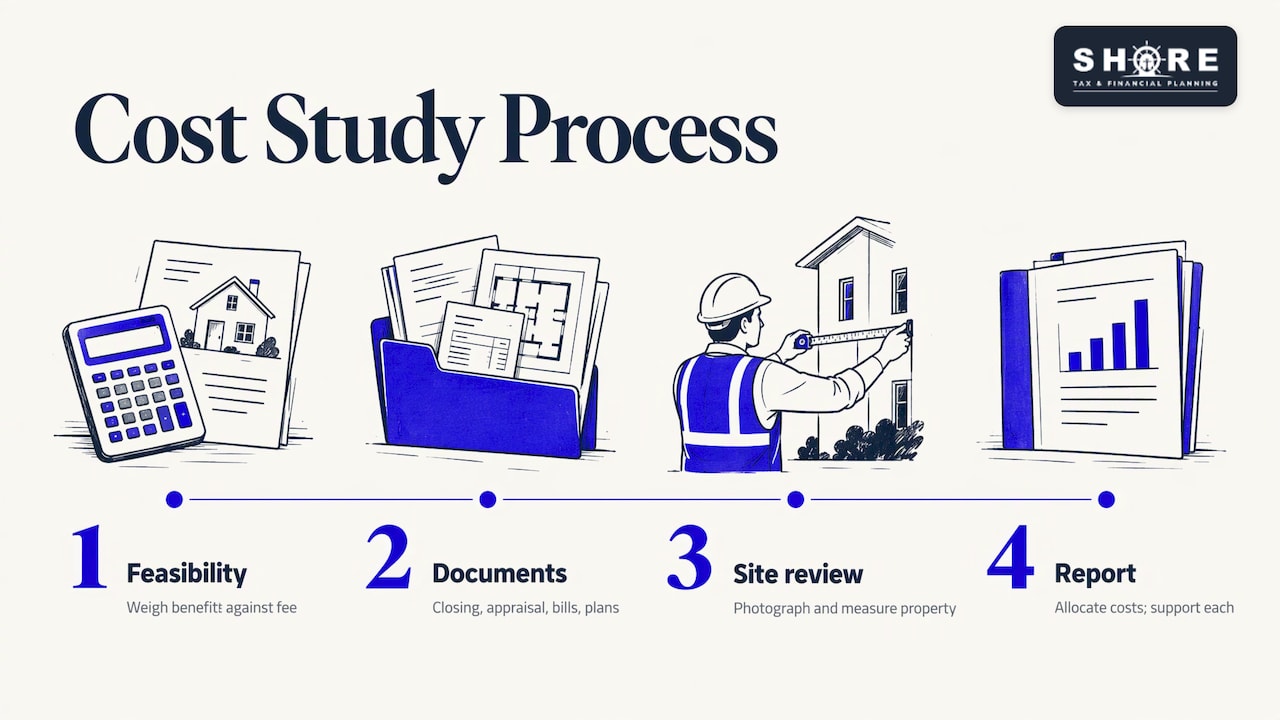
Feasibility. Before anyone spends serious time, the preparer estimates the likely benefit against the study fee. This is where small or low-basis properties are screened out.
Documents. Expect to provide the closing statement, any appraisal, construction or renovation invoices, and blueprints if you have them.
Site review. An engineer or experienced analyst walks the property, photographs it and measures what is there.
Report. The final document allocates costs to each asset class and supports every allocation. That report goes to your CPA and becomes part of your tax file.
The IRS cautions against “rule-of-thumb” allocations without a measurable basis. It says studies should tie back to actual costs or documented engineering estimates that reconcile to the total capitalized basis. It also states that no industry-wide standards exist, so studies vary widely in depth and methodology.
That gap is why the quality of the work matters more than the price tag. A study that traces every dollar back to a source is far easier to defend. Understanding how cost allocation models tie totals to their parts helps you see why a good report reconciles every line to the whole.
Our firm reports a 0.01% audit rate across client returns, and we build every strategy around defensibility first. Our guide to IRS red flags covers the habits that keep a return clean.
The main benefits are practical:
That last point links to a related technique. When you replace a component of a building, a partial asset disposition can let you write off the remaining basis of the old piece. A study makes that far easier to support.
Rental owners ask the most about this, so the passive-loss rules deserve care. The IRS explains that rental real estate is generally a passive activity, so losses cannot offset active income unless you qualify as a real estate professional and materially participate. Under IRC § 469©(7), people who qualify can treat their rentals as non-passive. The accelerated deductions from a study can then potentially offset other income, such as wages or business profit.
What this means in practice:
The same framework applies to short-term rentals such as Airbnb properties and to long-term rentals. How the activity is classified depends on how you operate it and how much you participate, so get your CPA’s view of your specific facts before you rely on a projection.
A study tends to make sense when several of these are true:
It is a weaker fit for a low-basis property, an owner with no income to offset, or someone planning to sell within a short window. A feasibility analysis answers this before you pay for the full study. If you are a business owner with equipment as well as real estate, our article on Section 179 and bonus depreciation for contractors shows how the same accelerated tools work on the equipment side.
Yes. A study can be performed on a property acquired in prior years. Missed depreciation is typically claimed by filing Form 3115 to change your accounting method, which lets you catch up on the depreciation you should have taken in a single year. You do not amend old returns.
This makes older properties worth reviewing, particularly those you renovated. A catch-up adjustment can produce a large deduction in one year, so timing it against a high-income year is part of the planning.
Fees vary widely. Pricing depends on property type, size, complexity, the level of engineering involved and whether the provider uses a site visit. Simple residential studies and large commercial studies sit at very different points on the range, and quotes differ by provider. The sensible comparison is the expected first-year tax savings against the fee, not the fee alone. We break this down in our piece on what a cost segregation study costs.
Timing also varies. A study depends on how quickly you supply documents and how soon a site visit can happen. If you want the deduction on a given year’s return, start well before the filing deadline, and ideally before year-end so your plan can account for it.
Can you do it yourself? A spreadsheet can give you a rough estimate to decide whether to pursue a study. It is not a substitute for a report built on documented costs, which is what the IRS looks for.
Most owners find out about cost segregation after the year they could have used it. By then the planning window has closed, and they are stuck explaining why a six-figure deduction was left on the table.
We approach it as one part of a year-round plan. Before a study, we look at your income, your entity structure, whether you qualify to use the losses and how long you plan to hold the property. A study that does not fit those facts is a cost with no return, and we would rather say so up front.
We are fee-only and take no commissions on products. That means our only job is to find the tax savings that hold up. The lead advisor holds both CPA and CFP credentials and has run a business, so the advice comes from practice, not theory. We build every position to be defensible, with reports tied to actual costs and the documents to back them up.
If you own or plan to buy property, bring us the closing statement and your last return, and we will show you where a study fits.
Joseph
A study is only as useful as the plan around it. At Shore Tax & Financial Planning, we handle cost segregation alongside tax reduction planning, S-corp strategy, bookkeeping and return preparation, so the deductions flow into a return that is prepared with them in mind. We serve profitable business owners and high-income professionals, and our advice is fee-only.

If you want to know whether a study makes sense for your property, start with tax reduction planning and tell us what you own. Our deeper explainer on cost segregation studies and real estate tax savings is also a good next read.
A study splits a property’s cost into components and assigns each to an asset class. Items that qualify as shorter-life personal property or land improvements are depreciated faster than the building. The IRS identifies the benefit as shorter recovery periods and accelerated methods such as bonus depreciation and Section 179.
It depends on the property’s depreciable basis, your ability to use the deductions and how long you will hold it. Higher-basis properties and owners with income to offset usually benefit most. A feasibility analysis compares the likely savings to the fee before you commit.
Yes. You can study a property acquired in earlier years and claim the missed depreciation in one year by filing Form 3115. You do not need to amend prior returns. Your CPA can help you choose the best year to take the adjustment.
Only if they qualify. Rental activity is generally passive, and losses offset active income only for those who qualify as real estate professionals and materially participate under IRC § 469©(7). Otherwise, the losses typically carry forward against passive income.