
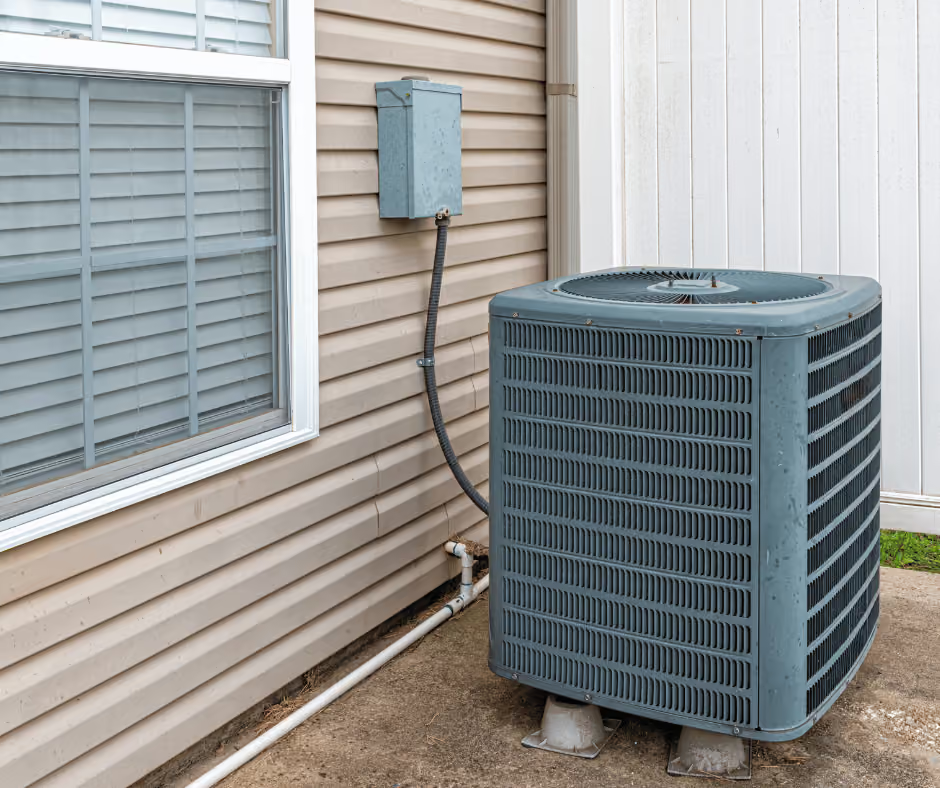
Your HVAC business requires significant equipment investments: service trucks, diagnostic tools, HVAC units, specialty equipment, warehouse machinery. Most contractors spread these deductions over five to seven years through standard depreciation, leaving thousands of dollars on the table every year.
The tax code offers immediate expensing strategies that can turn a $75,000 equipment purchase into a $75,000 tax deduction in the same year—creating $20,000 to $30,000 in immediate tax savings. For profitable HVAC contractors in Edison, Newark, and across Central New Jersey, understanding equipment depreciation isn't just accounting trivia—it's one of the most powerful tax reduction strategies available.
This guide breaks down Section 179, bonus depreciation, and HVAC-specific equipment strategies that can dramatically reduce your tax bill while you're growing your business.
When you purchase equipment for your HVAC business, the IRS classifies it as a capital asset—not an immediate expense. Under standard depreciation rules, you deduct the cost over the equipment's "useful life" as determined by the tax code.
Standard depreciation schedules for HVAC equipment:
Example using standard depreciation: You purchase a $60,000 service van in January. Using the Modified Accelerated Cost Recovery System (MACRS), you'd deduct approximately $12,000 in year one, $19,200 in year two, $11,520 in year three, and so on over five years. In a year where you're netting $250,000 and paying 35% effective tax rate, that first-year $12,000 deduction saves you $4,200 in taxes.
This works, but it's painfully slow. Section 179 and bonus depreciation allow you to accelerate those deductions dramatically.
Section 179 allows you to deduct the full purchase price of qualifying equipment in the year you buy it and place it in service. Instead of waiting five years to fully deduct that $60,000 van, you deduct all $60,000 immediately—saving $21,000 in taxes (at 35% effective rate) in year one.
Translation: If you purchase $3,150,000 in equipment in one year, your Section 179 deduction is reduced by $100,000 ($3,150,000 - $3,050,000 = $100,000 reduction). Very few HVAC contractors hit these thresholds, meaning Section 179 is effectively unlimited for most.
Must have taxable income: Section 179 cannot create or increase a net operating loss. Your deduction is limited to your business taxable income for the year. If your HVAC business nets $150,000, your maximum Section 179 deduction is $150,000—even if you purchased $200,000 in equipment.
Solution for excess purchases: Any unused Section 179 deduction carries forward to future years, or you can elect bonus depreciation instead (which CAN create a loss).
Property must be purchased and placed in service by December 31: The delivery date matters, not when you signed the contract or made the down payment. If your new van arrives January 2nd, it doesn't count for the prior year's taxes.
Business use must exceed 50%: Track your mileage meticulously. If your van is 48% personal use, it doesn't qualify for Section 179. This is why accurate bookkeeping throughout the year matters—you need documentation to support business use.
Vehicles under 6,000 lbs GVWR (most service vans and trucks):
Vehicles over 6,000 lbs GVWR (heavy trucks and large vans):
HVAC equipment and tools:
Shop and warehouse equipment:
Office equipment:
Demo and rental HVAC units:
What does NOT qualify:
Bonus depreciation works similarly to Section 179 but with different rules and advantages. Understanding when to use each strategy—or combine them—is where strategic tax planning creates maximum savings.
Bonus depreciation is gradually being phased out:
This phase-out makes 2025-2026 a critical window for HVAC contractors planning major equipment investments.
Income limitation:
Property type:
State tax treatment:
This state difference is crucial for New Jersey HVAC contractors. A $100,000 equipment purchase might create an $80,000 federal deduction but only a $25,000 New Jersey deduction if using Section 179.
Strategic approach for New Jersey contractors: Use Section 179 up to $25,000 to maximize state benefit, then apply bonus depreciation to remaining cost for federal purposes.
Scenario 1: Equipment cost exceeds taxable income
A plumbing contractor in Woodbridge nets $80,000 but purchases $150,000 in equipment. Section 179 is limited to $80,000. The remaining $70,000 can be immediately expensed using bonus depreciation (60% in 2024 = $42,000 additional deduction), creating a $42,000 net operating loss that can be carried forward.
Scenario 2: Heavy vehicles exceeding Section 179 limits
You purchase a $75,000 Ford F-450 service truck. Section 179 is limited to $30,500 for vehicles over 6,000 lbs. The remaining $44,500 qualifies for bonus depreciation (60% = $26,700 additional first-year deduction).
Total first-year deduction: $30,500 + $26,700 = $57,200
Scenario 3: Multiple large purchases in high-income year
Your HVAC business has an exceptional year, netting $450,000. You purchase $300,000 in equipment. Using Section 179 for the full amount works, but combining strategies might optimize state taxes:
Total first-year deduction: $190,000
Most HVAC contractors operate a fleet of service vehicles. Strategic purchasing and depreciation planning can save tens of thousands annually.
Scenario: Three-vehicle replacement strategy
You operate six service vans, each with 120,000+ miles. Rather than replacing all six at once (creating a massive expense in one year with potentially limited tax benefit), you implement a two-year rotation:
Year 1: Replace three vans at $55,000 each = $165,000
Year 2: Replace remaining three vans at $55,000 each = $165,000
This strategy spreads tax benefit over two years while maintaining deductibility.
Alternative approach using OBBBA rule: If you already own vehicles personally that you use for business, the One Big Beautiful Bill Act (OBBBA) allows you to convert them to business use and claim immediate expensing. Learn more: How to Deduct Your Personal Vehicle Under the OBBBA 2025 Rule
HVAC contractors accumulate tools constantly. Strategic purchasing creates consistent tax benefits.
Strategy: Year-end tool purchase push
You're projected to net $180,000 for the year. In December, you purchase:
Total: $31,000
This $31,000 purchase creates an immediate $31,000 deduction, saving approximately $10,850 in combined federal and state taxes (at 35% effective rate). You needed these tools anyway—timing the purchase strategically turns necessary expenses into immediate tax savings.
HVAC contractors in Brick and Toms River often maintain demo units for customer consultations and loaner units for temporary installations during repairs.
Tax treatment:
Strategy: Designate specific high-end units as "demo units" and claim immediate expensing.
Example: You purchase three high-efficiency systems at $15,000 each as demonstration units for your showroom and for customer consultations. Total cost: $45,000. These qualify for Section 179, creating a $45,000 immediate deduction and saving $15,750 in taxes (at 35% rate).
After two years, you sell these demo units at a discount and purchase new models, repeating the cycle. This creates ongoing depreciation benefits while keeping your demo inventory current.
Expanding HVAC contractors often overlook warehouse equipment as a major tax benefit opportunity.
Case study: Jersey City HVAC expansion
A growing HVAC contractor in Jersey City moved to a larger warehouse to support expansion. Equipment purchased:
Total investment: $101,000
Using Section 179, the entire $101,000 became an immediate deduction, saving $35,350 in taxes. This made the expansion effectively "free" from a tax perspective—the tax savings funded a significant portion of the equipment investment.
The tax code imposes "luxury vehicle" limits on certain vehicles, restricting first-year depreciation regardless of Section 179 or bonus depreciation elections.
For vehicles under 6,000 lbs GVWR:
Example: You purchase a $65,000 Tesla Model Y for business use. Despite Section 179 availability, your first-year deduction is limited to $20,200. The remaining $44,800 is depreciated over subsequent years following the luxury vehicle schedule.
Vehicles with a GVWR (Gross Vehicle Weight Rating) of 6,000 lbs or more are exempt from luxury vehicle limits. This creates the "SUV loophole."
Vehicles over 6,000 lbs GVWR qualifying for enhanced deductions:
Section 179 limit for 6,000+ lb vehicles: $30,500 in 2026 (estimated)
Strategy: Purchase a qualifying heavy vehicle and combine Section 179 ($30,500) with bonus depreciation (60% of remaining balance in 2024).
Example: $75,000 Ford F-350 service truck
Section 179 and bonus depreciation require business use exceeding 50%. For vehicles and equipment used partially for personal purposes, you must track and document business use percentage.
Compliant tracking methods:
What doesn't work:
IRS audit focus: Vehicle deductions are among the most commonly audited items. If you claim 80% business use without documentation, the IRS will disallow the entire deduction—and may assess penalties for negligent or intentional misreporting.
For tools and equipment used both personally and for business (rare for most HVAC equipment, but relevant for computers, tablets, phones):
80%+ business use: Full Section 179/bonus depreciation50-79% business use: Deduction limited to business percentageUnder 50% business use: No Section 179/bonus depreciation (regular depreciation only)
Strategic equipment purchasing isn't about buying things you don't need for tax purposes—it's about timing necessary purchases to maximize tax benefit.
This is why Shore Financial Planning meets with HVAC contractor clients before year-end. We review:
Example: Edison HVAC contractor
A profitable HVAC contractor in Edison projected $325,000 net income in November. They planned to purchase three service vans in Q1 of the following year.
Original plan: Wait until January, spread purchases across Q1Tax-optimized plan: Accelerate one van purchase to December
Result: $55,000 immediate deduction in current year, saving $19,250 in taxes. The other two vans were purchased in January, creating deductions for the following year when income was also high.
This simple timing shift saved $19,250 without changing total equipment purchases—just the timing.
S-Corporation owners must pay themselves a "reasonable salary" subject to payroll taxes. Large equipment purchases can affect this calculation.
Section 179 deductions reduce business income, which reduces the pool of money available for distributions. Your CPA needs to ensure your salary remains reasonable relative to the reduced profit after equipment deductions.
Example: Your HVAC company nets $300,000 before equipment purchases. You pay yourself a $120,000 salary (40% of profit—reasonable). You purchase $150,000 in equipment and take full Section 179.
New net income: $150,000 after equipment deduction
Your $120,000 salary now represents 80% of reduced profit—still reasonable, but the IRS might question why salary is so high relative to distributions. Better approach: slightly increase salary to $130,000, maintaining reasonable ratio.
This is why integrated tax planning and payroll services matter. Reactive accountants file your taxes after the fact. Proactive CPAs coordinate equipment purchases, estimated tax payments, payroll adjustments, and entity structure optimization throughout the year.
You ordered a $65,000 service van on December 15th, but it doesn't arrive until January 3rd. You assume you can deduct it for the prior year since you ordered and paid for it in December.
Wrong. The IRS "placed in service" rule requires physical possession and use by December 31st. Your deduction shifts to the following tax year.
Solution: Plan major purchases by mid-November to ensure delivery by year-end. If cash flow requires it, many dealers accept deposits in December with January delivery—but that means the deduction moves to January's tax year.
You claim 90% business use on your primary vehicle without maintaining any mileage log. During an audit, the IRS examines your vehicle and determines it's a luxury SUV with personal items and family photos visible.
Result: Entire vehicle deduction disallowed. Additional penalties for negligent or fraudulent reporting.
Solution: Track meticulously from day one. If you can't document it, you can't deduct it. Use automated mileage tracking apps integrated with your bookkeeping system.
You take a $200,000 Section 179 deduction on your federal return, dramatically lowering your federal tax bill. You assume the same deduction applies to New Jersey state taxes.
Wrong. New Jersey only allows Section 179 up to $25,000. You owe significantly more state tax than projected.
Solution: Work with a CPA familiar with New Jersey tax rules who coordinates federal and state strategies. We structure equipment purchases to maximize both federal and state benefits, typically by combining limited Section 179 (for state benefit) with bonus depreciation (for federal benefit).
Your HVAC business has a slow year, netting only $45,000. You purchase $120,000 in equipment and elect Section 179 for the full amount.
Problem: Section 179 is limited to taxable income ($45,000). The remaining $75,000 carries forward but loses immediate benefit. If you had used bonus depreciation instead, you could have created a net operating loss to carry forward.
Solution: Model different scenarios before year-end. Sometimes bonus depreciation is superior despite Section 179 availability.
You purchase a $70,000 van and take full Section 179. Two years later, you sell the van for $45,000 and use the proceeds to purchase a new vehicle.
Surprise: You owe "recapture" tax on the $45,000 sale because you already deducted the full $70,000. This $45,000 gain is taxed as ordinary income.
Solution: Understand that accelerated depreciation doesn't eliminate taxes—it defers them. When you sell equipment with accumulated depreciation, you'll recapture that benefit. This is still advantageous (time value of money), but it needs to be planned for.
Equipment depreciation strategies exist within a broader tax planning framework. Shore Financial Planning integrates equipment purchasing with:
A successful HVAC contractor in Newark was on track to net $380,000 for the year. In our Q4 planning meeting, we identified:
Implementation:
We simultaneously:
Total first-year tax savings: $43,500 through combined strategies
The contractor purchased equipment they needed anyway, timed it strategically, and kept an additional $43,500 that would have gone to taxes. This is the difference between reactive tax preparation and proactive planning.
If you're planning major equipment purchases before December 31st to maximize current-year deductions:
8 Weeks Before Year-End (Early November):
6 Weeks Before Year-End (Mid-November):
4 Weeks Before Year-End (Early December):
2 Weeks Before Year-End (Mid-December):
After Year-End (January):
Shore Financial Planning specializes in tax planning for HVAC contractors throughout Central New Jersey, including:
We also serve plumbing contractors, electrical contractors, roofing contractors, and all construction trades with the same specialized equipment depreciation strategies.
Equipment depreciation is one piece of comprehensive tax reduction planning. If you're an HVAC contractor in New Jersey netting six figures or more, you should be working with a CPA who proactively manages equipment purchases, estimated taxes, entity structure, retirement planning, and year-round strategy—not someone who just files your taxes once a year.
Schedule a complimentary strategy session to review your current tax situation and identify immediate opportunities. We'll analyze your projected income, planned equipment purchases, and current tax structure to quantify exactly how much you could save through strategic planning.
Contact Shore Financial Planning or call (732) 704-8982.
Our guarantee: If our tax planning doesn't identify savings greater than our fees, we refund your money.
Shore Financial Planning provides tax planning, accounting, and bookkeeping services to HVAC contractors and construction businesses throughout New Jersey. We guarantee our tax planning will save you more than our fees.