

When you sell a business, a building or land and collect at least one payment after the year of sale, the IRS generally taxes your gain as the money arrives, not all at once. That can keep a large gain out of a single high-tax year. But the method has traps: depreciation recapture, related-party buyers, assumed debt and a reporting duty that lasts until the last payment. If you plan the deal before you sign, you decide how much gain lands in each year. If you plan it afterward, the contract has already decided for you.
We work with business owners and high earners on exactly this kind of timing question. Below is how the rules work, with a worked example.
An installment sale is a sale of property where you receive at least one payment after the close of the tax year in which the sale happens. Publication 537 covers casual sales of real or personal property, which is why it applies to a seller-financed building, a parcel of land, or a business sold with a promissory note.
Several sales cannot use the method at all:
If you sell goods you hold for resale, the gain is recognized in the year of sale. Dealers who track inventory costing for dealers know that income from those sales is reported in the year the sale happens, regardless of when the buyer pays.
The math has three pieces, all defined in Publication 537:
Every principal payment you receive, excluding interest, is multiplied by that percentage. The result is your installment sale income for the year. The rest of each payment is a tax-free return of basis.
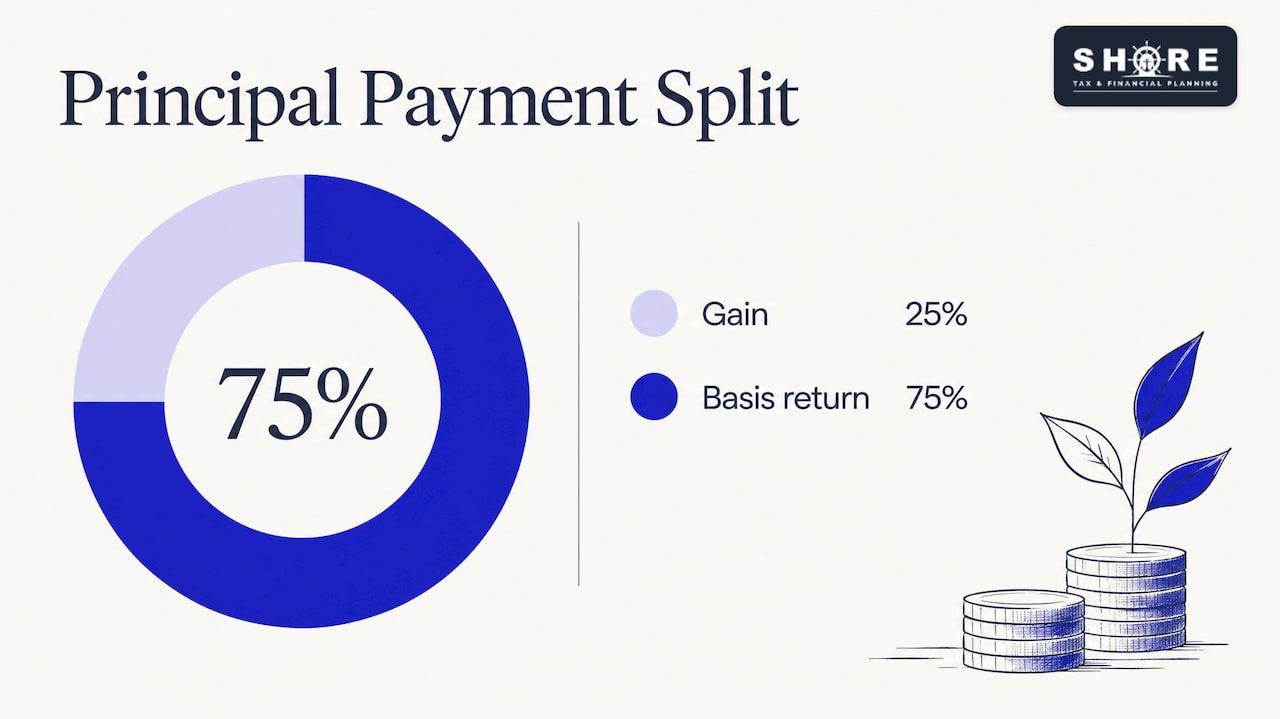
The IRS illustrates this with a simple case: a contract price of $6,000 and gross profit of $1,500 gives a 25% gross profit percentage. Twenty-five percent of each payment, after subtracting interest, is reported as income, and the other 75% is a return of basis.
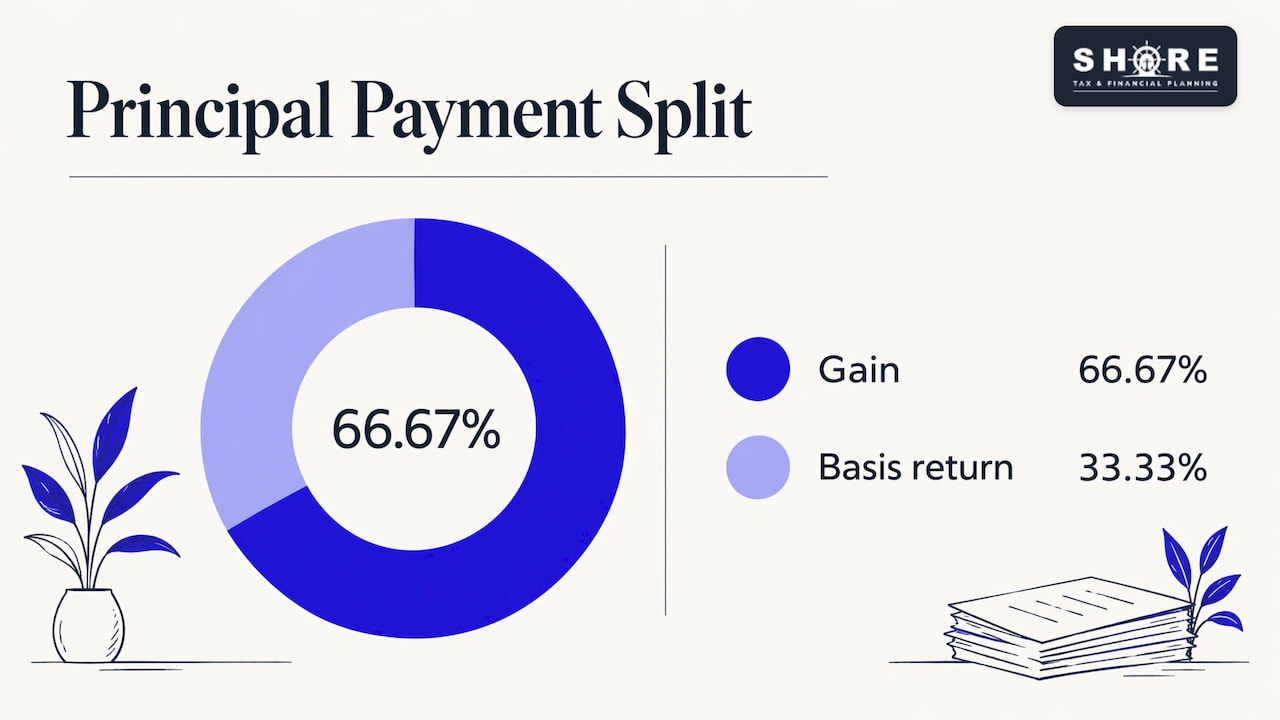
Here is a hypothetical sale of land you have held for years. You sell it for $600,000. Your adjusted basis is $200,000, and there are no selling expenses and no debt on the property.
The buyer pays $120,000 at closing and $120,000 in each of the next four years, plus interest. Each $120,000 principal payment carries about $80,000 of gain (66.67%) and $40,000 of basis recovery. Instead of reporting $400,000 of gain in one year, you report about $80,000 a year across five years.
Why does that matter? Spreading the gain can keep more of it in lower brackets and may help with surtaxes that depend on income in a given year. The 3.8% Net Investment Income Tax is one example of a surtax that turns on your income level. Whether the spread actually saves you money depends on your income in each of those years, which is why we model it before a contract is signed.
The buyer’s interest is not part of the gain. IRS Topic No. 705 says interest on an installment sale is generally reported as ordinary income, like any other interest. If the contract does not charge adequate stated interest, part of the stated principal can be recharacterized as unstated interest or original issue discount, using the applicable federal rate (AFR), the minimum rate the IRS publishes monthly.
That has a practical effect. A note with a very low rate can shift some of your capital gain into ordinary interest income. Setting the rate and terms deliberately, in a written note, avoids surprises. A loan agreement clause guide shows the kinds of terms a note typically spells out: principal, rate, payment schedule and default remedies. Your CPA and attorney should review the actual document.
This is where business owners and real estate investors get caught. If you sold depreciable property, such as equipment, a vehicle or a building, any gain that is ordinary income under the recapture rules (sections 1245 and 1250) must be reported in the year of sale. Topic No. 705 says so directly, and the 2026 Form 6252 instructions confirm that ordinary recapture is fully taxable in the year of sale.
In plain terms: you took depreciation deductions that lowered your taxable income in earlier years. When you sell for more than the depreciated value, the IRS taxes that part as ordinary income, and the installment method does not postpone it.
Suppose you sell a business asset where $400,000 of the gain is ordinary recapture, and the buyer pays only 20% at closing. You still report the entire $400,000 as ordinary income in year one. The cash arrives slowly, but the tax bill does not.
This changes how you structure a business sale:
If the buyer takes over your mortgage or other liabilities, and those liabilities exceed your basis, the excess is treated as a payment received in the year of sale. The contract price is reduced as well. The Form 6252 instructions describe this, and it can produce taxable income in the year of sale even when the buyer pays little cash.
Selling to a family member, or to a business you control, draws extra scrutiny. For depreciable property sold to a related person, the installment method generally is unavailable, and all payments are treated as received in the year of sale. The exception is when you can show to the IRS’s satisfaction that avoiding federal income tax was not a principal purpose of the sale (Form 6252 instructions).
There is also a resale rule. If a related buyer sells the property before paying you in full, part or all of what that buyer receives may be treated as received by you at that time. Related-party sales require Part III of Form 6252 for the year of sale and the two years after.
An interest charge on the deferred tax applies when the sales price is over $150,000 and your outstanding nondealer installment obligations exceed $5 million, with exceptions for certain farm and personal-use property and older real and personal property sales, according to the Form 6252 instructions. Most owners selling a single business or property will not reach that scale, but a large exit can.
If the sale produces a loss, the installment method does not apply (Topic No. 705). The loss is handled in the normal way.
The installment method is automatic. According to Topic No. 705, you must use it unless you elect out on or before the due date of your return, including extensions, for the year of the sale.
To elect out, you do not file Form 6252. You report the entire gain in the year of sale on Form 8949 and Schedule D, Form 4797, or both. The 2024 edition of Publication 537 adds that an automatic six-month extension is available if you filed the original return on time without making the election.
Why would anyone give up deferral? A few common reasons:
The pull in each direction depends on your numbers. Run both versions of the return before you file.
The 2026 Form 6252 instructions require you to file the form for the year of sale and every year after, until and including the year of final payment, whether or not you received a payment that year.
A note that runs five or ten years means five or ten returns that need to tie back to the original calculation. Keep the closing statement, the allocation schedule, the note and an amortization table in one file. A missed form or a wrong percentage in year four is easy to make and hard to spot.
The American Bar Association’s tax section describes the installment method as usually beneficial because it lets a seller defer a portion of the gain until payments are received. But that benefit is built in the contract. Price, down payment, interest rate, payment schedule, allocation among assets and who the buyer is all change the tax result.
Before you sign a letter of intent, work through these questions:
This is the difference between tax prep and tax planning: prep reports what happened, and planning changes what happens. Once a deal closes, the options narrow to the election on your return.
Most owners come to us after a term sheet is already on the table. By then the headline price is set, but the after-tax result is not, and the difference between a well-structured and a default-structured sale can be large.
We are fee-only. We do not earn commissions on products, so the only thing we are paid to do is advise on what keeps more of your money. Our lead advisor holds both CPA and CFP credentials and has run a business, which helps when the question is not just how the tax works but whether the deal fits your life after the sale.
Installment timing is one lever among several. It sits alongside entity choice, retirement plan contributions and depreciation planning, and it works best when we look at them together across several years, not in a scramble in April.
Joseph
If you are considering selling a business or a property, or you hold a note from a past sale, our Tax Reduction Planning engagement is built for this. We work year-round with profitable business owners and high-income professionals, not only at filing time, and we prepare business tax returns so the reporting matches the plan. Business owners can start with our year-round advisory and CFO services.

If the IRS asks questions about a past sale, our IRS representation and support service is part of the same relationship. For a broader look at how we plan across the calendar, see our guide to year-round tax planning.
Any sale of property where you receive at least one payment after the tax year of the sale can qualify, such as real estate or a business sold with a seller-financed note. Inventory, publicly traded securities, dealer sales and sales at a loss are excluded, per Publication 537. Certain related-party sales of depreciable property are also excluded.
You report gain as you collect payments, so the tax is spread across the years of the note instead of landing in the year of sale. That can keep each year’s income lower, and the ABA describes the deferral as usually beneficial. The interest you charge is taxed as ordinary income in the year you receive it.
Yes. You elect out by reporting the whole gain in the year of sale on Form 8949, Schedule D or Form 4797, instead of filing Form 6252. The election must be made by the due date of the return, including extensions, according to Topic No. 705.
No. Ordinary income from recapture under sections 1245 and 1250 is taxable in the year of sale, however little cash you collect that year. Only the remaining gain follows the payment schedule, as the Form 6252 instructions explain.