

Net unrealized appreciation (NUA) is the growth in value of employer stock held inside a 401(k) or other qualified plan. If you take that stock out in kind as part of a qualifying lump-sum distribution, you pay ordinary income tax only on the original cost basis. The growth is taxed as long-term capital gain when you sell. For someone holding a lot of appreciated company stock, that gap between ordinary and capital gains rates can be worth real money. The rules are strict, though, and one wrong move can end the opportunity for good.
This guide explains how NUA treatment works, who qualifies, where people go wrong, and how to decide whether it beats a plain rollover.
The IRS defines NUA as the net increase in the value of employer securities while they were held in a qualified retirement plan trust. Say your plan bought or received shares at an average cost of $100,000 and they are now worth $600,000. The $100,000 is your cost basis. The $500,000 of growth is the NUA.
The NUA is “unrealized” because you have not sold anything. Under the normal rules, every dollar leaving a traditional 401(k), basis and growth alike, is taxed as ordinary income. NUA treatment splits the stock into two pieces and taxes each differently.
| Piece | When taxed | How taxed |
|---|---|---|
| Cost basis | Year of distribution | Ordinary income |
| NUA (growth inside the plan) | When you sell the shares | Long-term capital gain, regardless of how long you hold after distribution |
| Growth after distribution | When you sell | Short-term or long-term gain, based on your holding period from the distribution date |
The IRS describes the first two rows in Publication 575. The IRS also notes in Topic no. 412 that you may elect to include the NUA in income in the year of distribution, if you would rather pay the tax now.
NUA is not a loose planning idea. It comes from the tax code, and the requirements are mechanical. Miss one and the whole distribution is taxed the ordinary way.
According to Publication 575, you must receive your entire balance from all of the employer’s qualified plans of one kind within a single tax year. The legal definition sits in 26 U.S.C. § 402(e)(4). Plans of one kind means, for example, all the employer’s profit-sharing plans. A 401(k) and a pension are different kinds, and each is tested on its own.
The lump sum has to follow one of four events: death, reaching age 59½, separation from service, or, for self-employed people, total and permanent disability. Hardship withdrawals and periodic payments generally do not qualify. The IRS explains what counts as a hardship distribution in its 401(k) distribution rules, and substantially equal periodic payments are a separate path with their own rules.
In practice, most people use NUA the year they retire or change jobs. If you are still working and over 59½, you may also qualify, but check with your plan administrator on whether in-service lump sums are allowed.
The company stock has to move out of the plan into a regular taxable brokerage account in your name. If you sell inside the plan and take cash, there is no NUA. If you roll the shares into an IRA, you lose NUA on those shares for good, and the appreciation is taxed as ordinary income when it comes out of the IRA.

The stock must be securities of the employer sponsoring the plan. Mutual funds that happen to hold your company’s shares do not count. Confirm with the plan administrator exactly what is in your account and how the plan classifies it.
Imagine a 62-year-old executive who just retired. Her 401(k) holds $1,000,000: $400,000 in company stock with a $60,000 cost basis, and $600,000 in diversified funds. The numbers are illustrative only, not a forecast or a recommendation.
Option A: roll everything into an IRA. No tax today. Every dollar later withdrawn is ordinary income, including the $340,000 of growth on the company stock.
Option B: take an NUA distribution.
She pays tax on $60,000 of ordinary income now instead of letting $340,000 of that stock growth eventually be taxed at ordinary rates. If she holds the shares and they rise further, the extra gain follows normal holding-period rules. A $40,000 gain after distribution, sold within a year, is short-term.
The long-term capital gains rate is generally lower than ordinary rates, and the spread widens the higher your bracket is. That is why NUA tends to matter for high earners with concentrated stock positions.
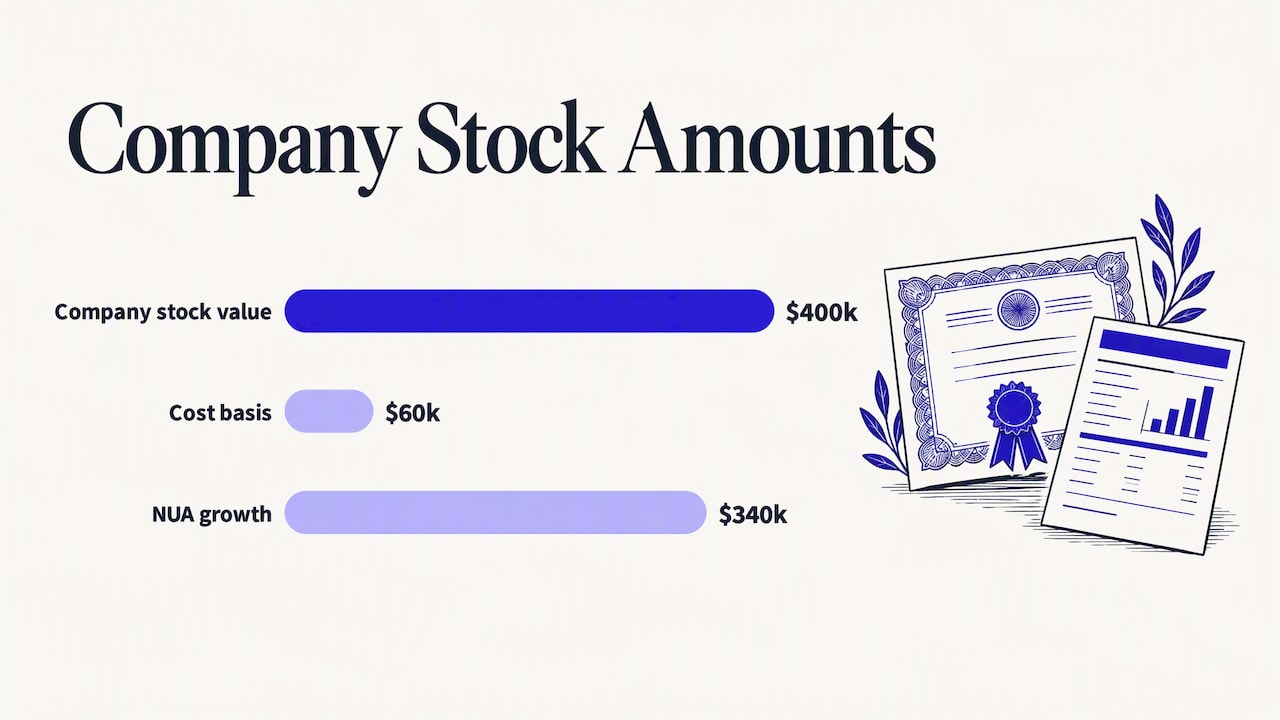
NUA is a trade. You accept tax now on the basis, and give up the IRA’s deferral on the stock, in exchange for lower-rate treatment on the growth. Whether that trade wins depends on several factors.
It tends to favor NUA when:
It tends to argue against NUA when:
The question is rarely “NUA or not” in the abstract. It is a side-by-side projection of the total after-tax outcome under each choice, over your actual time horizon.
Because the cost basis is ordinary income in one year, the timing of that year matters. A few points we look at with clients:
If equity pay was a big part of your career, our article on stock options and equity compensation planning shows how the tax rules interact before you ever reach retirement.
Most NUA problems are procedural, and most cannot be fixed afterward. The IRS does not offer do-overs for an incorrectly executed distribution.
The IRS has published private letter rulings on NUA that show how technical the cases can get, such as one on how NUA is computed for non-rollover shares. Private letter rulings apply only to the taxpayer who requested them, but they illustrate how the agency reads the rules.
We see NUA as a strategy that is easy to describe and easy to get wrong. Most of the value comes from the planning before the paperwork: choosing the year, sizing the basis income, and lining up the rest of your tax picture. The mechanics are the last step.
We are a fee-only firm. We earn nothing from where you roll your money or what you buy afterward, so our only job is to show you the after-tax result of each path, including the path where NUA is the wrong answer. Our lead advisor holds both CPA and CFP credentials and has run a business, so we look at the full picture: your retirement accounts, your business income if you have it, and your investments. For many clients that means a year-round conversation, not a single decision at the point of separation.
If you are two or three years from retirement and hold a significant amount of company stock, start the analysis now. Some choices, like the timing of other income, are much easier to make before the distribution year than during it.
— Joseph
NUA touches your tax return, your retirement accounts and your investment portfolio at once. If you are a high-income professional with concentrated company stock, our team can model the NUA decision as part of year-round tax advisory for high earners. If you own a business and are also deciding on retirement plans or entity structure, see how we work with business owners. You can also read how tax planning differs from tax preparation, which explains why a decision like this has to happen before the return is filed.
Yes, in part. You can roll the non-stock assets to an IRA and still get NUA on the employer shares, as long as the whole balance is distributed in one tax year. If you roll the shares themselves into an IRA, that stock loses NUA treatment permanently, according to IRS Publication 575.
The most common causes are failing to take a lump-sum distribution of the entire balance in one tax year, taking a distribution without a qualifying event, and rolling the company shares into an IRA. Distributions for reasons such as hardship or periodic payments generally do not qualify either. Because the IRS does not allow do-overs, confirm eligibility before instructing the plan.
It depends on the gap between your cost basis and the stock’s current value, your tax bracket now and later, and how long you want the money to stay tax-deferred. A large gap and a high bracket favor NUA. A small gap usually favors a rollover. A CPA can compare the two outcomes with your actual figures.
The plan reports the NUA in box 6 of Form 1099-R. Under IRS Topic no. 412, the NUA is generally not taxed until you sell the shares, though you may elect to include it in income in the distribution year.