

A guaranteed payment is money a partnership pays a partner for services or for the use of the partner’s capital, in an amount set without regard to the partnership’s profit. The partnership generally deducts it, and the partner reports it as ordinary income and pays self-employment tax on it. A distribution is a different thing: it moves cash out of the partnership and is not a salary substitute. Getting the two straight, and structuring them on purpose before year-end, is where partners and LLC members taxed as partnerships find real tax savings.
The Internal Revenue Code defines a guaranteed payment as a payment to a partner for services or for the use of capital that is determined without regard to partnership income (26 U.S.C. § 707©). In plain terms, the amount is fixed or formula-driven in a way that does not depend on profit. A monthly $8,000 payment to a managing partner is a guaranteed payment. So is a 7% annual return on contributed capital that the agreement says gets paid regardless of results.
The tax law treats the payment, for most purposes, as if it went to someone outside the partnership. According to the IRS’s Publication 541, revised December 2025, the partnership generally deducts it as a business expense, and the partner treats it as ordinary income. That is why it behaves like a paycheck without being one. Partners are not employees of their own partnership, so no income tax is withheld from the payment. You are responsible for estimated tax payments instead.
One detail matters for planning: the payment must be fixed without regard to profit. If a partner is simply promised a percentage of profits, that is a distributive share, not a guaranteed payment. Where an agreement promises a minimum, such as the greater of a profit percentage or a floor amount, only the amount by which the floor exceeds the partner’s profit share before the payment is the guaranteed payment.
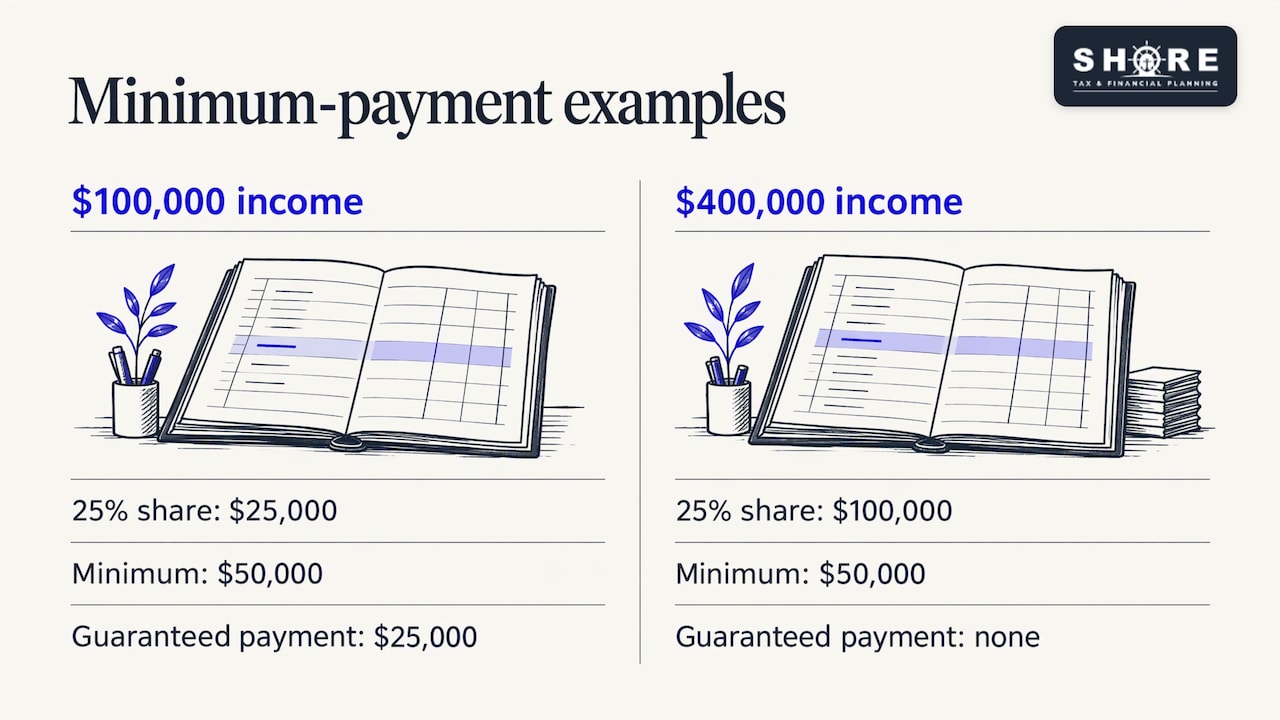
Suppose a partner is entitled to 25% of partnership income, with a minimum of $50,000. The partnership earns $100,000 before the payment. The 25% share would be $25,000, so the guaranteed payment is the $25,000 shortfall that tops the partner up to the $50,000 floor. If the partnership earned $400,000, the share would be $100,000, above the floor, and there would be no guaranteed payment at all.
These three terms are confused constantly, and the confusion creates tax mistakes. They answer three different questions.
| Guaranteed payment | Distributive share | Distribution | |
|---|---|---|---|
| What it is | Compensation for services or capital, fixed regardless of profit | Your allocated share of the partnership’s income, deductions, and credits | Cash or property moved from the partnership to you |
| Depends on profit? | No | Yes | No, it follows cash and the agreement |
| Partnership deducts it? | Generally yes (Form 1065, line 10) | No, it is an allocation of what is left | No |
| Taxed to you as | Ordinary income | Your share of each item (ordinary, capital gain, and so on) | Generally not taxed on its own; reduces basis |
| Reported on | Schedule K-1 and your Schedule E | Schedule K-1 and your Schedule E | Schedule K-1 |
The key point is that you are taxed on your distributive share and guaranteed payments whether or not any cash reaches you. A partner can owe tax on $300,000 of allocated income and take home $120,000 in distributions. Distributions matter for basis and for cash flow, but they do not set your taxable income. Publication 541 describes a distribution as a transfer that does not itself determine your distributive share and may reduce your basis.
Timing works the same way. You report guaranteed payments in the tax year in which the partnership’s tax year ends, not when each payment was made. For a partnership on a calendar year, that is the same year, which is why year-end review matters.
Anna and Ben own an LLC taxed as a partnership. Before any guaranteed payment, the business has $300,000 of ordinary income. The agreement says Anna, who runs operations full time, receives a guaranteed payment of $80,000 a year, and profits are split 50/50 after that.
The total reported is still $300,000. What changed is who bears it. The guaranteed payment moves $80,000 of income to Anna before the split, which is exactly what the partners intended to compensate her for the extra work. It also changes the character of that income, which leads to the next two issues.
The IRS says partners, including members of LLCs taxed as partnerships, are self-employed rather than employees when they provide services to the partnership, and those with net earnings generally file Schedule SE. Guaranteed payments are included in self-employment income. Partners who are not limited partners also include their distributive share of ordinary business income or loss. A qualifying limited partner includes only guaranteed payments for services rendered to or on behalf of the partnership.
That last distinction is where much of the planning attention goes. The IRS’s practice unit on partner self-employment tax notes that the statute does not define limited partner and no final regulations exist under Section 1402(a)(13), so the answer depends on the statute, legislative history, and case law. If you are an LLC member who works in the business, that question deserves a documented answer rather than an assumption.
Self-employment income also has effects beyond the tax bill. Lenders typically underwrite self-employed borrowers on documented earnings, so the way your K-1 income is split between guaranteed payments and distributive share shows up when you apply for a home loan. This two-year self-employment mortgage requirement overview explains how lenders look at that history.

The Section 199A qualified business income (QBI) deduction lets eligible owners of pass-through businesses deduct a portion of their business income. The Tax Adviser, the AICPA’s publication, explains that the deduction applies to qualifying distributive share but not to guaranteed-payment income for services. Eligibility is still subject to the statutory limits.
In practice, every dollar that moves from a guaranteed payment into distributive share could become eligible for the QBI deduction, and every dollar that moves the other way could lose it. The same article cautions that restructuring changes the partnership’s economics between partners, so the partners need to agree on it, not just the tax preparer. We cover the broader rules in our guide to Section 199A strategies for pass-through owners.
The trade-off is rarely one-directional. Guaranteed payments give a working partner predictable compensation and give the partnership a deduction. Distributive share can give a QBI deduction but depends on profit. The right mix depends on the partners’ roles, the partnership’s cash flow, and the income level at which the deduction phases down.
Partners often pay business costs out of pocket: continuing education, a home office, travel between job sites, professional dues, and licenses. These are unreimbursed partner expenses, usually shortened to UPE.
The rule comes from the IRS Schedule E instructions. You can deduct unreimbursed ordinary and necessary partnership expenses you paid on behalf of the partnership if you were required to pay them under the partnership agreement. The deduction goes on Schedule E, Part II, on its own line, with UPE entered in column (a).
Three practical points follow from that sentence:
UPE is separate from guaranteed payments, though the two interact. A partner who receives a guaranteed payment of $80,000 and pays $6,000 of qualifying expenses personally reports the $80,000 as ordinary income and the $6,000 as a UPE deduction on the personal return. UPE is not automatically deducted in computing the partnership’s Form 1065 ordinary income. Keep a running log of these costs with receipts, because Schedule E shows only the total.
The order of operations matters, and mistakes here are common on first-year returns.
A frequent error is treating a guaranteed payment as a distribution in the books. If the bookkeeping records Anna’s $80,000 as a draw, the partnership return will not show the deduction, and Anna’s K-1 will not show the payment. Both returns are then wrong in different directions. Clean monthly bookkeeping prevents it.
Guaranteed payments are an agreement-level decision. The amount, the services it covers, and any minimum guarantee are written into the partnership agreement, ideally before the year starts. That gives you room to plan:
The rules in this article are stable. IRS Publication 541, dated December 2025, still applies Section 707© to guaranteed payments, and Section 1402(a)(13) still governs the limited-partner exception. Because the QBI and deduction landscape moved with the 2025 tax legislation, see our summary of the small business changes in the One Big Beautiful Bill Act for how those changes interact with your structure.
Most partners we talk to learn about guaranteed payments from their K-1 in March, when nothing can be changed. That is the wrong time. The amount, the services it covers, and the UPE language in the agreement are decisions for the start of the year, and they are easier to get right with a year-round plan than with a rushed return.
We are a fee-only firm. We do not earn commissions on products, so the only thing we are paid to solve is your tax bill. Our lead advisor holds both CPA and CFP credentials and has run a business, which shapes how we look at partner compensation: the tax result, the cash flow, and what the other partners will actually agree to.
Our strategies are built to be defensible, and we point to our 0.01% audit rate as the evidence. If you are a profitable owner or a high earner with partnership income, the useful question is not what you owe on this K-1. It is what the structure should look like next year.
Joseph
If you are a partner or LLC member with a K-1, we can review how your guaranteed payments, distributive share, and expenses are set up, and build that into a year-round tax reduction plan. Our Tax Reduction Planning service is built for profitable business owners and high-income professionals, and our Business Tax Return Preparation team prepares the Form 1065 and K-1s that carry these numbers.

If you also run the books, our monthly bookkeeping and payroll services keep guaranteed payments recorded correctly all year, so they do not surface as errors at filing time. Start with our business owner services.
Yes. Guaranteed payments are included in a partner’s self-employment income, and partners who file Schedule SE report them there. Qualifying limited partners include only guaranteed payments for services rendered to or on behalf of the partnership, while other partners also include their distributive share of ordinary business income. Whether you qualify as a limited partner is a facts-and-circumstances question, since the IRS notes there are no final regulations defining it.
No. A guaranteed payment is compensation for services or capital that the partnership generally deducts and the partner reports as ordinary income. A distribution is a transfer of cash or property that does not by itself create taxable income and generally reduces your basis. You can receive distributions with no guaranteed payment, and the reverse.
No. Under Publication 541, guaranteed payments are not subject to income-tax withholding, so partners generally cover the tax through quarterly estimated payments. The partnership reports the payments on your Schedule K-1 after year-end.
UPE stands for unreimbursed partner expenses: ordinary and necessary business costs you paid personally that the partnership agreement required you to bear. You deduct them on Schedule E, Part II, on a separate line marked UPE. Without that requirement in the agreement, the deduction generally is not available.
Not for guaranteed payments received for services. The AICPA’s Tax Adviser explains that Section 199A applies to the qualifying distributive share, not to guaranteed-payment income for services. The deduction remains subject to its income thresholds and other statutory requirements.