

A penalty abatement request asks the IRS to remove or reduce a penalty. You can make it by phone, in a written letter, or on Form 843. It works when you qualify under one of three routes: a first-time or administrative waiver, reasonable cause, or a statutory exception. If you have a clean three-year history, the first route is usually the fastest. If you have a documented hardship, the second is the one to build.
This guide covers who qualifies, how the first-time abate program is changing, what a strong letter contains, where to mail it and what to do if the IRS says no. It is written for business owners and high earners, where penalties tend to be larger and the paperwork more involved.
Abatement is the IRS removing or reducing a penalty it assessed. The IRS lists the penalties it may relieve: information return, failure to file, failure to pay, accuracy-related, failure to deposit, dishonored check, and underpayment of estimated tax for individuals and corporations, among others. The type of relief available depends on the penalty.
Two points to keep in mind:
The IRS also works through relief in a set order. According to a summary of the Internal Revenue Manual, staff consider correction of IRS error, then statutory and regulatory exceptions, then administrative waivers, then reasonable cause. If you meet first-time abate criteria, that waiver is applied before reasonable cause, even if your letter only argues reasonable cause.
First-time abate (FTA) has been the most common administrative relief for taxpayers with a record of timely compliance. You do not have to name FTA when you ask, and you do not have to send supporting documents.
According to the IRS administrative penalty relief page, you generally need all of the following:
FTA covers a single tax period. Asking for the first time is not enough on its own. A Form 941 filer who is compliant for three years and then incurs deposit penalties in all four quarters of the next year gets FTA for the first quarter only. The other three quarters need reasonable cause.
In July 2026 the IRS announced it will replace FTA with an Automatic Exemption from Penalty (AEP) program, initially for original returns for tax years 2025 and 2026. Under AEP, eligible taxpayers receive relief without asking.
Here is how the transition works, based on IRS Publication 6171:
AEP eligibility requires a history of filing on time and paying any tax due over the previous three years (or 12 consecutive quarters). The eligible return series include Forms 1040, 1065, 1120, 940, 941, 943, 944, 945 and CT-1. Returns tied to one-off events, such as Form 706 or Form 709, generally are not eligible.
During the transition, some qualifying taxpayers may still get a penalty notice for tax year 2025 and 2026 quarterly returns. If you believe you qualify, the IRS says you may contact it to request First Time Abate. Do not assume a penalty notice means you are ineligible. Check the criteria above first.
If you do not meet the clean-history test, reasonable cause is the main route. The IRS standard is that you exercised ordinary care and prudence and were still unable to file or pay on time.
Reasons the IRS recognizes include:
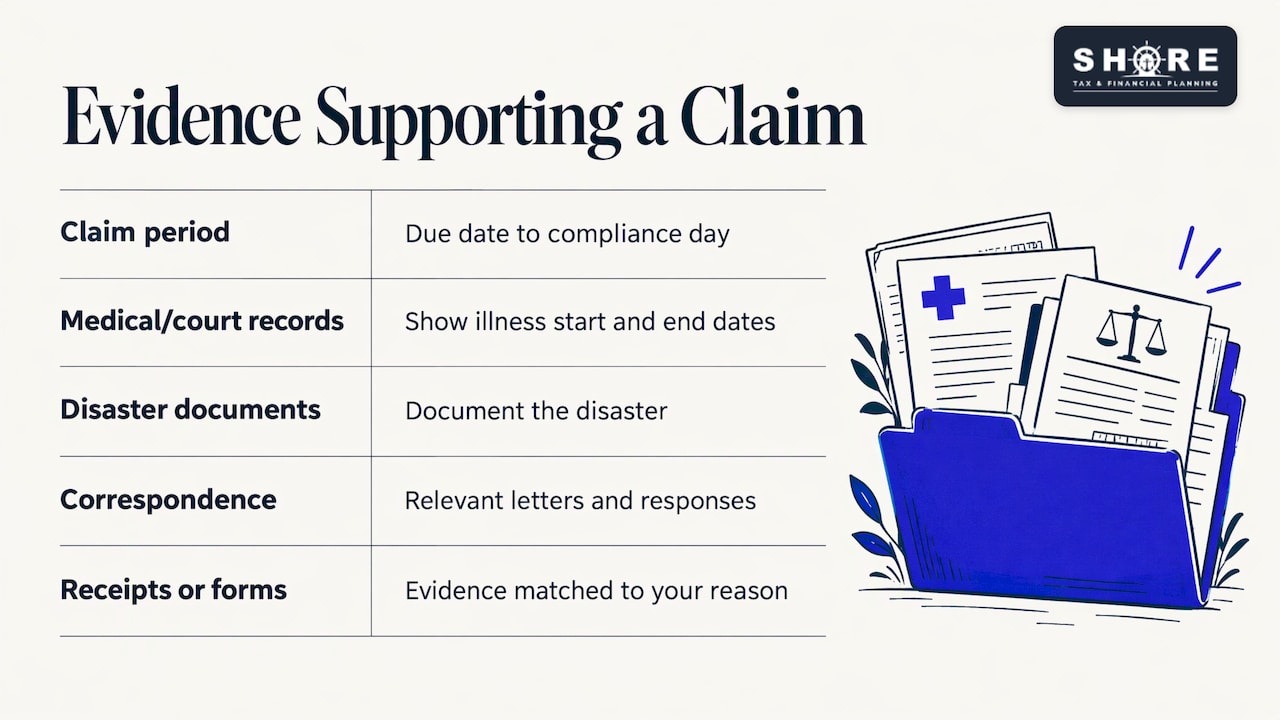
The IRS asks for evidence matched to your reason. That can include a doctor’s letter or hospital or court records showing start and end dates for an illness, documentation of the disaster, copies of relevant letters and responses, and receipts or forms. The dates matter most: the story has to explain the whole gap between the due date and the day you complied.
These are judged differently. The IRS looks at your efforts to report the correct tax, the complexity of the issue, your education and experience, and whether you took steps to understand the obligation or sought help from a tax advisor. For owners with complex returns, a record of professional advice at the time is often the strongest evidence you can have. That is one reason year-round planning pays off after the fact as well as before.
The IRS does not publish a mandatory template for a letter. A letter that gets read is short, factual and organized. Use this structure:
Keep the tone neutral. Do not argue that the penalty is unfair. Show the IRS the facts that fit its own criteria. One page is often enough, and two is plenty.
A consultant’s S corporation return was due March 16 and was filed 41 days late because the owner was hospitalized. The letter names Form 1120-S and the tax year, states the failure-to-file penalty and its amount, and gives the admission and discharge dates. It explains that the bookkeeper was out the same month, lists the date the return was filed once records were available, and attaches the discharge summary. This is an illustration of structure, not a real case, and your facts will decide the outcome.
You have three ways to ask.
| Method | Best when | What to have ready |
|---|---|---|
| Phone | You have a notice and likely meet FTA or have a simple reason | The notice, the penalty, your reasons and documents |
| Written letter | The call did not resolve it, or the facts need explanation | Letter with dated facts and attachments |
| Form 843 | Phone relief was not approved, or you are claiming a refund of a penalty already paid | Completed form plus attachments |
The IRS says it may reduce or remove some penalties over the phone. Call the toll-free number on the notice. If it cannot approve relief by phone, request it in writing with Form 843. The current Instructions for Form 843 cover the form’s purposes, including abatement or refund of a penalty due to reasonable cause.
There is currently no way to submit an abatement request through an IRS Online Account, according to one published guide. Plan on phone or mail.
The Form 843 instructions set out the rule:
Mail addresses change, so confirm the current one on the notice or on the IRS site before you send. Use certified mail with return receipt and keep a complete copy of everything you send.
One timing exception applies to certain business penalties. The Texas-style rule some readers expect does not exist federally, but some penalties are handled at filing. If you are asking for a waiver on a return you are filing late, ask your preparer whether the relief request should accompany the return or follow the notice.
A denial is not the end. If the request is rejected, you can request a hearing with the IRS Independent Office of Appeals within 30 days of the date on the rejection letter.
The Internal Revenue Manual requires the IRS to tell you in writing about the denial and your appeal rights when it decides a penalty does not qualify for reasonable-cause abatement, whether you asked in person, by phone or in writing. Check that the letter lists those rights, and calendar the 30-day deadline the day it arrives.
A practical way to prepare an appeal:
Abatement is a repair. For a business owner, the cheaper fix is a process that keeps deposits, estimates and returns on time. Three habits make the biggest difference:
If an unpaid balance grows into a lien, it can affect borrowing. This overview of business loan tax liens explains how liens interact with financing, which is one more reason to resolve penalties promptly.
Most penalty problems we see are not about bad intent. They come from a missed deposit, a late estimate, or books that fell behind during a busy quarter. The owner then spends hours trying to talk their way out of a bill that a calendar and a monthly close would have prevented.
We are a fee-only firm. We do not earn commissions on products, so our advice on a penalty, an S-corp election or a retirement plan is tied to what you owe and what you can defend, not to what we can sell. Our lead advisor holds both CPA and CFP credentials and has run a business, so we think about cash flow and deadlines the way you do.
Our view is that tax work should run all year, not only in season. When planning, bookkeeping and filing sit with one team, deadlines get tracked, documentation is created at the time of the event rather than after, and a penalty request, if one is ever needed, is backed by a clean file. We also design strategies to be defensible, and we report a 0.01% audit rate across our client work.
If you have a penalty notice in front of you, read the criteria above, check your three-year history, and act before the response window closes.
Joseph
If you own a profitable business or earn a high W-2 income, a penalty notice is usually a symptom of a process gap. We handle the whole chain: business tax return preparation, bookkeeping and payroll support, and IRS representation and year-round advisory for owners who want deadlines handled and strategy built in advance.

If you want a team that keeps your filings on time and your tax position defensible, start with our tax reduction planning page or reach us through shorefp.com.
Yes. The IRS lists failure-to-file, failure-to-pay, failure-to-deposit and information return penalties among those it may relieve, and the first-time abate and automatic relief programs cover business return series such as Forms 1065, 1120, 941 and 940. Business deposit penalties have extra conditions, including limits on prior waivers.
No. The IRS says you do not need to name FTA or provide supporting documents to be considered for it. You do need to contact the IRS to request it for returns still under the old program. If you meet the criteria, it is applied before reasonable cause.
Interest that relates to a penalty is reduced or removed automatically when the penalty is reduced or removed. Interest on the underlying tax itself is a separate matter and generally remains.
You can request a hearing with the IRS Independent Office of Appeals within 30 days of the date on the rejection letter. Read the letter carefully, because it should state your appeal rights and how to use them.
You can ask the IRS yourself. A CPA or other authorized representative can help when the penalty is large, the facts are complex, or several periods are involved. If you are unsure whether you qualify, review the criteria with your tax advisor before you call.