

If you work in your S corporation, the IRS expects you to be paid a wage that fits the work you do before you take any non-wage distributions. There is no published formula. The right number is the one you can support with data, a documented method and consistent payroll. Pay yourself too little and the IRS can reclassify distributions as wages. Pay yourself more than you need to and you give up savings. At Shore Tax & Financial Planning, we set this number with S-corp owners every year, and this guide shows you how it is done.
The IRS states that an S corporation must pay reasonable compensation to a shareholder-employee for services before any non-wage distributions are made. Wages should generally be in line with the officer’s duties. The IRS looks at factors such as:
Two points follow from this. First, reasonable compensation can never exceed what the shareholder actually receives, directly or indirectly. Second, if the officer is underpaid, the IRS may adjust both the corporation’s return and the shareholder’s return.
Being a shareholder does not change your status. The IRS says corporate officers who perform services and are entitled to payment are employees for FICA, FUTA and income tax withholding. An officer who performs no or only minor services and is not entitled to pay is not an employee. If you run the business day to day, you are in the first group.
The tax logic is simple. Wages carry the 15.3% payroll tax rate, made up of 12.4% Social Security and 2.9% Medicare. Nolo explains that S corporation distributions pass through to your personal income tax return but are not subject to employment tax. That gap is where many S-corp savings come from, and it is why the IRS pays attention to how owners split profit between salary and distributions.
There is a second reason to get it right. Your share of S corporation income is not self-employment income, according to the IRS Schedule K-1 instructions, but you may owe income tax on it whether or not the cash leaves the company. Salary also affects other parts of your return. The Tax Adviser notes that W-2 wages set the wage limit for the qualified business income deduction. So the salary is a planning decision, not just a payroll setting.
The backdrop is stable for now. The Tax Adviser reports that the One Big Beautiful Bill Act, passed July 4, 2025, made permanent the 20% qualified business income deduction and the 37% top rate, which leaves an effective top rate of 29.6% on ordinary S corporation income for owners who benefit from the deduction.
Because there is no single formula, the safest path is to use an established method and write down what you did. The Tax Adviser describes three approaches under Treasury Regulation §1.162-7(b)(3) in its guide to advising S corporation clients on reasonable compensation.
Break your role into its components: operations manager, salesperson, bookkeeper, technician, and so on. Price each at what the market pays for that work, then add up the hours you spend on each. This approach, often called the “many hats” method, suits owners who really do several jobs.
Compare what the business would pay a non-owner to fill a similar position in your industry and region. Salary surveys and job-market data are the usual inputs. If you want a practical way to read pay data, a look at estimating market salary with percentiles shows why a range beats a single data point. Then adjust for your own experience, hours, responsibilities, revenue and profitability.
Ask whether a hypothetical outside investor would be satisfied with the return left after your pay, given what the company is worth. If your salary leaves almost no return on the capital invested, that is a red flag. If your pay is modest and the return is healthy, the salary is easier to defend.
Most owners combine them. The market approach gives you a range, the cost approach shows how your actual duties compare, and the income approach checks the result against the business’s profit. The Tax Adviser’s author, a CPA, stresses that the intent behind a payment matters and that a recognized, fact-based methodology is essential if the IRS challenges the figure.
This is an illustration with round numbers, not a recommended salary.
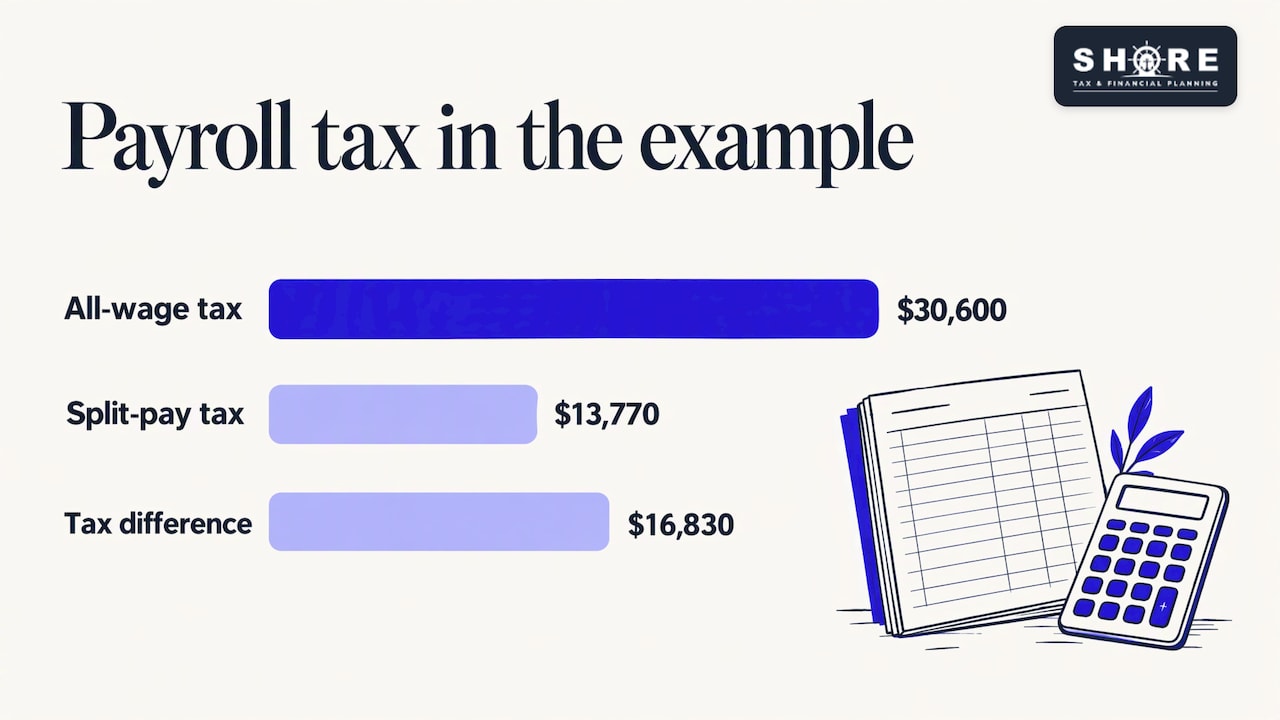
Say your S corporation earns $200,000 in profit before your pay, and you are the only person doing the core work. You and your adviser review market pay for the role and your actual duties, and land on a defensible salary of $90,000. The other $110,000 is distributed as profit.
| All paid as wages | $90,000 salary, $110,000 distributions | |
|---|---|---|
| W-2 wages | $200,000 | $90,000 |
| Payroll tax at 15.3% (employer and employee halves combined) | $30,600 | $13,770 |
| Difference | $16,830 |
The figures use the flat 15.3% rate for simplicity. In practice the Social Security part applies only up to an annual wage base, and the corporation deducts its half of payroll tax, so your real numbers will differ. The point is the shape of the decision. The distribution is not subject to payroll tax, but it must still follow a salary that stands up to scrutiny.
Now reverse the case. If most of your profit comes from your own labor, a low salary is hard to defend. The reasonable figure may be a large share of the profit, and the savings shrink accordingly. That is a good reason to run the numbers before you elect S status rather than after.
The IRS cares about substance, not labels. The Tax Adviser lists the kinds of records that show a payment was meant as compensation:
Add to that the salary data you used and a short memo explaining the method. The same article notes that in Paula Construction Co., payments recorded as distributions were not reclassified as compensation because the evidence of compensatory intent was lacking. Records written at the time, not rebuilt after a letter arrives, are what carry weight.
The IRS also now says it up front. Brach Eichler reports that in late 2023 the IRS revised the CP261 notice, sent when an S election is approved, to state that a reasonable salary must be determined for shareholder-employees and that distributions paid in lieu of pay can be recharacterized.
A salary only counts if it runs through real payroll. That means putting yourself on the payroll, withholding income tax and the employee share of FICA, paying the employer share, depositing the taxes on schedule, filing payroll returns and issuing a W-2 at year end. The IRS says distributions to an officer are treated as wages to the extent they are reasonable compensation, so skipping payroll does not make the obligation go away.
Clean books support all of this. Your bookkeeping should separate:
Mixing these is how distributions end up looking like wages, or loans end up looking like distributions. Monthly bookkeeping and payroll handled together make the records match each other. We offer both, and you can see how we handle payroll services for S-corp owners.
Distributions are where owners get the most confused, so here is the short version.
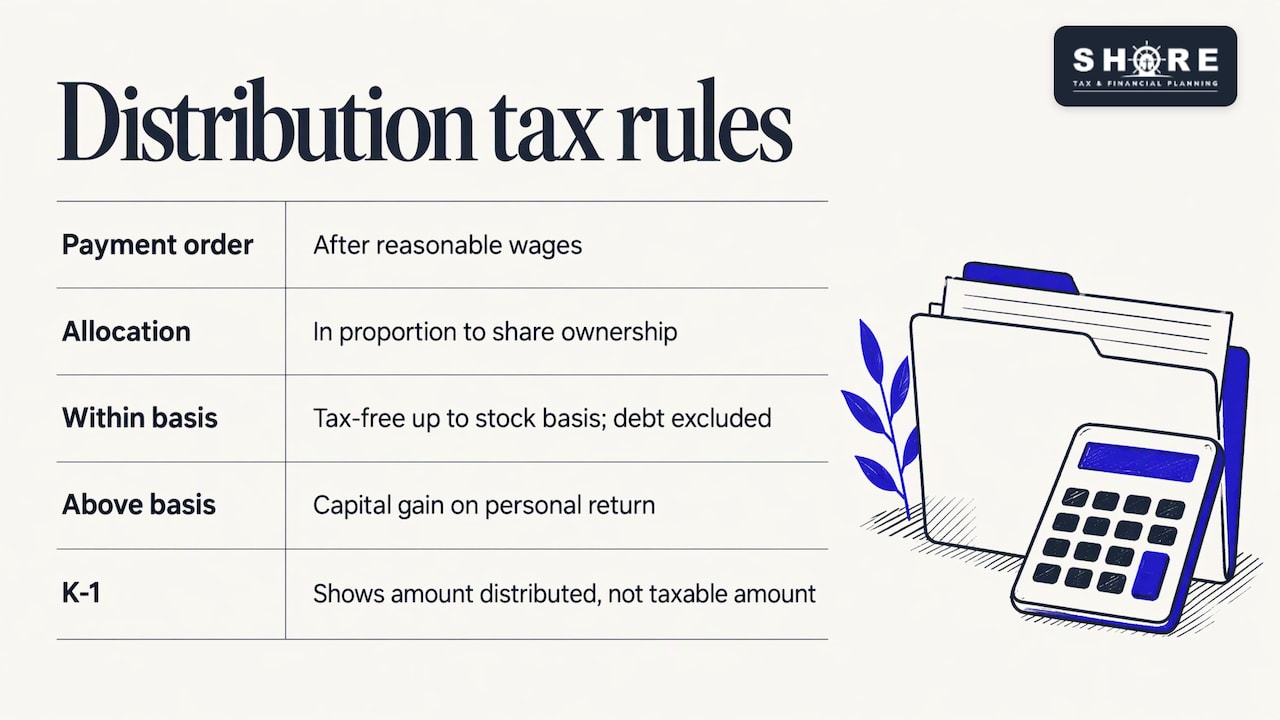
Distributions are not a second salary. They are a return on your ownership, paid in proportion to share ownership, after reasonable wages are in place.
Basis limits the tax-free portion. The IRS explains that a non-dividend distribution is tax-free up to your stock basis, which debt basis does not count toward. Any amount above basis is taxed as capital gain on your personal return, long-term if you have held the stock more than a year. The K-1 shows the amount distributed but not its taxable amount, so tracking basis is your responsibility, and your preparer needs the records.
There is no special “distribution tax rate.” Your share of the company’s income is taxed on your personal return whether or not it is paid out. A distribution within basis is generally not taxed again. One above basis is taxed as capital gain, as above.
Accumulated earnings and profits change the order. If the company was once a C corporation and still has accumulated earnings and profits, 26 U.S.C. § 1368© sets an ordering: the amount up to the accumulated adjustments account follows the basis rules, the next piece is a dividend to the extent of those earnings and profits, and the remainder follows the basis rules again. If this applies to you, have a CPA review it before you distribute.
Owner’s draw vs. salary. A draw is the word for pulling money from a sole proprietorship or partnership. Once you are an S corporation shareholder who works in the business, the pay for your work goes through payroll as wages, and profit comes out as distributions.
The best-known case is David E. Watson, P.C. A district court found that Mr. Watson’s $24,000 salary for 2002 and 2003 was unreasonable, found $91,044 a year reasonable, and reclassified $67,044 of distributions as wages each year, with employment taxes, interest and penalties due. The Eighth Circuit later upheld the result. Attorney James MacGillis notes the court looked at economic substance over form: where payments are clearly pay for services, calling them dividends does not change them.
The IRS also cites Veterinary Surgical Consultants, P.C. v. Commissioner, in which the Tax Court held that a company cannot avoid employment taxes by labeling pay to its sole director and shareholder as distributions.
The lesson is not to fear S corporations. It is that a salary built on data and written down is far easier to stand behind than one chosen to hit a target.
We see the salary question as the center of S-corp planning, not a footnote to it. The election works because wages and distributions are taxed differently, and that same difference is what makes the salary worth defending.
Our lead advisor holds both CPA and CFP credentials and has run a business, so we look at the number from both sides: what the market pays for the role, and what the business can carry. Our firm is fee-only and earns no commissions on products, so the advice is aimed at your tax result and nothing else.
We also treat the figure as a yearly decision. Profit, duties and market pay move, and the salary, payroll and bookkeeping should move with them. Our audit rate is 0.01%, which is what we point to as evidence that this approach holds up.
Joseph
If you already run an S corporation, or you are weighing the election, we handle the pieces together: S-corp conversion, payroll, monthly bookkeeping and year-round tax reduction planning, so your salary, payroll records and distributions agree with each other.

If you want a second look at your current salary or a plan before you elect, start with our tax reduction planning page. You can also read how an LLC converts to an S corp and how S-corp tax savings add up.
A salary set in your first year can be wrong by your third. Revisit it when:
State rules can matter too. The Tax Adviser notes that the 2025 federal law did not eliminate state pass-through entity tax regimes, so check how your state’s regime interacts with your S election before you rely on it.
If you perform services for the corporation and are entitled to pay, yes. The IRS treats you as an employee, and reasonable compensation must be paid before non-wage distributions. An officer who does only minor services and is not entitled to pay is not treated as an employee.
The IRS does not publish one. You use the factors it lists, such as duties, experience, time devoted and comparable pay, and a recognized method such as the cost, market or income approach. Document the result.
Yes. If distributions are really pay for your services, the IRS can recharacterize them as wages and assess employment taxes, penalties and interest, as the Watson case shows. A documented salary based on market data is the best protection.
Your share of the company’s income is taxed on your personal return whether or not it is distributed. A distribution up to your stock basis is generally tax-free. Amounts above basis are taxed as capital gain. Distributions are not subject to the 15.3% payroll tax.