

If you own more than 2% of an S corporation, your health insurance is deductible, but only if it runs through the company the right way. The S corp pays or reimburses the premiums, reports them as wages in Box 1 of your W-2, and you then claim the self-employed health insurance deduction on your personal return. Skip a step and you can lose the deduction, even though you paid the premiums every month.
This guide walks through the rule, the paperwork, a worked example and the mistakes we see most often with business owners who switch from a sole proprietorship or LLC to an S corp.
In a regular company, employer-paid health insurance is a tax-free fringe benefit. An S corp owner with a meaningful stake is the exception. IRS Notice 2008-1 explains that Congress treats an S corporation as a partnership for fringe-benefit purposes and a more-than-2% shareholder as a partner. That means the shareholder is not treated as an employee for the ordinary exclusion, so the premiums become taxable income to you.
The corporation’s side is simple: it takes a normal business deduction for the premiums. Your side takes two steps: include the premiums in income, then claim a separate deduction. The IRS describes the split in its guidance on S corporation compensation and medical insurance: the corporation deducts qualifying premiums, and the shareholder includes them in wages and may then claim an above-the-line deduction, subject to its limits.

Despite the name, the rule applies to owners with more than 2%. The IRS defines a greater-than-2% shareholder as someone who owns more than 2% of the outstanding stock, or stock carrying more than 2% of the combined voting power, on any day of the tax year. In practice that covers almost every owner-operator.
Ownership is measured with the attribution rules of section 318. Stock held by a spouse (unless legally separated), children, grandchildren and parents is attributed to you. So a spouse who owns 1% of the company and works in the business is still treated as a more-than-2% shareholder if you own more than 2%. Do not assume a minority family member escapes the rule.
There are three ways the premiums can be handled, and the right one depends on who is named on the policy.
Timing matters as well. Notice 2008-1 requires that the corporation’s payment or reimbursement and your gross-income inclusion occur in the same year for you to qualify for the deduction. A premium paid in December and reimbursed the following February is a problem waiting to happen.
The S corporation reports the premiums as wages in Box 1. They are not included in Boxes 3 or 5. The IRS states these amounts are not subject to FICA or FUTA, provided the premiums are paid under a plan or system that covers employees or their dependents.
That last condition is easy to miss. If you are the only person the company covers, ask your payroll provider and CPA to confirm the arrangement qualifies before you rely on the payroll-tax savings.
The practical effect: Box 1 is higher than Box 3 and Box 5. Payroll software that is not set up for 2% shareholders will often put the premiums in every box, which overpays payroll tax and inflates your Social Security wages. Check your first payroll run of the year, not your W-2 in January.
Here is an illustration with round numbers. It is not a client result and your figures will differ.
Say you own 100% of an S corp, pay yourself a $100,000 salary, and the company pays $18,000 a year in family health premiums.
| Item | Amount |
|---|---|
| Salary through payroll | $100,000 |
| Premiums paid by the S corp, added to wages | $18,000 |
| W-2 Box 1 | $118,000 |
| W-2 Boxes 3 and 5 (Social Security and Medicare wages) | $100,000 |
| Corporation’s deduction | $100,000 salary plus $18,000 premiums, plus employer payroll tax on the salary |
| Your personal deduction (Form 7206) | Up to $18,000, subject to limits |
The $18,000 appears as income on your W-2 and then comes back out as a deduction on your personal return. The corporation also deducts it, so the cost to you after tax is the premium itself, not a second layer of tax. The benefit of doing it correctly is that you avoid payroll tax on the $18,000 and keep the deduction.
You claim the deduction on your personal return using Form 7206. It is an above-the-line deduction, which means it reduces adjusted gross income whether or not you itemize.
IRS Topic 502 says the deduction may cover premiums for you, your spouse, your dependents and a child under age 27 at the end of the year. The Form 7206 instructions add that voluntary Medicare premiums paid for coverage in your name can be included in the calculation. They also state that retired public safety officer health insurance exclusions cannot be used to figure the deduction.
A note for owners who also buy coverage through the marketplace: the premium tax credit calculation interacts with this deduction, so coordinate it with your CPA before you file rather than after.
Many owners ask whether the S corp can set up an HRA to cover medical costs tax-free. For more-than-2% owners, the answer is no. A 2-percent shareholder-employee is not eligible to participate in a QSEHRA, FSA, HRA or other self-insured arrangement, because the shareholder is not treated as an employee for those provisions.
That does not mean the company cannot offer one to non-owner employees, and it does not mean every health-related tax tool is closed to you. We cover the options for owners in our guide to health insurance tax deductions for small business owners, and our year-end medical plan strategies post goes further into planning.
Paying personally and deducting on Schedule A or Form 1040 only. Without company payment or reimbursement and W-2 reporting, the S corp plan is not established and the deduction is at risk.
Leaving the premiums off the W-2. The most common error. The company deducts the expense, the owner’s W-2 shows nothing, and the books and the return do not agree.
Running the premiums through FICA. Payroll platforms often treat them as ordinary wages. Correcting this mid-year is far easier than amending later.
Mismatched years. Reimbursing in January for last year’s premiums breaks the same-year requirement.
Ignoring family attribution. A spouse or child on payroll with a small ownership stake is still treated under the same rules.
Taking the deduction with other eligible coverage. If you or your spouse could have enrolled in a subsidized employer plan, that month is likely out.
Setting salary too low. A very low salary limits the deduction and invites scrutiny of reasonable compensation.
If you are still deciding whether the S corp is worth it, our overview of S corp tax savings explains where health insurance fits among the other tradeoffs, including payroll, reasonable compensation and compliance.
We see S corp health insurance handled wrong more often than almost any other owner benefit, and nearly always for the same reason: the owner switched entities and nobody told payroll. As a sole proprietor, the deduction took care of itself on the return. As an S corp owner, it is a payroll and bookkeeping process that has to happen during the year, not at tax time.
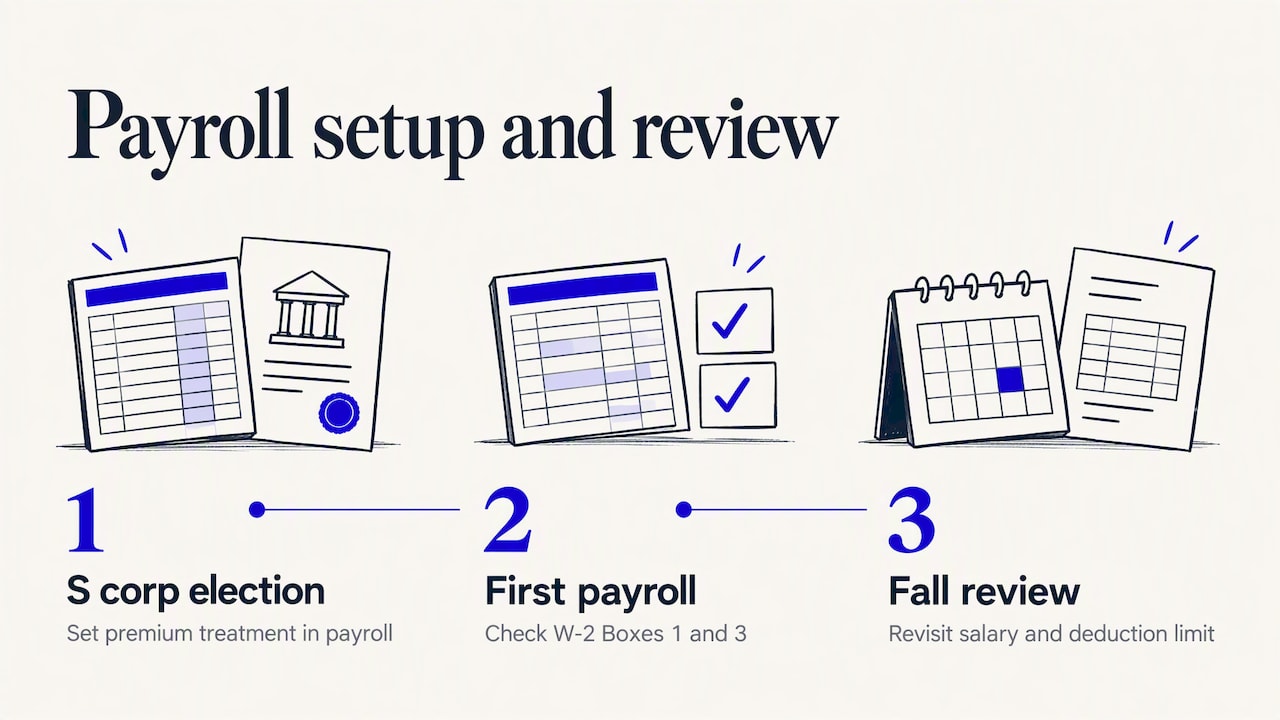
That is why we do not treat it as a January task. We set up the premium treatment in payroll when the S corp election takes effect, check Box 1 and Box 3 on the first payroll run, and revisit salary and the deduction limit in the fall while there is still time to adjust. Because we are fee-only and earn no commissions on insurance or investment products, our advice on which coverage to carry stays separate from the tax question of how to report it.
One point of view we hold firmly: do not choose a health plan to chase a deduction. The deduction reduces what the premium costs you, but it does not make an unnecessary premium free. Pick coverage that fits your family and then make sure the tax treatment is airtight.
— Joseph
If you already run an S corp, or you are weighing the election, our team handles the payroll setup, the W-2 reporting and the personal return together so the pieces match. You can learn how we approach S corp conversion and optimization, or see how our year-round advisory for business owners keeps benefits like this on track from January through December.
Yes. An S corporation may pay or reimburse premiums for a greater-than-2% shareholder-employee. The corporation can deduct them, and they are reported as W-2 wages. The owner then claims the self-employed health insurance deduction on the personal return, subject to its limits.
It applies to anyone who owns more than 2% of the stock or voting power on any day of the tax year. Stock owned by your spouse, children, grandchildren and parents counts toward your total under section 318. Owners above the threshold are treated like partners for fringe-benefit purposes, so employer-paid premiums become taxable wages to them.
Yes, generally. The plan must be established by the S corporation, meaning it pays or reimburses the premiums and includes them in your W-2 wages in the same year. You then deduct them on Form 7206, up to your earned income from the business and not for months you could have joined a subsidized employer plan.
They are not added to them. The premiums appear in Box 1 but not in Boxes 3 or 5, so they are not subject to FICA or FUTA when paid under a qualifying plan. If your payroll system adds them to Boxes 3 and 5, you are overpaying payroll tax and the setup needs correcting.
Not if you own more than 2%. A 2-percent shareholder-employee cannot take part in a QSEHRA, FSA, HRA or similar self-insured arrangement. Other tax-advantaged options may still be available to you, so talk with a CPA about your full benefit mix.