

An S corporation gets a tax extension by filing Form 7004 on or before the original due date of its Form 1120-S. The extension adds six months to file the return, which moves a calendar-year S corp from March 15 to September 15. It does not give you more time to pay. Any tax the corporation owes is still due on the original date. Our business tax return preparation team at Shore Tax & Financial Planning handles S corp returns and extensions for profitable owners, so the filing never gets in the way of planning.
An S corporation is a business that has elected to pass its income, deductions and credits through to its shareholders. It does not usually pay federal income tax itself. Instead it files Form 1120-S, an information return, and sends each shareholder a Schedule K-1 showing their share.
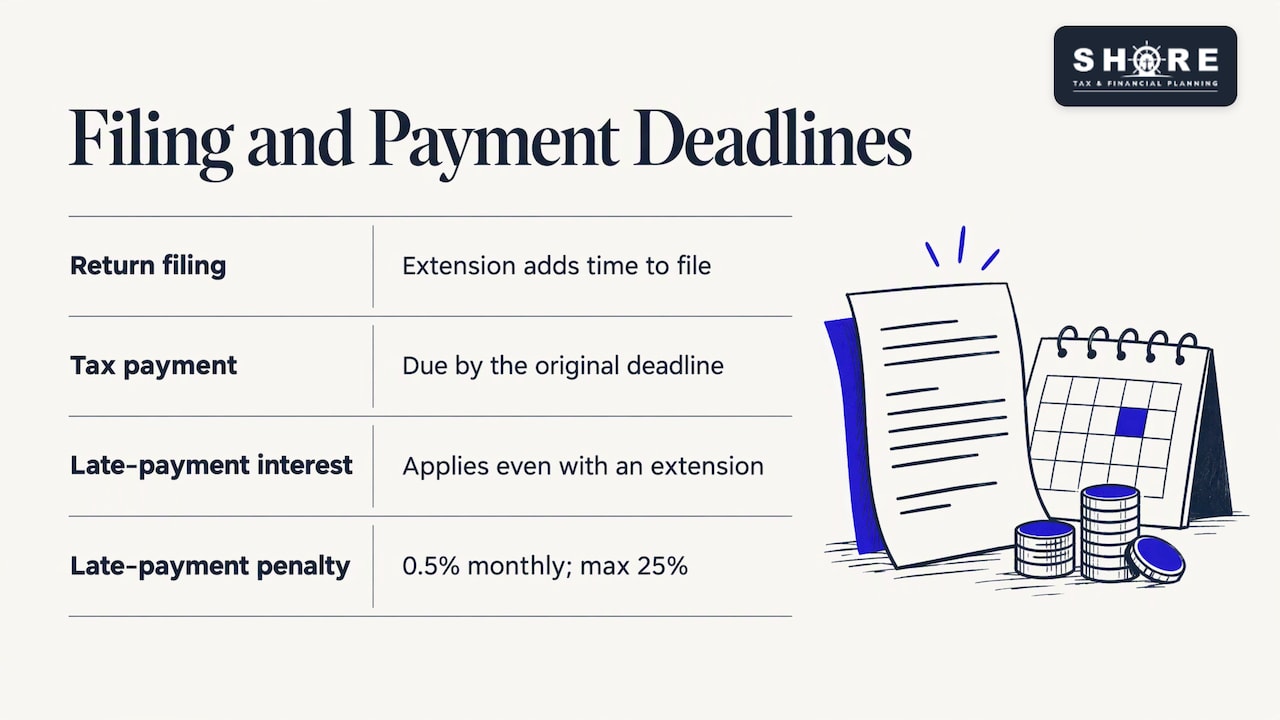
An extension moves the filing deadline for that return. Nothing else moves. The IRS instructions for Form 7004 say the form does not extend the time to pay any tax due, and that properly filing it automatically grants the maximum extension, generally six months.
Three practical points follow from this:
A calendar-year S corporation’s Form 1120-S is due by the 15th day of the third month after the tax year ends, according to the IRS instructions for Form 1120-S. For most S corps that means March 15. When March 15 falls on a weekend, the deadline rolls to the next business day. For 2025 returns, that made it March 16, 2026, because March 15 was a Sunday.
The extended date for a calendar-year S corp is September 15, six months after the original due date, as long as Form 7004 was filed on time. When September 15 lands on a weekend, the same next-business-day rule applies.
Here is the pattern in one place:
| Item | Calendar-year S corp | Fiscal-year S corp |
|---|---|---|
| Original Form 1120-S due date | March 15 (next business day if a weekend or holiday) | 15th day of the 3rd month after year-end |
| Form 7004 due | Same as the original due date | Same as the original due date |
| Extension length | 6 months | 6 months |
| Extended due date | September 15 | 15th day of the 9th month after year-end |
The dates repeat every year, so check the IRS’s current-year instructions for the exact calendar day. If your corporation uses a fiscal year, count from your own year-end rather than from December 31. If you also have state filings, your state may follow the federal extension automatically or may have its own form and rules, so confirm that with your state’s revenue department.
The filing is simple. The mistakes happen around it. Here is the process, with the point where each step usually goes wrong.
Work out the 1120-S due date from your tax year-end, not from the calendar year. Corporations that changed their year-end, started mid-year or elected S status recently are the ones most likely to get this wrong. Everything else depends on this date.
The form needs the corporation’s legal name, EIN (employer identification number), address, the tax year-end date and, in the payment section, an estimate of any tax due. Make sure the name matches what the IRS has on file. A mismatch is a common reason an e-filed form is rejected.
Most S corps owe no federal tax at the entity level. Some do, for example when built-in gains tax or excess net passive income tax applies. The IRS instructions say to make a proper estimate of tax if applicable, and that is the amount you pay by the original due date. Guessing low is the usual error here. Interest runs on whatever is paid late.
Businesses can e-file Form 7004 through the IRS’s Modernized e-File system, according to the IRS e-file page for Form 7004. The form must generally be filed on or before the due date of the return it extends. E-filing gives you a confirmation of acceptance, which is worth saving. A rejected submission that you never noticed is the way many “extended” returns end up late.
The IRS instructions note that most entities must use the Electronic Federal Tax Payment System, EFTPS, for federal tax deposits, and the payment is due by the original deadline. Filing the extension and paying are two separate actions. Do both before the original date.
The extended deadline is a hard stop, not a cushion. Set your internal deadline for the books to be closed well before it, because the corporation’s K-1s feed your personal return and any other owners’ returns.
We handle the extension as part of the return work for clients on business tax return preparation, so the 7004 is filed, tracked and tied to the plan for the year rather than left as a loose task.
This is the point that surprises owners most. The IRS instructions for Form 1120-S say the corporation must pay any tax due in full by the return’s due date, not counting extensions. Interest is charged on tax paid late even when the extension to file was granted, at a rate set under section 6621 of the tax code.
The IRS Taxpayer Advocate Service says the same thing from the taxpayer’s side. Extending the time to file generally does not extend the time to pay, interest and penalties generally begin right after the original due date, and you should estimate what you owe and send that amount with the extension.
There is a separate failure-to-pay penalty. The 1120-S instructions put it at one-half of one percent of the unpaid tax per month or part of a month, up to 25% of the unpaid tax, unless the failure was due to reasonable cause.
If your S corp usually owes nothing at the entity level, the payment piece is a non-issue and the extension is purely a filing tool. That is the most common situation. The important part is to confirm it rather than assume it.
The late-filing penalty for S corporations is unusual because it applies even when no tax is owed. According to the IRS instructions for Form 1120-S, a penalty may be assessed when the return is filed after the due date, including extensions, unless there is reasonable cause. The amount is $255 for each month or part of a month the return is late, for up to 12 months, multiplied by the number of shareholders who held stock at any time during the year.
Here is a worked example. An S corp with four shareholders files a year late. The math is 4 shareholders × $255 × 12 months, which is $12,240, and that is on a return showing no tax at all. A single month of lateness costs $1,020 for that same company, and any part of a month counts as a full month.
If tax is also due, a separate late-filing charge applies. The IRS instructions state it as 5% of the unpaid tax for each month or part of a month, up to 25%. A minimum penalty also applies for returns more than 60 days late: the smaller of the tax due or $525.

The clock starts the day after the deadline including any extension. That means missing the September 15 extended date has the same effect as missing the March date outright. Having filed an extension does not soften that.
The IRS can remove these penalties for reasonable cause, which in general means you used ordinary care and prudence and still could not file on time. Treat that as a safety net, not a plan. It requires a written explanation and the IRS decides whether you qualify. If a notice arrives, our IRS representation and support is there for business owners who want it handled by a CPA.
For many S corps an extension is routine. Owners with several entities, rental property, a new S election, or K-1s coming in from partnerships often cannot finish accurate returns by mid-March. Filing late is one of the costliest ways to be accurate. Filing the extension is not.
There are a few situations where the extension is the right call:
There is also a pattern worth noticing. If you extend every single year because the books are always behind, the extension is covering a bookkeeping problem. Fixing that earns you more than the filing deadline does. Monthly bookkeeping and an accounting cleanup mean the return is built from a clean ledger instead of a scramble in March, and an extension becomes a choice rather than a rescue.
The six months between March and September are a good time to look at the structure that drives the return. A few items belong on your list:
The bigger point is that the best savings come from decisions made before the year ends, not from the return. This year-end tax planning checklist lays out what to review in December, when planning moves are still available. Our own approach is year-round, which is described on our year-round tax planning page.
We see the extension as a tool, and we use it deliberately. For a profitable S corp, a late March deadline is rarely the best time to finalize numbers. It is the time to make sure nothing is missed, and filing Form 7004 gives the return the time it needs.
What we push owners away from is treating the extension as a way to put off thinking about taxes. Filing it takes minutes. The value is in what you do with the six months: close the books, check reasonable salary, review retirement contributions and confirm the structure still fits the business.
We are fee-only. We do not earn commissions on products, so our advice on this is about your tax outcome and nothing else. Our lead advisor holds both CPA and CFP credentials and has run a business, which shapes how we look at deadlines: as someone who has felt the pressure of them. Our firm reports a 0.01% audit rate, and we design strategies to be defensible, which starts with filing correctly and on time.
Joseph
If you own a profitable business or earn high W-2 income, the cost of an extension mistake is the penalty plus the savings you did not capture. Shore Tax & Financial Planning offers tax reduction planning, business tax return preparation, bookkeeping, payroll and IRS representation for business owners and high earners, all on a fee-only basis. Tax reduction planning is where most clients start.

To talk through your S corp’s filing calendar and what to do with the extra time, visit shorefp.com.
For a calendar-year S corporation, the extended due date for Form 1120-S is September 15, or the next business day if that falls on a weekend or holiday. That applies when Form 7004 was filed on time. A fiscal-year S corp gets six months from its original due date.
No. According to the IRS instructions for Form 7004, a properly filed Form 7004 automatically gives the maximum extension, generally six months. No signature is required. The IRS notifies you only if it disallows the request.
No. The form must be filed on or before the original due date of the return. If you miss it, the return is late, and the per-shareholder, per-month penalty can start the next day. Talk to a CPA right away about filing the return and asking for penalty relief based on reasonable cause.
No. The extension applies to filing only. Any tax owed at the corporate level is still due by the original deadline, and interest is charged on late payments even when the extension was granted.
No. Form 7004 covers the corporation’s return. Your personal return has its own deadline and its own extension process, so plan both together because the K-1 from the S corp feeds your personal return.