

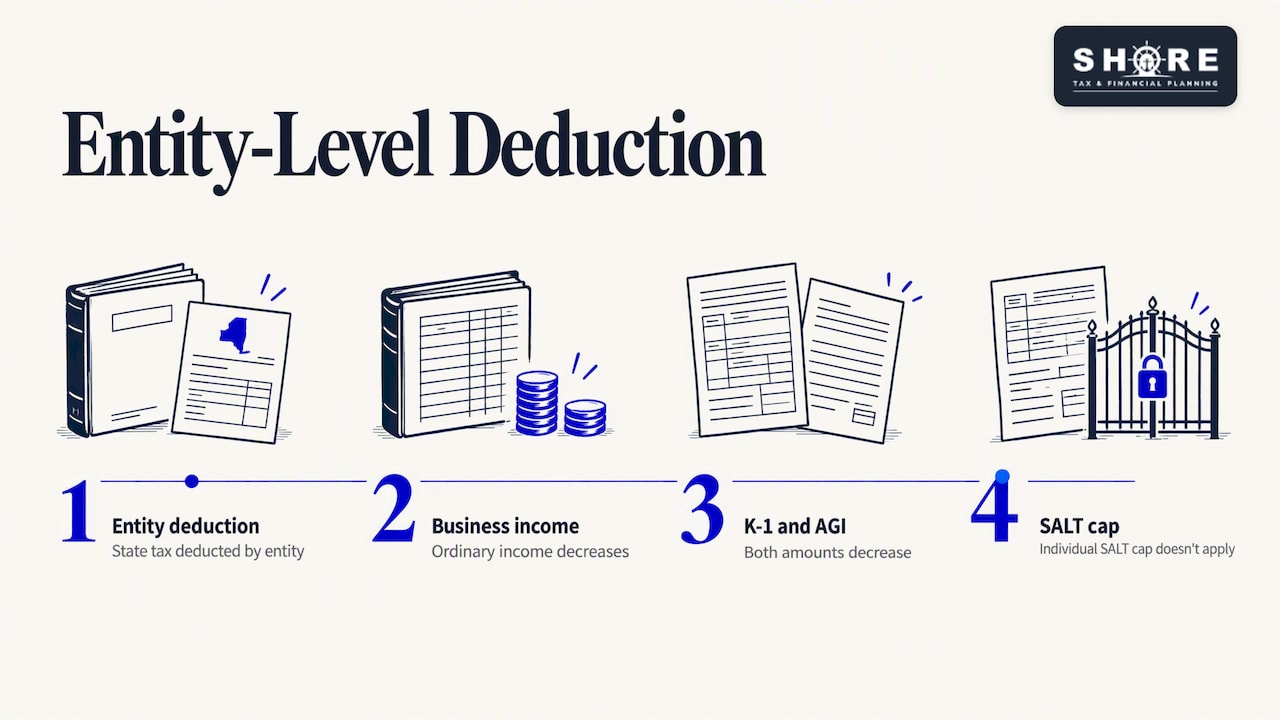
The SALT cap workaround is a pass-through entity tax (PTET) election. Your S corporation or partnership pays state income tax itself, deducts that payment at the entity level, and you claim a credit or offset on your state return. The federal deduction is no longer squeezed through your personal SALT limit. The 2025 federal law raised that limit, but it did not remove the workaround, and for many owners it is still worth modeling every year.
This guide explains the mechanics, what the larger cap changes, how the credit shows up on your return, what to do if you file married separately, and how to decide whether an election pays off for you.
The state and local tax (SALT) deduction is the itemized deduction for state and local income, sales, and property taxes combined. Individuals face a dollar limit on it. A business is different: when a pass-through entity pays tax and the entity is the taxpayer for that state purpose, the payment is a business deduction, not an itemized one.
That is the whole idea. According to a Bipartisan Policy Center explainer, states allow pass-through entities such as partnerships and S corporations to pay state income tax at the entity level. Owners then receive a state tax credit, and the entity-level payment reduces the business income reported to them. The result is an effective federal deduction for state tax that bypasses the individual cap.
Connecticut was the first state to enact a PTET, in 2018, in response to the limit created by the 2017 Tax Cuts and Jobs Act, according to a Federation of Tax Administrators presentation. Many other states followed with elective regimes of their own.
The IRS addressed this in Notice 2020-75. It announced forthcoming regulations clarifying that state and local income taxes imposed on and paid by a partnership or S corporation are deductible by the entity in computing its non-separately stated income or loss. The notice also lets taxpayers rely on its provisions for entity-level payments, which is the footing the whole strategy stands on.
The mechanics, as University of Illinois tax school materials describe them, run like this: the entity deducts the state tax in computing ordinary business income, which lowers the amount on your Schedule K-1 and your federal adjusted gross income. Because the deduction sits at the entity level, the individual limit never applies to it.
For tax year 2025, the IRS Schedule A instructions set the SALT limit at $40,000, or $20,000 for a married taxpayer filing separately. The limit covers state and local income, sales, and property taxes combined.
There is a catch for higher earners. The same instructions say the cap starts to shrink when modified adjusted gross income exceeds $500,000 ($250,000 married filing separately), and it cannot fall below $10,000 ($5,000 married filing separately). The IRS courseware states that the increased limit applies to tax years beginning in 2025 and ending before January 1, 2030. For 2026, one state PTET summary puts the cap at $40,400 with the phasedown beginning above $505,000 of MAGI.
What does that mean for the workaround?
Here is a hypothetical, not a client result. Say you are a New Jersey S corporation owner in the 35% federal bracket, below the phasedown range. You pay $30,000 of state income tax on business income and $15,000 of property tax on your home.
Without an election, you have $45,000 of SALT against a $40,000 cap, so $5,000 is lost. With an election, the $30,000 is deducted at the entity, and your $15,000 of property tax fits under the cap. You recover that extra $5,000 of deduction, worth about $1,750 at 35%.
Now raise your income so the cap drops to $10,000. Without an election, you deduct $10,000 of $45,000. With one, the $30,000 comes out at the entity and your property tax still fills most of the remaining cap. The gap, and the value of the election, is far larger. That is why income level matters more than almost anything else.
The federal cap is not the only reason owners elect. Thomson Reuters reports that an entity-level payment can reduce the income flowing to owners, potentially affecting self-employment tax exposure as well. How much depends on the state regime and the entity’s facts, so treat it as something to test, not assume.
If you own a business and also care about the Section 199A deduction, remember that lowering your qualified business income can interact with it. We walk through that in our guide to Section 199A strategies for pass-through owners.
The credit is what makes the arrangement fair to you. You are not paying state tax twice. The Multistate Tax Commission explains that most states give owners a credit or other offset for their share of entity-paid tax against the state tax they owe on that income, and that details vary by state.
In practice, you receive a K-1 or equivalent statement from the entity showing your share of the tax paid. You enter it on your resident state return as a credit. Some states make the credit refundable or allow carryforwards, and others do not, so a credit larger than your state liability can behave very differently depending on where you live. Your state’s instructions govern.
A few situations deserve a closer look before you elect:
Most states with an income tax now have some form of elective PTET, and the details differ on rates, who can elect, how the election is made, and how the credit works. Because those rules change, the reliable move is to read your state tax agency’s current PTET page, and the Multistate Tax Commission maintains a state-by-state PTE tax overview that is a good starting point.
Two examples show how different the regimes can be. Connecticut started the trend in 2018, as noted above. California’s elective tax program, which began in 2021, allows an entity-level tax of up to 9.3% of the entity’s income, according to a state tax administrators presentation. If your business operates in several states, you may need to look at more than one regime at once.
This is where owners most often get hurt. Deadlines are state-specific, and many fall before or during the tax year, not at filing.
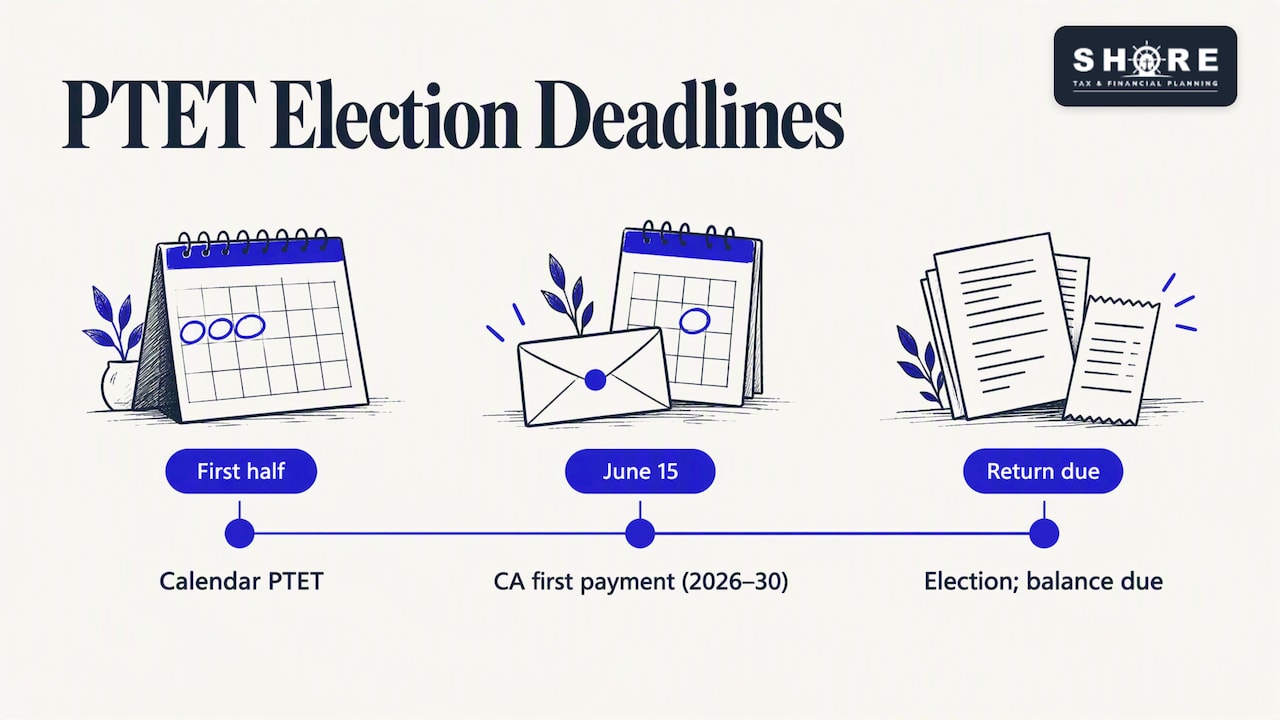
California is a useful example because its rules are published by the state. The Franchise Tax Board says the election is made annually on a timely filed original return. For 2026 through 2030, the required first payment is due by June 15, and the remaining payment is due by the original return due date, without extensions.
Other states use quarterly-style schedules, and some tie the election to a specific box or separate form on the entity return. One multi-state summary lists several states with estimated payment dates spread through the year and election methods that range from an online submission to a checked box on the return. Check each state’s agency site for the current dates.
The practical rule: put PTET on your calendar in the first half of the year, not in the spring after the year ends. A late or short payment can mean no valid election, and no deduction.
If you file separately, the cap is halved. For 2025 the limit is $20,000, the phasedown begins above $250,000 of MAGI, and the floor is $5,000, per the IRS instructions. The IRS courseware confirms the separate-return limit is half the otherwise applicable amount.
Two points follow. First, a couple filing separately loses more to the cap than a joint couple with the same income, so the entity-level deduction can matter more. Second, the PTET election is made by the entity, not by you personally, so your filing status does not stop it from working. Whether filing separately makes sense in the first place is a bigger question that turns on student loans, liability concerns, and other credits, and it should be decided with a CPA, not to chase a SALT result.
Use a short checklist and run actual numbers:
J.P. Morgan’s guidance points the same way: model projected savings against administrative costs and complexities, using the entity’s income sources and the residency of all members.
This is a question that needs a CPA’s model, not a rule of thumb. At Shore Tax & Financial Planning, we build PTET analysis into year-round tax reduction planning, so the election, the estimated payments, and your owner-level return all line up. If you are still deciding on entity structure, our S-corp conversion work is where many owners start, because only certain entity types can use the workaround.

We are fee-only and earn no commissions on products, so the only thing we are trying to optimize is your tax bill. If you are a profitable business owner who wants an election modeled before the deadline, see how our business owner advisory works.
We see the SALT cap workaround misunderstood in two opposite ways. Some owners hear that the cap went up and assume the election is dead. Others hear it is a big deduction and elect without checking the credit or the other owners. Both are expensive mistakes.
Our view is that the election is a modeling exercise first and a filing second. The size of your state tax, where you land against the phasedown, the residency of your co-owners, and the cash you will need in June all feed the answer. Our lead advisor holds both CPA and CFP credentials and has run a business, which matters here, because the cash-flow side of a mid-year payment is as real as the deduction.
The other thing we push is timing. A strategy like this belongs in a plan you revisit during the year, not in a rushed conversation at filing. That is why we work year-round and not only in tax season, and why we would rather tell you an election will not help than collect a fee for one.
— Joseph
For many high earners, yes. The cap rises to $40,000 for 2025 but shrinks for incomes above $500,000 and cannot fall below $10,000, per the IRS. Owners whose cap is reduced or already used up by property tax tend to gain the most. Owners well under the phasedown with modest state taxes may see a small benefit.
The deduction is federal: the entity deducts the state tax it pays, which lowers the income on your K-1. The credit is on your state return: it offsets your state tax by your share of what the entity paid. The deduction produces the federal savings, and the credit keeps you from paying state tax twice.
Yes, the workaround is built for partnerships and S corporations, and most elective regimes cover both. Sole proprietors and C corporations generally are not the target. Rules on which owners and entity types qualify vary by state, and investment-only partnerships face unsettled questions.
It depends on the state. California, for example, requires the election on a timely filed original return and a first payment by June 15 for 2026 through 2030. Other states use different election methods and payment dates, so check your state agency before the year is half over.
The entity makes the election, so your filing status does not block it. Your individual cap is simply half as large, at $20,000 for 2025. That can make the entity-level deduction more valuable to you.