

A Section 481(a) adjustment is the one-time catch-up amount you report when you change a tax accounting method. It keeps income or deductions from being counted twice or skipped entirely as you move from the old method to the new one. A positive adjustment adds to your taxable income. A negative adjustment reduces it. Whether you recognize it all at once or over several years depends on its sign and on how the change was made.
This guide explains how the adjustment is calculated, shows a worked cash-to-accrual example, and walks through the timing rules and the Form 3115 filing mechanics. It is written for business owners and their advisors who want to plan the change rather than be surprised by it.
Every taxpayer uses accounting methods: cash or accrual, how inventory is valued, when prepaid expenses are deducted, how long equipment is depreciated. When you switch from one permissible method to another, the switch can leave a gap. Some income could be counted under both methods, and some could be counted under neither.
The IRS’s internal guidance for its examiners says a Section 481(a) adjustment is generally required when a method change could duplicate or omit income or deductions. The adjustment closes that gap. Think of it as reconciling every prior return to the new method so that, over the life of the business, each dollar of income and each deduction is counted exactly once.
It is not a penalty, and it is not a new tax. It is a timing correction. That distinction matters when you decide whether a method change is worth making.
The sign of the adjustment tells you which direction your taxable income moves.
| Positive adjustment | Negative adjustment | |
|---|---|---|
| Effect on taxable income | Increases it | Decreases it |
| Common nickname | Government-favorable | Taxpayer-favorable |
| Typical cause | Income that was deferred under the old method is now picked up | Deductions or costs that were not yet taken under the old method are now allowed |
| Voluntary change, timing | Generally spread over four years | Taken in the year of change |
The IRS describes a positive adjustment as one that increases taxable income and is often called government-favorable, while a negative adjustment decreases taxable income and may be called taxpayer-favorable. The sign is a result of the math, not a choice. You cannot pick it, but you can often influence it by choosing the year of change.
The calculation compares two numbers for the same moment in time. The adjustment is the cumulative difference between your present method and your proposed method as of the first day of the year of change.
That “first day” detail is important. You are not measuring what happens during the year. You are measuring where your books stand on day one of the year you switch, as though the new method had always been in place.
The practical steps look like this:
If your records are weak, step 1 is where things stall. This is why clean books come before a method change, and why we often start with an accounting cleanup when a client’s balance sheet is not reliable.
A cash-to-accrual change is the classic case, and it is the one most readers searching for a 481(a) adjustment example are after. Under the cash method, you recognize income when you receive payment and expenses when you pay them. Under accrual, you recognize them when earned and incurred. A change requires you to account for items like accounts receivable and accounts payable that were not recognized under the former cash method.
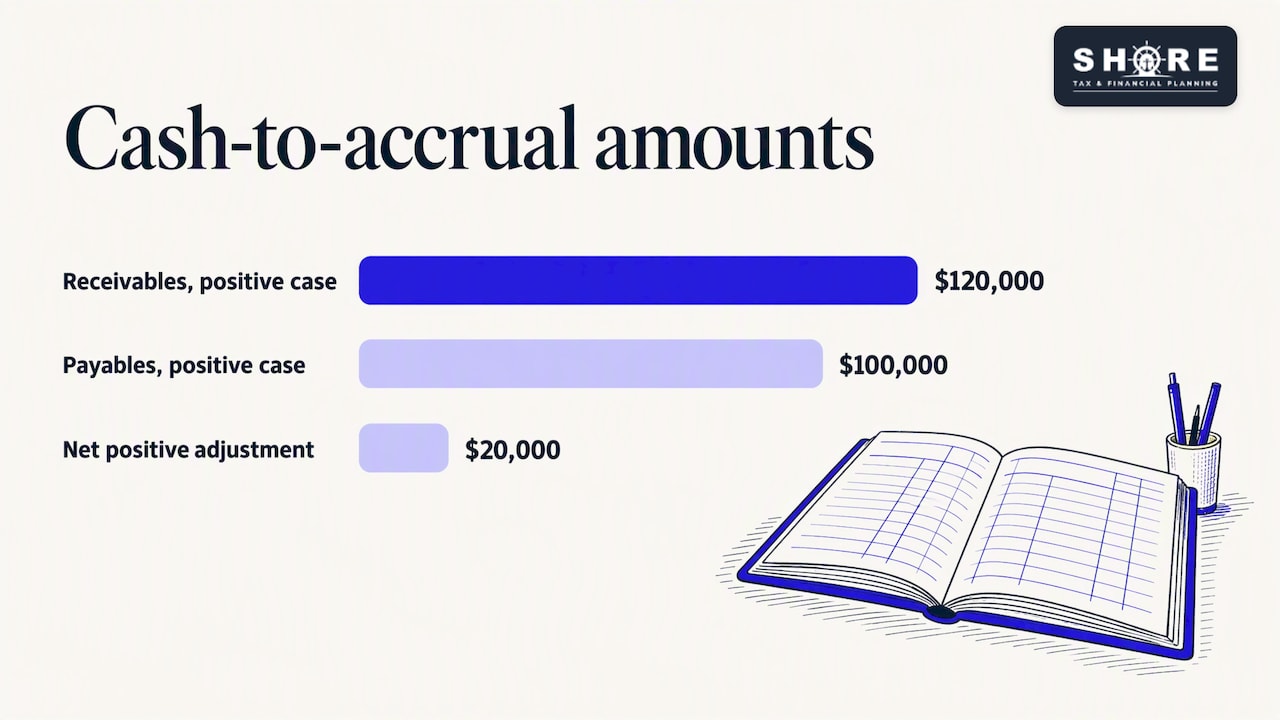
The IRS’s own illustration is simple: a business with $120,000 in receivables and $100,000 in payables has a $20,000 positive adjustment.
Here is how that plays out, step by step.
| Item on day one of the year of change | Amount |
|---|---|
| Accounts receivable (earned, not yet collected) | $120,000 |
| Accounts payable (incurred, not yet paid) | $100,000 |
| Net positive adjustment | $20,000 |
The receivables were never taxed under the cash method because the cash had not arrived. The payables were never deducted because the cash had not left. Moving to accrual, the $120,000 is income that belongs to earlier periods, and the $100,000 is a deduction that also belongs to earlier periods. The net effect is $20,000 of additional income that has to be picked up somewhere.
If this were a voluntary change with the standard four-year spread, the $20,000 would be recognized at $5,000 a year. That spread is our simple arithmetic applied to the IRS rule, not an IRS-published schedule. You would still pay tax on the full amount eventually, but not all in one year.
Now flip the numbers as an illustration. Suppose the same business had $90,000 in receivables and $110,000 in payables. The adjustment would be negative $20,000. A negative adjustment on a voluntary change is taken in the year of change, so it would reduce that year’s taxable income by the full $20,000.
Note that the opening balances drive everything. Reasonable owners are sometimes surprised that a growing, profitable company can have a large positive adjustment simply because a lot of revenue is sitting in receivables.
Timing is where the real planning value sits. The rules differ by who initiates the change.
For a voluntary change, positive adjustments are generally spread over four years, while negative adjustments are taken in the year of change. That asymmetry favors the taxpayer: you get the benefit of a negative adjustment immediately and you defer the pain of a positive one.
When a voluntary change is made while a return is under exam, the IRS guidance says a two-year spread period generally applies to positive adjustments, unless specific exceptions apply. A shorter spread means higher taxable income in each of those years.
If an examiner changes your method because it was impermissible, the adjustment is imposed rather than chosen. Involuntary adjustments are recognized entirely in the year of change. No spread, no choice of year.
The lesson is direct. If you are using a method that may not hold up, correcting it on your own initiative before an exam usually produces a gentler result than waiting for an examiner to do it. Our related piece on IRS red flags that can trigger a small business audit covers what tends to draw attention in the first place.
A 481(a) adjustment is not limited to cash-to-accrual. These are the changes we see most with business owners:
One exception is worth knowing. For changes involving the accrual of foreign income taxes, the Form 3115 instructions tell taxpayers not to compute a Section 481(a) adjustment and to apply modified cut-off rules under Regulations section 1.905-1(d)(5) instead. Not every method change follows the standard pattern, which is one reason to confirm the rules for your specific change before you file.
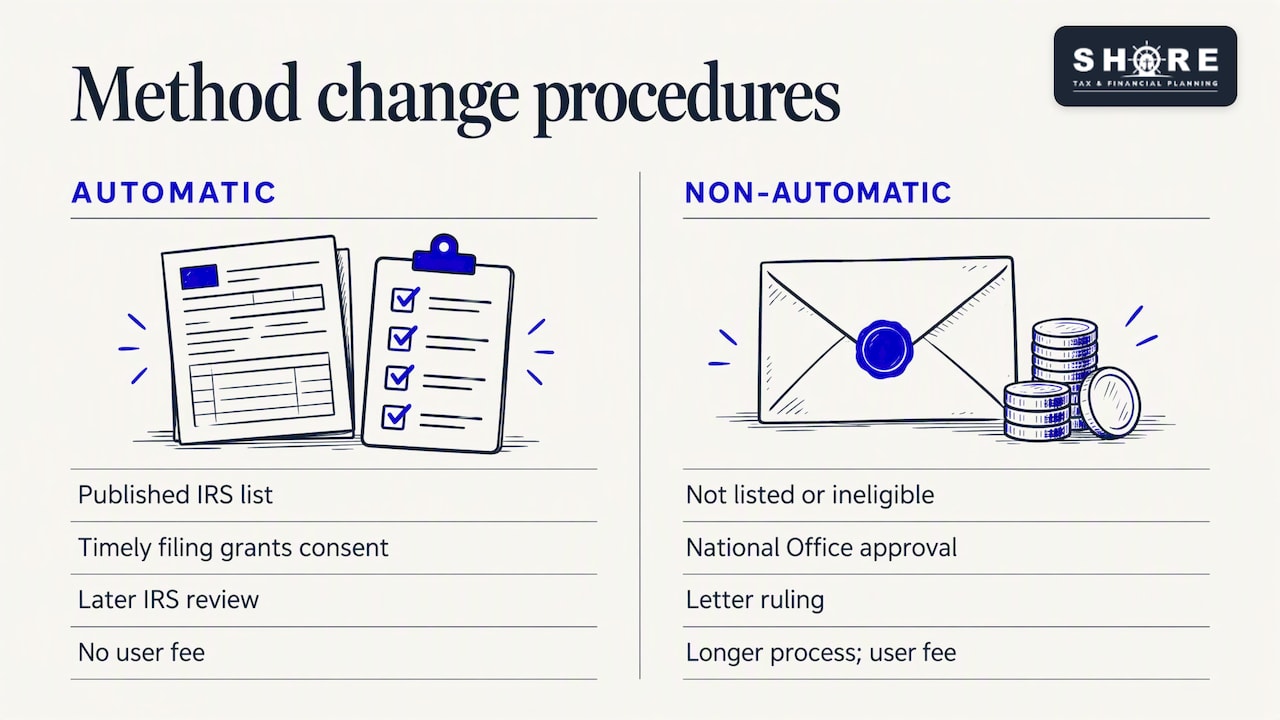
The IRS splits method changes into two procedural tracks.
Automatic changes are on a published list of method changes the IRS has pre-approved procedures for. If you timely file and follow the procedures, consent is granted subject to later review by the IRS National Office and the operating division director. No user fee is required for a Form 3115 filed under the automatic procedures.
Non-automatic changes apply when your change is not on the list, or when you do not meet the eligibility rules for the requested year. In that case the instructions note that the request is filed under the non-automatic procedures, and if the National Office approves, you receive a letter ruling. That path takes longer and involves a user fee.
The list of automatic changes is updated through IRS revenue procedures, and which changes are included, along with the eligibility rules, can shift from year to year. Before you assume a change is automatic, check the current IRS list or have your CPA confirm it for the specific year of change.
Form 3115 is how you ask for consent. The instructions say it must include the computed net Section 481(a) adjustment and the methodology used. For an automatic change, the process works like this:
Because the form is tied to your return, the practical deadline is the return due date, including extensions. Missing the duplicate-copy step can put the whole request at risk. Always check the current form instructions for where to send the copy, since filing details have been revised over time.
A method change is a tax planning decision before it is a compliance task. A few questions shape the best timing.
This is why the gap between tax prep and tax planning matters. A preparer who first sees your numbers after year-end can report the adjustment. A planner who sees them earlier can shape it.
We see method changes as one of the most underused levers in a business owner’s tax plan, and also one of the most mishandled. The mistakes are rarely exotic. A business grows past the point where its method still makes sense, nobody revisits it, and the cumulative difference quietly gets larger every year. Or a return preparer spots a problem at filing time, when the choices have already narrowed.
Our approach is to look at methods as part of year-round planning, not as a filing afterthought. Because we are fee-only and do not earn commissions on products, the only question we are paid to answer is what is right for your tax position. Our lead advisor is both a CPA and a CFP and has run a business, so we think about the cash side of a positive adjustment as seriously as the tax side. A four-year spread is only helpful if you have budgeted for it.
Our practical advice: do not file Form 3115 until you can answer three things. What is the adjustment, in dollars? Which years does it hit? And what does your tax picture look like in each of those years with and without the change? If the answers are not clear, the change is not ready.
— Joseph
If you are considering a change, or suspect your current method is not one the IRS would accept, the work is best done before the year of change begins. Our tax reduction planning engagement reviews your methods alongside entity structure, retirement plans and depreciation, and our business tax return preparation team handles the Form 3115 and the adjustment reporting. For ongoing support, see our year-round advisory for business owners.

If you want a second opinion on whether a method change makes sense for your business, you can reach us through Shore Tax & Financial Planning.
It is the catch-up amount you report when you switch accounting methods, so that no income or deduction is counted twice or missed. It is measured as the cumulative difference between the old and new methods on the first day of the year of change. It can be positive (more income) or negative (less income).
For a voluntary change, a positive adjustment is generally spread over four years. If the IRS changes the method in an exam, the whole amount is recognized in the year of change. A voluntary change made while under exam generally has a two-year spread, subject to exceptions.
Generally yes. Form 3115 is the form used to request consent for accounting method changes. Many changes qualify for the automatic procedures, which carry no user fee, but you need to confirm eligibility for your year of change.
It reduces taxable income in the year of change when voluntary, so it is usually favorable. It is not free, though: it means deductions were previously deferred, and the change still requires a properly prepared Form 3115 and clean supporting records.
Not freely. The recognition period is set by the rules for your type of change: four years for voluntary positive adjustments, the year of change for negative ones, and full recognition for IRS-imposed changes. What you can often choose is the year of change, and that is where planning pays off.