

A CPA is a state-licensed accountant. “Tax advisor” is a job description, and a CPA can be one. So the real question is whether the person advising you on taxes holds a license and a credential you can verify, and whether their work is planning or only filing. If you earn a high income or own a profitable business, the best fit is usually a CPA who also does tax planning all year, not once in March.
Below, we break down credentials, IRS representation rights, planning versus preparation, fees, and how to choose.
A tax advisor is a professional who helps you minimize taxes while staying compliant, usually in complicated financial situations. That is a function, not a license. The people who fill it include CPAs, tax attorneys, enrolled agents and some financial advisors.
That matters because nobody licenses the title “tax advisor” or “tax strategist” as such. The Wall Street Journal notes that “tax planning advisor” is not a regulated term, so anyone can use it. Common qualifications behind the label are CPA, EA, tax attorney, registered investment adviser and CFP.
So when you compare a “tax strategist” with a CPA, you are comparing a title with a license. A strategist may be a CPA. Or they may hold no credential at all. Before you hire, ask which license they hold and look it up.
One baseline applies to everyone who prepares returns for pay. They must have an IRS preparer tax identification number (PTIN), but the IRS notes that skills, education and expertise vary widely among PTIN holders. Investopedia adds that tax advisors and preparers are regulated but not licensed by the IRS, and that Treasury Department Circular 230 sets their duties and ethical standards.
A Certified Public Accountant holds a license issued by a state. According to the IRS, CPAs are licensed by state boards of accountancy. They have passed the Uniform CPA Examination, studied accounting and met their board’s experience and good-character requirements.
AARP summarizes the typical path: a bachelor’s degree in accounting or a related field, at least 150 college credits, a year of professional accounting experience, and a 16-hour exam. To keep the license, CPAs typically need at least 40 hours of continuing education every year.
Two caveats help you shop well:
This is where credentials stop being abstract. If the IRS questions your return, the person who prepared it may or may not be allowed to speak for you.
The IRS says CPAs, enrolled agents and attorneys have unlimited representation rights. That means they can represent any taxpayer on any tax matter before any IRS office. Preparers in the Annual Filing Season Program have limited representation rights. PTIN holders with no professional credential can only prepare returns.
Here is how the main credentials compare.
| Credential | Who licenses it | IRS representation | Typical focus |
|---|---|---|---|
| CPA | State board of accountancy | Unlimited | Accounting, tax, business advisory, audit |
| Enrolled agent (EA) | The IRS | Unlimited | Federal tax only |
| Tax attorney | State courts | Unlimited | Legal disputes, estate and transaction structuring |
| AFSP participant | IRS program (not a license) | Limited | Return preparation |
| PTIN holder, no credential | IRS registration | Preparation only | Return preparation |
Enrolled agents deserve a note. They must pass a three-part exam covering federal tax planning, individual and business return preparation, and representation, and they complete 72 hours of continuing education every three years. They are a strong choice for federal tax questions, though their scope is narrower than a CPA’s.
Tax attorneys fit a different need. BYU accounting professor Troy Lewis, quoted by AARP, says serious problems like large unpaid tax bills, IRS investigations or lawsuits may call for a tax attorney. He also suggests asking whether an audit of your return is covered by the fee.
Most of the confusion in this keyword family comes from two jobs sharing one name.
Tax preparation is looking backward. Someone takes last year’s numbers and files them accurately. The work happens in the weeks before a deadline, and the savings available are whatever last year’s decisions already allowed.
Tax planning is looking forward. The Wall Street Journal lists typical planning work as projecting estimated tax payments, updating withholding forms and calculating retirement plan contributions. For an owner it goes further: entity structure, retirement plan design, timing of equipment purchases, and how you pay yourself.
The difference in dollars is simple to see. A preparer can only report that you paid a certain amount. A planner can work with you in June to change it. Most strategies, such as an S-corp election, a retirement plan, or a cost segregation study on a building, need action before the tax year ends. Once December 31 passes, the preparer is working with whatever you did.
A CPA can do all of this. So can an EA or tax attorney in their areas. What matters is that the engagement includes planning meetings during the year and not only a return in the spring. Our own take on this split is in tax prep versus tax planning.
The third pairing people search is financial advisor versus tax advisor. The two overlap, but the core jobs differ.
A financial advisor focuses on goals, cash flow, investments, insurance and retirement. A tax advisor focuses on how those decisions are taxed and what you report. Financial advisors generally do not prepare returns unless they are separately credentialed to do so. Some professionals do both. A CFP who is also a CPA can build your investment plan and your tax plan together, so the two do not pull against each other.
How your advisor is paid matters as much as the title. A fee-only advisor is paid by you and not through commissions on products. That removes one conflict when the advice involves insurance, annuities or funds. Ask every advisor, tax or financial, how they are compensated.
Fees vary with complexity, so treat these as a floor and not a quote for a business or high-income return. According to an annual National Association of Tax Professionals study reported by the Wall Street Journal, the average fee for a basic Form 1040 is $124 for a preparer with no designation, $177 for an enrolled agent, $182 for a tax attorney, $188 for a CFP and $210 for a CPA.
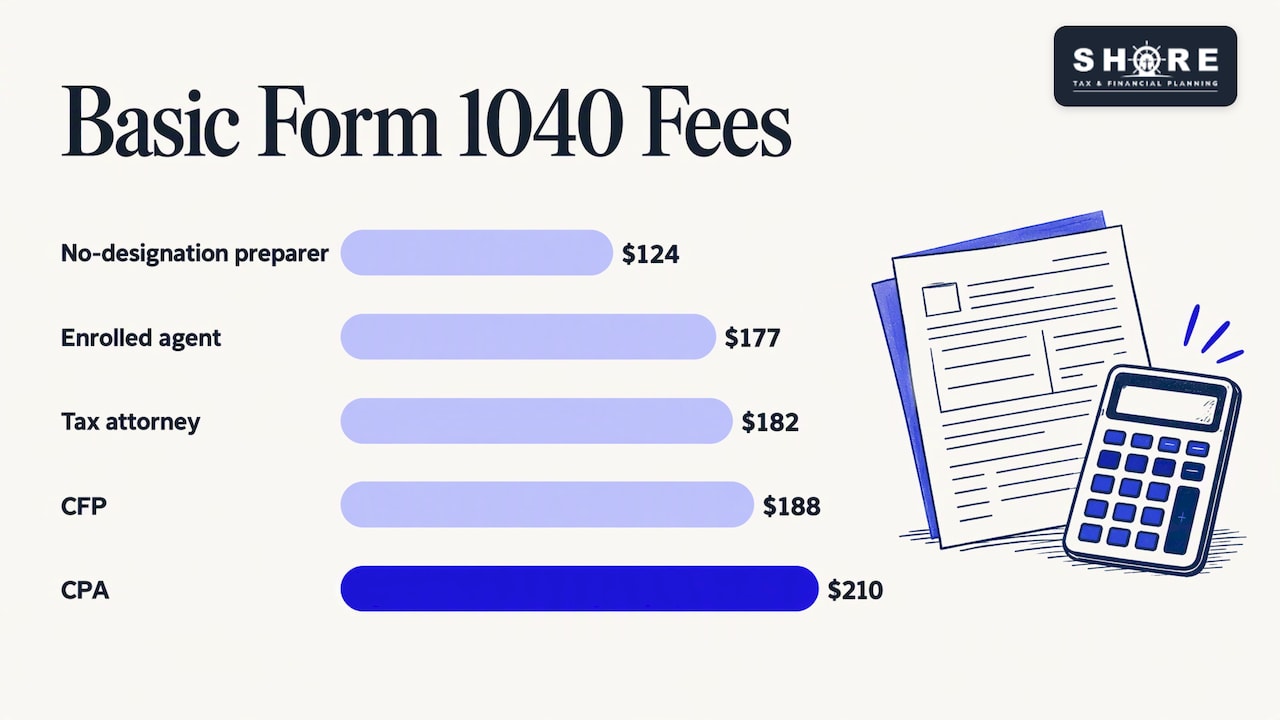
The same report found the most common structure, used by half of preparers, is a minimum fee plus a charge based on complexity. It averages $345 for a new client and $332 for a returning one. About 35% charge per form and schedule, and fewer than 15% bill hourly, averaging $179.
Those figures are for filing. Planning is priced differently, usually as a project fee or a recurring advisory engagement, because you are paying for decisions and not data entry. The useful comparison is fee against tax saved. A planner who finds a strategy worth several times their fee is cheaper than a low-cost preparer who finds nothing. We do not publish set fees, because scope depends on your entity, income and goals.
If you own a business, it also helps to run your own numbers before any meeting. Basic small business financial research and calculators can give you margins and cash flow figures to bring along.
Use these questions in a first call.
When the answers are vague, keep looking. We cover what to watch for in signs you need a new accountant.
Many situations call for a team. A CPA handles planning and returns. A tax attorney joins for an estate transfer, a business sale structure or an IRS dispute. An investment manager implements the portfolio. The best advisors know where their lane ends and bring the right person in.
We built our practice around one gap we kept seeing. Owners and high earners have a preparer who files accurately in the spring, and nobody who talks to them in the other eleven months. By then the savings are gone.
We are a CPA and CFP-led firm, and the lead advisor has run a business. That shapes how we work. We plan during the year, we explain each strategy in plain terms, and we design it to be defensible. Our clients’ audit rate is 0.01%, which is our own reported figure and a result of that approach.
We are fee-only. We earn no commissions and sell no products, so the only thing we have to offer is tax savings and clear advice. For us, “tax advisor versus CPA” is the wrong choice. You want both in one person: a licensed CPA who acts as your year-round tax strategist.
Joseph
We help business owners and high-income professionals reduce taxes legally through year-round planning, return preparation, and accounting support. Depending on your situation, that can include tax reduction planning, S-corp conversion, cost segregation, retirement plan setup, payroll and bookkeeping, and fiduciary investment management.

If you own a business, start with our year-round advisory and CFO services. If you earn a high W-2 income, see tax planning for high W-2 earners. You can also read about our lead CPA and CFP before you reach out.
Not necessarily. A tax advisor may be a CPA, an enrolled agent, a tax attorney or a financial advisor, and the title itself is unregulated. Some tax advisors are accountants, and some are not. Ask for the credential behind the title.
For complex returns, usually yes. CPAs are state-licensed, have unlimited IRS representation rights, and can plan as well as file. For a simple W-2 return, other credentialed preparers are also able to file it. If you own a business or have high income, a CPA with tax planning experience is the stronger fit.
It depends on scope. Basic Form 1040 preparation averages $210 for a CPA, according to the NATP data reported by the Wall Street Journal, but business and high-income returns cost more. Planning is usually a project fee or recurring retainer. Compare the fee against the tax it can save.
“Strategist” describes the work and a CPA is a license. A tax strategist can be a CPA, but the title requires no credential. Look for the license first, then confirm they do proactive planning for clients like you.