

Tax-efficient investing means keeping more of what your portfolio earns by controlling when, where and how its returns are taxed. For a high earner or a profitable business owner, the biggest gains come from coordinating three things: which account holds which investment, when you realize gains and losses, and how your investing fits your business and your income for the year. Done once a year in April, it captures a fraction of the benefit. Done all year, it compounds.
This guide walks through the moves that matter most at higher income levels, with the 2026 numbers that apply, and shows where an investment decision is really a tax decision.
You cannot control what the market returns. You can control how much of that return you hand over each year.
Tax drag is the difference between what a portfolio earns before taxes and what you keep after them. If a portfolio earns 10% before tax and 8% after, the drag is 2 percentage points. That sounds small. Over decades it is not, because the money you pay each year stops compounding. Research from AQR on hypothetical portfolios found that over 40 to 50 year horizons, tax-efficient investments could leave more than twice the after-tax value of tax-inefficient ones, even after the deferred tax is paid at the end.
Three levers do most of the work:
Most investing content stops at the first two. For a business owner or a high W-2 earner, the third often decides the result.
Two features of the tax code make this more valuable as income rises.
First, investment income can be taxed on top of your regular rate. The 3.8% net investment income tax (NIIT) applies to investment income such as interest, dividends and capital gains once your modified adjusted gross income (MAGI) passes a threshold that depends on your filing status. Lowering your AGI through retirement contributions and well-timed income can keep you below it, or reduce how much of your investment income it reaches.
Second, the type of income matters. Interest from a taxable bond fund is taxed as ordinary income. Long-term gains and qualified dividends are taxed at lower capital gains rates. When your ordinary rate is high, the gap between those two treatments is wide, so putting the right income in the right place pays more.
If you earn a high W-2 salary, we built a tax reduction planning approach for high W-2 earners around exactly this: investment decisions made alongside your paycheck, bonuses, equity compensation and deductions rather than separately from them.
Before you pick a single fund, decide which accounts you are funding. A common sequence for someone with access to everything:
High earners hit a wall at step 3. In 2025, the same IRS publication shows that Roth IRA contributions phase out at modified AGI of $150,000 to $165,000 for single filers and $236,000 to $246,000 for married couples filing jointly. Above those ranges you cannot contribute directly, which is why Roth conversions, and for some plans after-tax contributions, become part of the conversation. Check the IRS’s Publication 590-A for the figures that apply to the year you are filing.
If you own a business, your retirement account options are much larger than an IRA. A solo 401(k), SEP IRA or a defined benefit plan can shelter far more income, and the contribution comes off your taxable income now while the money grows tax-deferred. Our guide to retirement plans for business owners compares the common choices, and our small business retirement plans service covers setup.
Asset allocation decides how much you hold in stocks, bonds and other assets. Asset location decides which account holds each one. Two portfolios with identical allocations can produce different after-tax results purely because of where the pieces sit.
The logic is simple:
This lines up with how Vanguard describes asset location: taxable bonds and actively managed funds in IRAs or 401(k)s, stocks, index funds and tax-exempt bonds in taxable accounts, and rebalancing inside tax-advantaged accounts so you avoid taxable sales.
That last point is practical. If you must rebalance, doing it inside a 401(k) or IRA triggers no tax. Doing it in a brokerage account can create a capital gain. We go deeper on this in our asset location strategy guide.
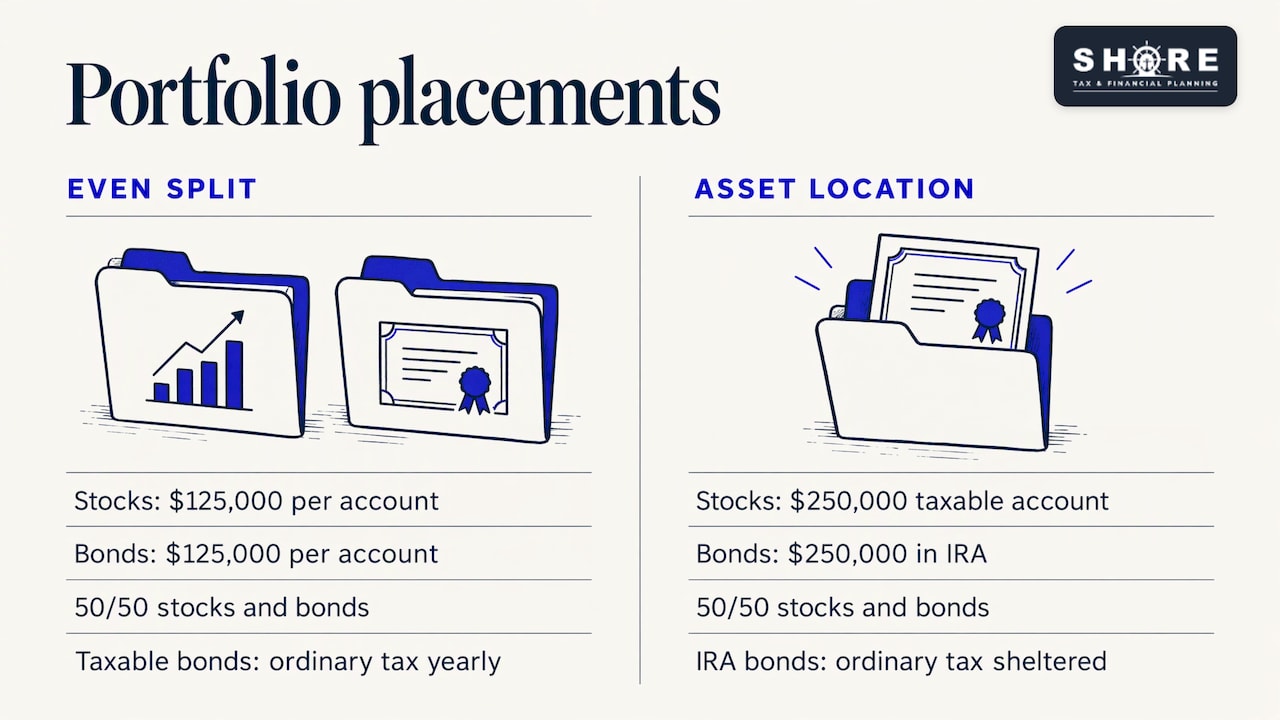
Say you hold $500,000 across a taxable account and a traditional IRA, split evenly between stock index funds and taxable bonds. You could put $125,000 of each in each account. Or you could put all $250,000 of bonds in the IRA and all $250,000 of stock index funds in the taxable account. Same 50/50 allocation, but the second setup stops the bond interest from being taxed at your ordinary rate every year. This is an illustration of the method, not a forecast. Your actual results depend on your rates, your funds and your state.
Inside a taxable account, the vehicle matters.
The goal is not to avoid gains. It is to let them compound, choose when you realize them and pay at the lowest rate you can.
Tax-loss harvesting means selling an investment at a loss in a taxable account so the loss offsets taxable gains elsewhere. Losses first offset gains. If losses exceed gains, the IRS lets you deduct the lesser of $3,000 or your net loss against other income each year ($1,500 if married filing separately), and the remainder carries forward to future years.
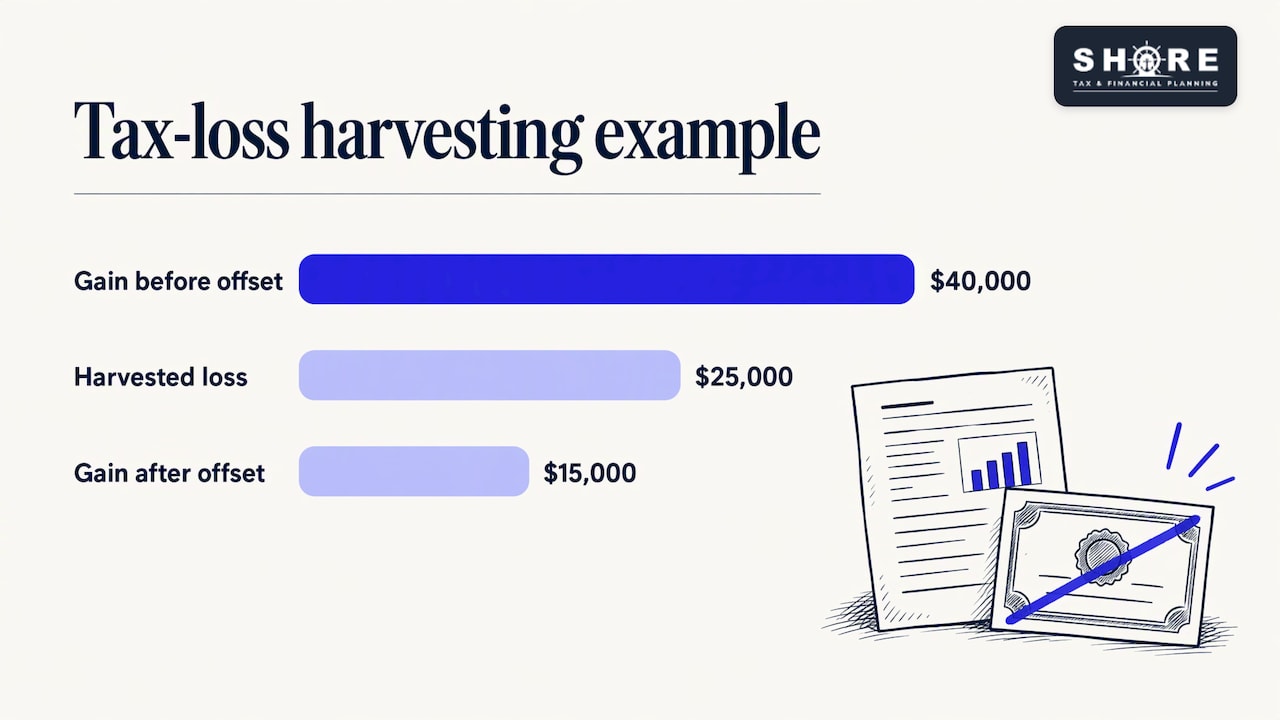
A quick illustration: you sold a business interest or a block of stock earlier this year for a $40,000 gain. A different position is down $25,000. Selling it and reinvesting in a similar, but not substantially identical, holding reduces your taxable gain to $15,000, and your portfolio stays invested.
Two cautions that keep harvesting from backfiring:
Harvesting works best as a year-round habit, not a December scramble. Markets drop in March as often as in December. Our look at year-end stock portfolio tax strategies covers the late-year checklist.
This is where high earners and owners separate from typical investors. Your investment tax bill is partly a function of your total income, so lowering that income helps your portfolio.
The pattern is the same each time: a decision that looks like an investing question is really an income question, and the two have to be solved together. That is the core difference between tax planning and tax prep. A return preparer records what happened. A planner changes what happens.
A Roth conversion moves money from a traditional IRA or 401(k) into a Roth and you pay income tax on the amount converted. The conversion makes sense when you expect to pay the same or a higher rate later, or when you have a year where your income is unusually low.
For business owners, those years show up: a startup year, a down year, a year between jobs or after a sale and before Social Security and required distributions begin. Converting a measured amount each year to fill a lower bracket, rather than one large sum, is the usual approach. A conversion also raises your AGI for that year, so check how it interacts with the NIIT and other thresholds before you do it.
Tax-efficient retirement income is the mirror image of everything above. You spend down accounts that are taxed differently, and the order changes how long the money lasts.
A common starting framework:
This is a starting point, not a rule. A better answer blends accounts each year to hold your bracket steady, and takes into account required minimum distributions, Social Security, Medicare premium thresholds, your state and charitable plans. Running a multi-year projection is the way to find the right mix for you.
Tax-efficient investing is a calendar, not a task.
| When | What to review |
|---|---|
| Q1 | Fund retirement plans, review last year’s distributions, set the year’s contribution targets |
| Q2 | Check asset location, estimate income, evaluate entity structure |
| Q3 | Review harvesting opportunities, plan Roth conversion size, project your year-end income |
| Q4 | Finalize retirement plan funding, charitable giving, gain and loss matching, last-minute moves |
If you own a business, our year-end retirement tax strategies for business owners shows how the Q4 moves fit together.
Most investors we meet were told to buy good funds and wait. That advice leaves out half the picture. For a high earner or an owner, the tax bill is often the largest cost of investing, and it is the one cost you can plan around.
We are fee-only. We do not earn commissions on products, so the only thing we are paid to do is reduce your taxes and give you sound advice. Our lead advisor is both a CPA and a CFP and has run a business, which means investing decisions get checked against your tax return, your entity and your cash needs at the same time.
We work year-round, not just in tax season, because the best moves, such as retirement plan design, S-corp elections, loss harvesting and Roth conversions, have to happen before the year ends. Our audit rate is 0.01%, which reflects how carefully we document and structure what we recommend.
Joseph
Investing advice and tax advice fall apart when they come from different people who never talk. At Shore Tax & Financial Planning, we offer year-round tax advisory, tax return preparation, fiduciary investment management, accredited investor strategy implementation and retirement plan setup, all for high-income professionals and profitable business owners.

If you want your portfolio, your retirement plan and your tax return working from the same plan, see how we help high W-2 earners or business owners, or start with tax reduction planning.
There is no single answer, because it depends on your bracket, your accounts and your state. Municipal bonds, broad index funds and assets held in a Roth are common tax-efficient choices. The real gain comes from matching each investment to the account that taxes it least.
It is the practice of deciding which account holds which investment. Income-heavy assets like taxable bonds usually go in tax-deferred accounts, and low-distribution holdings like index funds go in taxable accounts. It is separate from asset allocation, which is your mix of stocks and bonds.
Losses offset capital gains first, then up to $3,000 of other income per year, with the rest carried forward, according to the IRS. Your savings equal the losses used multiplied by your tax rate. Avoid wash sales by waiting more than 30 days to repurchase the same security.
Yes. Owners can use solo 401(k)s, SEP IRAs and defined benefit plans, structure pay through an S corporation and time income and deductions. Those choices change the income your investments are taxed against, so they should be planned together.