

Year-round tax planning means making tax decisions while they can still change your result: when you set your pay, time a purchase, fund a retirement plan or choose an entity. It does not mean filing earlier. If you meet your tax professional for the first time in March, the year is already closed and the only thing left to do is report it. For profitable business owners and high W-2 earners, that gap is where the money goes.
This guide walks through what to do each quarter, which decisions need modeling before year-end, and how to tell whether the advice you get is built to save you tax or to sell you a product.
The tax code rewards action taken at specific times. You can only change your payroll structure going forward. You can only fund most retirement plans within set windows. You can only place equipment in service when you buy it. A preparer who sees your numbers after year-end can find missed deductions, but cannot create the choices you did not make.
The IRS makes the same basic point in its year-round tax planning tips: organize records during the year so the next filing season is less stressful. That advice is a floor. For an owner with a profitable business, the larger value sits in structure and timing.
There is also a coordination problem. Experts at U.S. Bank point out that a Roth conversion or a large equipment purchase affects more than that year’s tax liability, and can influence Medicare premiums, credit eligibility and future bracket positioning. A single move that looks smart alone can cost you elsewhere. Planning across the year, and across your business and personal returns, is how you catch that.
You do not need a different strategy every month. You need a rhythm: a few checkpoints that repeat, each with a clear purpose.
The first quarter is for locking in the year’s structure while the whole year is ahead of you.
We lay out our own first-quarter checklist in 7 Q1 Tax Moves to Lower Your 2026 Business Taxes.
After filing, you finally have a clean picture of last year. Use it.
This is when you decide what the business will buy, hire or build before year-end.
Practitioners advise reassessing these decisions in the fall so there is time to model the impact before year-end. October is not too early. December is often too late for anything that needs paperwork, a purchase, a contribution or a custodian.
At this stage, test these levers against your projected taxable income:
Our year-end articles on last-minute deductions for business owners and medical plan strategies go deeper on specific moves. They were written for 2025, so check current-year limits before acting.
Most owners treat estimated payments as bookkeeping. They are better understood as cash-flow management, and a planning conversation should include them.
The IRS says individuals, including sole proprietors, partners and S-corporation shareholders, generally should make estimated payments if they expect to owe at least $1,000 after withholding and credits. For the 2026 tax year, the four payment periods and due dates are:
| Income earned | Payment due |
|---|---|
| Jan 1 to Mar 31 | April 15, 2026 |
| Apr 1 to May 31 | June 15, 2026 |
| Jun 1 to Aug 31 | September 15, 2026 |
| Sep 1 to Dec 31 | January 15, 2027 |
The periods are uneven, which surprises many owners. The second payment covers only two months.
To avoid the underpayment penalty, your withholding and timely estimated payments generally need to reach the smaller of 90% of this year’s tax or 100% of last year’s. If your prior-year adjusted gross income was above $150,000, the prior-year figure becomes 110%. Many high earners fall into that 110% group.
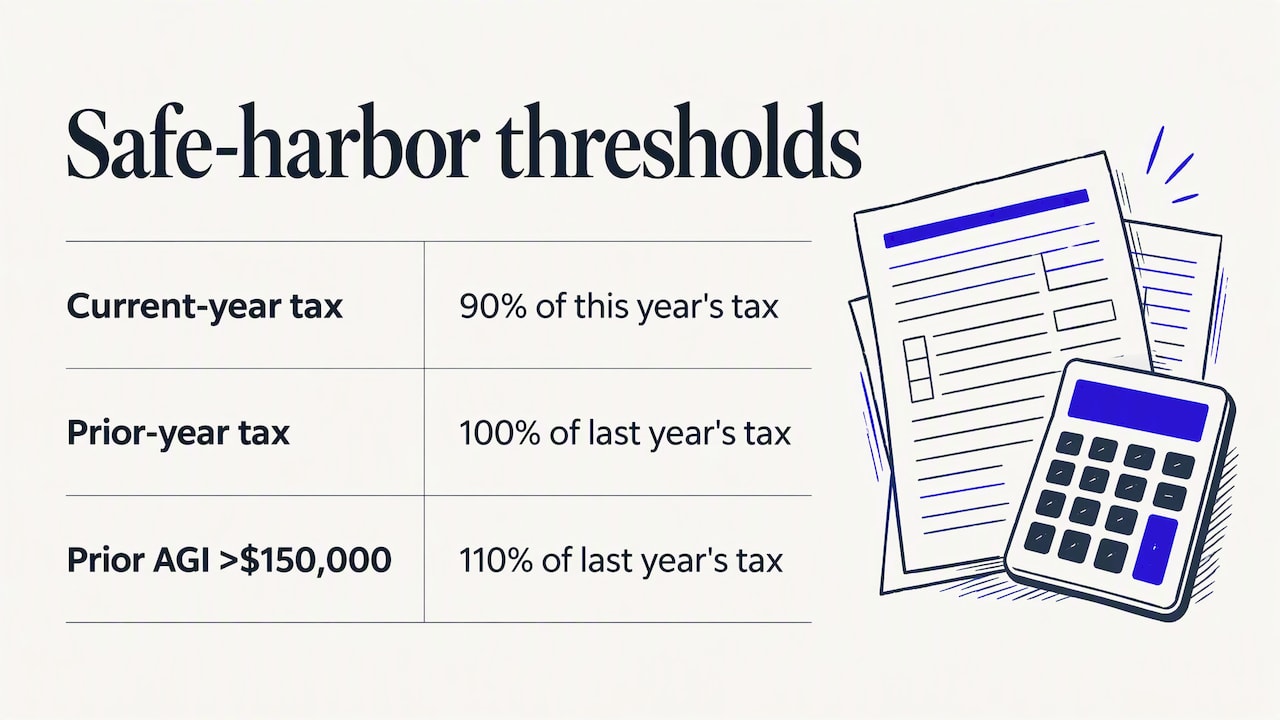
Why this matters for planning: if your income is volatile, paying against last year’s liability gives you a known target even when this year’s profit is hard to forecast. You still owe the full tax at filing. The safe harbor only protects you from the penalty, so you will want cash set aside for any balance.
A habit that works: move a fixed percentage of every deposit into a separate tax account the day money arrives. The IRS Taxpayer Advocate Service also has a guide to making estimated payments if you want the mechanics. For New Jersey owners, see our post on quarterly estimated tax payments for New Jersey business owners.
An S-corporation election gets a lot of attention because it can reduce self-employment tax on profit taken as distributions. It also brings real obligations. IRS training materials on choosing an entity list payroll, filing requirements and administrative discipline among the factors to weigh. Once you elect S-corp status, you must run payroll for yourself and pay yourself reasonable compensation.
So the right question is not whether an S-corp saves tax in theory. It is whether it saves enough after payroll costs, extra filings and the effect on other deductions to be worth running. That depends on your profit, your state and how you plan to fund retirement.
That last piece matters because the pieces interact. The same IRS material notes that entity choice and retirement strategy should be coordinated, since different plan contributions can affect the qualified business income deduction in different ways.
The qualified business income deduction is generally 20% of qualified business income, though it can be limited by taxable income, wages paid and property held. Under IRS Publication 505 for 2026, the deduction is now permanent, and taxpayers with at least $1,000 of qualified business income from an active business may qualify for a minimum deduction of $400. High earners will usually care more about the limits than the minimum, which is another reason to model before you act.
If you are weighing the election, our page on S-corp tax savings and conversion explains how we approach it.
Some planning moves are simple and still missed. For 2026, IRS guidance sets the HSA contribution limit at $4,400 for self-only coverage and $8,750 for family coverage. The same guidance sets the minimum deductible for a qualifying high deductible health plan at $1,700 for self-only or $3,400 for family coverage. Our post on health insurance tax deductions for small business owners covers HSAs, HRAs and related options for owners.
The same IRS document puts the 2026 standard deduction at $16,100 for single filers, $32,200 for married filing jointly and $24,150 for head of household. Most high earners with a profitable business will itemize or use business deductions, but the figures are the benchmark against which itemizing is tested, and they matter when you decide whether bunching charitable gifts makes sense.
For retirement, a small business plan can do two jobs at once: build your own savings and lower current taxable income. We explain the options on our small business retirement plans page.

High earners sometimes worry that proactive planning invites an audit. In our experience the opposite is closer to the truth, when the planning is documented. The IRS Taxpayer Advocate Service’s small business tax tips stress keeping records throughout the year rather than reconstructing them in April.
In practice, defensibility rests on a few habits:
That is also why our clients’ audit rate is low: we report a 0.01% audit rate across our client work, which we attribute to strategies that apply the tax law as written and are supported by records.
We see the same pattern with new clients. They come in after a large tax bill, ask what they could have done, and the honest answer is that most of the options expired months ago. The bill was not a surprise to the tax code. It was only a surprise to them.
That is why we do not treat tax work as a seasonal service. Our lead advisor holds both CPA and CFP credentials and has run a business, so the advice comes from someone who has made payroll and managed cash flow, not only prepared returns. We stay in contact through the year, because a mid-year change in revenue, a hire or a property purchase can change what the right move is.
We are also fee-only. We earn no commissions on products, so when we recommend a retirement plan, an entity change or a cost segregation study, the only thing riding on it is whether it saves you tax. That matters most for the larger decisions, where the product that pays an advisor best is not always the one that serves you best.
One practical point: do not wait for the perfect strategy. A reviewed projection in October, with clean books behind it, usually beats an elaborate plan started in December.
— Joseph
We work with profitable business owners, high W-2 earners and accredited investors. Our work typically combines tax reduction planning, business and personal return preparation, bookkeeping and payroll so the numbers behind the plan are reliable. Owners who want ongoing support can look at our year-round advisory and CFO services, and high-income employees can see how we help on our high W-2 earners page. If you are weighing a conversion, we cover it on our S-corp conversion page. We do not publish fees on the site, so the first step is a conversation about your situation.
If you do one thing before year-end, do this:
For more ideas on where owners leave money behind, read our list of overlooked small business deductions and our 2026 tax planning guide for small business owners.
No. Preparation reports what already happened, using the numbers you have at year-end. Planning uses projections during the year to change what happens, such as timing purchases, setting payroll and funding retirement plans.
Quarterly is a good rhythm for most owners, lined up with estimated payment dates. Add a deeper review in the fall, since that is when you can still model and carry out year-end moves. Review sooner after a big change in income, a major purchase or a new hire.
In general, you avoid the underpayment penalty by paying the smaller of 90% of this year’s tax or 100% of last year’s. If last year’s AGI was above $150,000, the prior-year figure rises to 110%. You still owe any remaining balance when you file.
No. Many planning moves apply whatever your structure, including retirement plans, HSAs, accountable plans and equipment timing. An S-corp can help some profitable owners, but it adds payroll and filing duties, so it should be tested against your numbers first.
It does not have to. Planning that follows the rules and is backed by records is easier to defend than a rushed return. Keep monthly books, written reasoning for large decisions and receipts for deductions.