

For 2026, bonus depreciation is 100% for qualified property you acquire after January 19, 2025 and place in service during the tax year. The One Big Beautiful Bill Act (OBBBA) made that rate permanent, so you can deduct the full cost of eligible equipment, vehicles, and other qualifying assets in year one instead of spreading it over many years. Section 179 is a second, separate tool with its own dollar caps. Most profitable owners get the best result by deciding how the two work together before the year ends, not while filing.
Before 2025, bonus depreciation was shrinking. Under the Tax Cuts and Jobs Act it started at 100% and then fell by 20 percentage points a year after 2022, which put it on a path to 0% in 2027. The OBBBA stopped that decline.
According to the IRS and Treasury guidance, the law provides permanent 100% additional first-year depreciation for qualified property acquired after January 19, 2025. The same guidance lets a taxpayer elect a lower rate for the first tax year that ends after that date: 40%, or 60% for certain longer-production-period property and aircraft.
Two points follow for a 2026 return:
If you want the full picture of what else the OBBBA changed for owners, we cover it in our small business OBBBA breakdown.
Bonus depreciation applies to qualified property, which in practice means assets with a recovery period of 20 years or less under MACRS. The categories business owners run into most often:
The IRS guidance also covers narrower categories, such as sound recording productions. Those qualify if production starts in a tax year ending after July 4, 2025, with acquisition treated as the start of principal recording and service as the first release or broadcast.
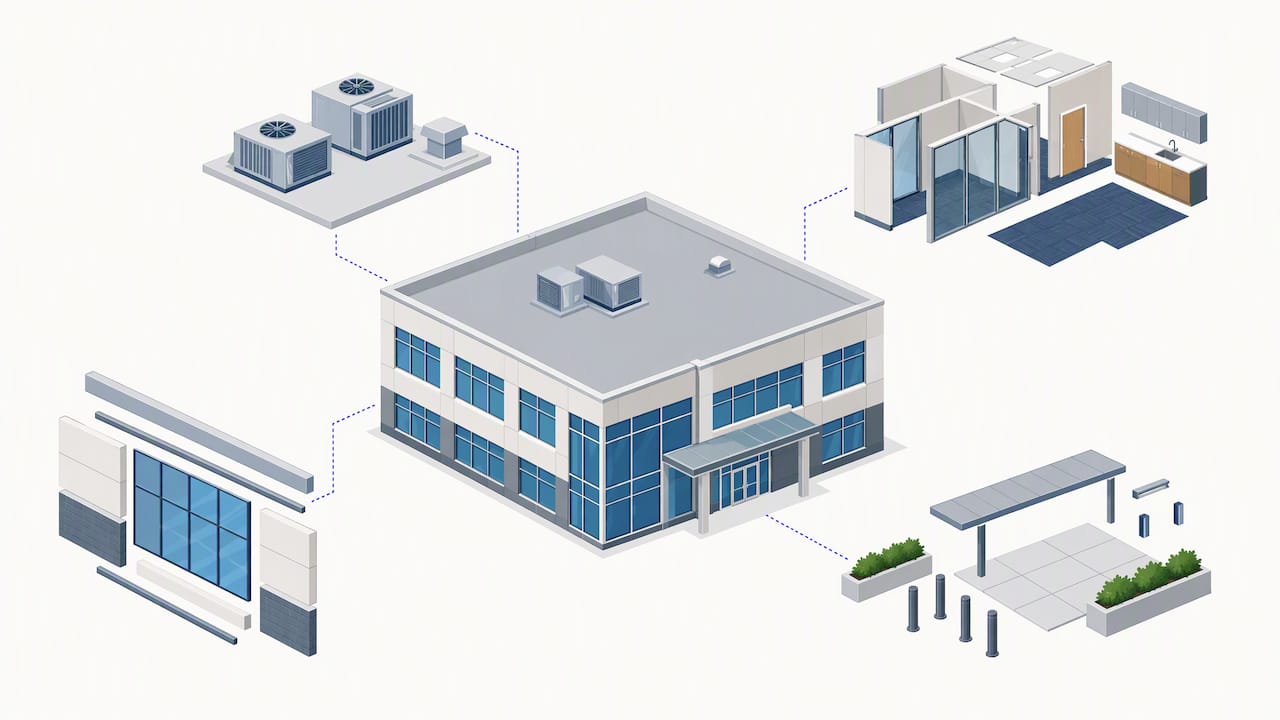
Buildings themselves do not qualify, because residential and nonresidential buildings depreciate over 27.5 and 39 years. That is why cost segregation matters for real estate owners: it carves shorter-lived components out of the building so they can be expensed. Our cost segregation service does exactly that for owners of commercial property and for businesses that buy their own buildings.
Used property can qualify, as long as you did not use it before and you did not acquire it from a related party. Buying a used truck or a used machine from an unrelated seller can therefore qualify for the full 100%.
Bonus depreciation is claimed for property placed in service during the tax year. Form 4562 is where you claim both bonus depreciation and Section 179. “Placed in service” means the asset is ready and available for its intended use in your business. A machine sitting in a crate on December 31 usually does not count. A delivered, installed, working one does.
This is the most common year-end mistake we see. An order placed in December that does not arrive until January belongs to next year’s return.
Section 179 lets you expense qualifying property up to a dollar cap. IRS Publication 946 lists the figures for tax years beginning in 2026:
| 2026 Section 179 item | Amount |
|---|---|
| Maximum deduction | $2,560,000 |
| Phase-out begins when qualifying purchases exceed | $4,090,000 |
Once your total qualifying purchases pass the phase-out threshold, the deduction drops dollar for dollar. Most small and mid-size businesses never come close to it.
Section 179 also has an income limit. According to the Form 4562 instructions, the deduction is limited to taxable income from the active conduct of your trade or business, and any amount you cannot use this year can be carried forward.
The same instructions say Section 179 property covers more than equipment. It includes tangible personal property, certain off-the-shelf computer software, and qualified real property improvements such as roofs, HVAC, and fire and security systems placed in service in a trade or business.
The two are often described as rivals. They are better understood as layers. The Form 4562 instructions put the special depreciation allowance (bonus) after any Section 179 deduction and before regular MACRS depreciation. You take Section 179 first, bonus second, and ordinary depreciation on whatever is left.
| Feature | Section 179 | Bonus depreciation |
|---|---|---|
| Election | You choose which assets and how much | Applies automatically unless you elect out by class |
| 2026 dollar cap | $2,560,000, phasing out above $4,090,000 of purchases | No dollar cap |
| Income limit | Limited to active business taxable income, with carryforward | Not tied to the Section 179 income limit |
| Selective by asset | Yes, you pick the assets | Applies to the whole asset class |
| Real property improvements | Roofs, HVAC, fire and security systems, if qualified | Qualified improvement property and shorter-lived components |
| Where claimed | Form 4562 | Form 4562 |
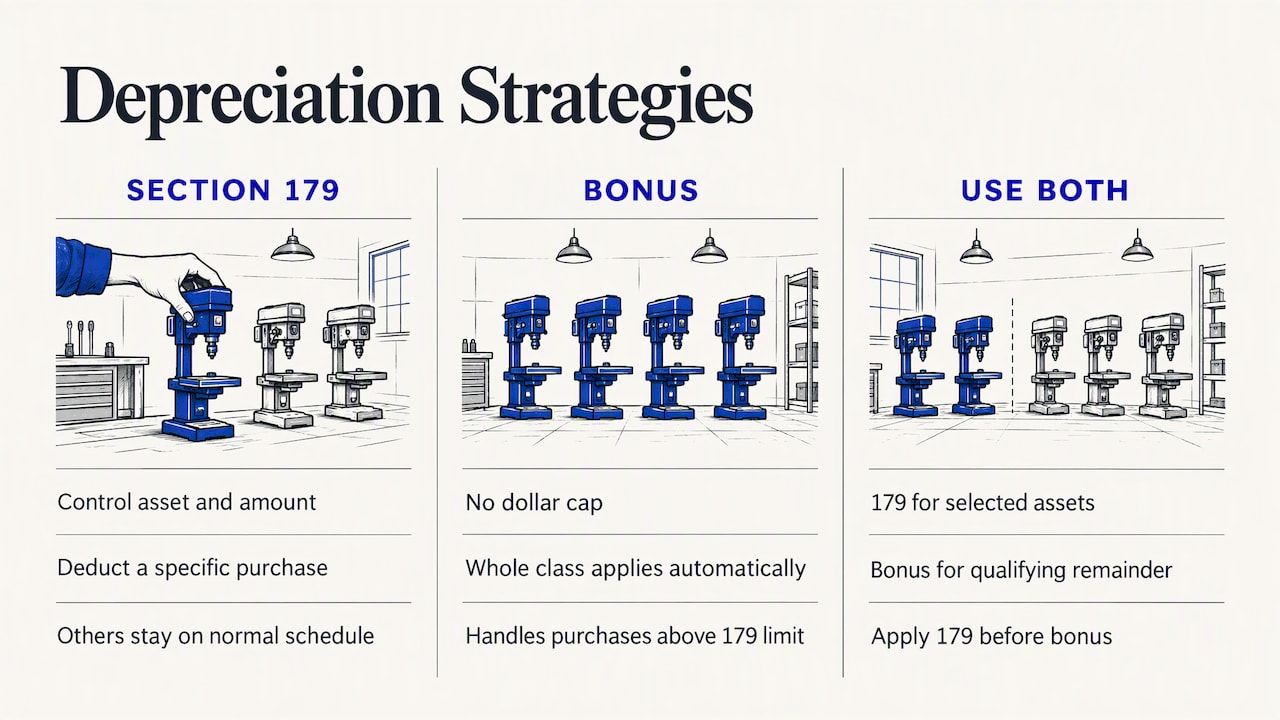
Use Section 179 when you want precision. Because you choose the asset and the amount, it fits when you want to deduct a specific purchase and leave other assets on a normal schedule. That can matter when you expect higher income in later years and want depreciation deductions then.
Use bonus depreciation when scale or income is the issue. There is no dollar cap, so it handles purchases that exceed the Section 179 limit. It also applies to a whole class of property automatically, which keeps the return simple.
Use both when the numbers call for it. A common sequence is to apply Section 179 to the assets you most want to control, then let bonus depreciation absorb the rest of the qualifying purchases.
Say an owner of a profitable remodeling company buys $300,000 of qualifying equipment and places it in service in 2026. The equipment is acquired after January 19, 2025, so it is eligible for 100% bonus depreciation. Taken alone, that gives a $300,000 deduction in 2026.
Now suppose the owner expects an unusually strong 2027 and would prefer to spread part of the deduction. With the right election, the owner could elect out of bonus for that class of property and depreciate it under regular MACRS, or use Section 179 for only the pieces they want to expense now. The best answer depends on this year’s income, next year’s expected income, the owner’s bracket, and the state. This is a modeling question, which is why we run the numbers before any purchase is made.
The figures here are illustrative. They are not a promise of any tax result.
Yes. Bonus depreciation is the default, but you can elect out for a class of property placed in service during the year. The 40% and 60% transition elections described in the IRS guidance are a separate option, available for the first tax year ending after January 19, 2025.
Why would anyone give up a full deduction? Three reasons come up in practice:
Eliminating a deduction is a decision to make with your CPA before filing, not after.
Bonus depreciation is a federal rule, and each state decides whether to follow it. According to Multistate, conformity depends on whether a state ties itself to the Internal Revenue Code on a static or a rolling basis, so the effect of federal changes differs by state.
Two examples from the Tax Foundation:
If you file in more than one state, or you are in a state that decouples, a federal deduction may be partly added back on your state return. You then carry separate depreciation schedules for federal and state, and the state tax cost can change the answer on whether to take bonus at all. Check your own state’s current rule before you buy.
The question we hear most often is about trucks and vans. Vehicle deductions come with weight, use, and documentation rules that differ from those for ordinary equipment, so do not assume the 100% rate covers a vehicle until you have confirmed what qualifies. Our guides on vehicle deductions after the OBBBA and on converting a personal vehicle into a business asset walk through the details.
Contractors have a related question about equipment and building systems. Our article on Section 179 and bonus depreciation for HVAC contractors shows how this works in a trade where trucks, tools, and shop equipment all hit the same return.
We think 100% bonus depreciation is one of the most useful tools available to a profitable owner, and one of the most misused.
The misuse comes from treating it as a reason to buy. A deduction is not free money. If you spend $100,000 on equipment you did not need, you do not come out ahead because part of it is deductible. The right order is business need first, then cash flow, then tax treatment.
The second mistake is taking the deduction automatically without modeling it. Two owners with the same purchase can have opposite right answers. One has a big income year and benefits from taking everything now. The other is in a lean year or about to grow and gains from smoothing the deductions. Add a state that does not conform, and the answer shifts again.
Third, year-end is too late for most of the real decisions. By December the options narrow: you can still make sure an asset is placed in service, but you cannot change how the entity is structured or reconsider how the year’s income was built. This is why we work with clients year-round and not only at filing time. As a fee-only firm that earns no commissions on products, we have no reason to push a purchase or a financial product, and our advice is aimed at the tax outcome and the business reasons behind it.
For owners working through this, our lead advisor holds both CPA and CFP credentials and has run a business, so the advice covers both the tax return and the cash behind the decision.
— Joseph
Work through these steps before you commit to a purchase:
If you own a profitable business and a large equipment, vehicle, or property purchase is coming, we build the depreciation plan alongside your overall tax strategy. We model the Section 179 and bonus combination, check state conformity, and look at how the choice interacts with your entity structure. Learn more about our tax reduction planning, or see how our year-round advisory for business owners works. If you are also deciding how your business is taxed, our 2026 tax planning guide shows how these decisions fit together.
Yes. The OBBBA provides permanent 100% bonus depreciation for qualified property acquired after January 19, 2025. The property also has to be placed in service in the tax year you claim it. You can elect out for a class of property if full expensing does not suit your situation.
For tax years beginning in 2026, Publication 946 sets the maximum Section 179 deduction at $2,560,000. It starts to phase out dollar for dollar when your qualifying purchases exceed $4,090,000. The deduction is also limited to your business taxable income.
Yes. The Form 4562 instructions place bonus depreciation after any Section 179 deduction and before regular MACRS depreciation. You take Section 179 first, then bonus on the remaining basis, then regular depreciation on whatever is left.
No. States choose whether to conform to the federal rule. North Carolina, for example, allows only 15 percent. Check your state’s current treatment before you assume the federal deduction carries over.
You claim it on Form 4562 along with any Section 179 deduction, for property placed in service during the tax year. Your business tax return then carries the result.