

A partial asset disposition (PAD) is an election that lets you deduct the remaining tax basis of a part of a building when you remove and replace it. Without it, you keep depreciating a roof, HVAC system or elevator that is already in a dumpster, and you also start depreciating the new one. With it, you recognize the old component’s loss on your return for the year of the replacement. This guide covers who qualifies, how the election is made, how to calculate the loss, what records to keep and where owners go wrong.
The IRS describes a PAD as a way to recognize the remaining adjusted basis of a disposed portion of MACRS property, such as a roof or another structural component, when that component is replaced. The result is usually a current-year loss rather than years of depreciation on an asset that is gone.
The default rule works against you here. For a building, the building is generally the unit of property. If you replace the roof and do nothing else, the old roof’s basis stays in the building’s depreciation schedule and keeps running, while the new roof is added as a second depreciable asset. That is the double depreciation problem. The PAD election removes the first half of it.
The election applies to tax years beginning on or after January 1, 2014, and the IRS states that any taxpayer with a depreciable interest in the building or structural component may make it. That includes landlords, owner-occupants who run an operating business out of their building, and partnerships or S corporations that hold the property.
The rules sit in Treas. Reg. 1.168(i)-8-8) and cover MACRS property. The IRS notes that pre-MACRS property generally cannot use these rules to recognize a partial-disposition loss, so a building placed in service before 1987 is a poor candidate.
Common building components that get replaced:
Whether a given item is a structural component of the building or separate personal property or land improvement is a classification question. That is where cost segregation comes in, covered below.
The election is generally made on your timely filed original federal return, including extensions, for the year the portion is disposed of. No special form or election statement is attached for the ordinary annual election. You report the resulting gain or loss on the return.
Three features matter in practice:
Because the election lives on the return, the deadline is practical: your preparer needs the replacement details before the return is filed, extensions included.
A replacement creates two separate tax questions, and mixing them up is the most common error.
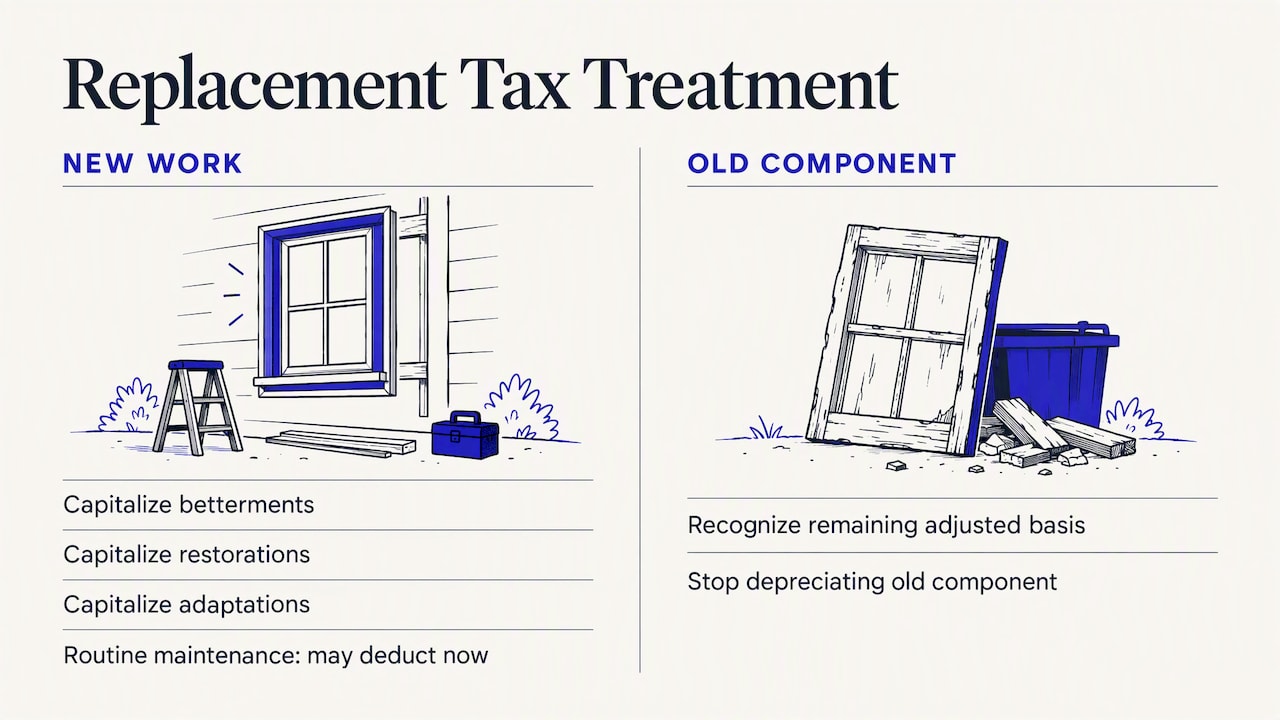
Question one: what happens to the new work? That depends on the repair regulations. Costs that are a betterment, a restoration or an adaptation to a new use are capitalized and depreciated. Costs for routine maintenance or true repairs may be currently deductible. As The Tax Adviser explains, PAD is not a substitute for that analysis. It addresses the old asset, after you have classified the project.
Question two: what happens to the old component? This is what the PAD answers. You recognize its remaining adjusted basis and stop depreciating it.
Treasury’s framework aims to prevent depreciating a discarded component and its replacement at the same time. Treating an entire project as either a repair or a write-off can create double deductions, or leave the old component’s basis stranded.
The numbers below are illustrative, not from a real client.
You own a small office building placed in service after 1986. Years ago the building cost was allocated, and the original roof is reasonably identified at $90,000 of unadjusted basis. Over the years you have claimed $38,000 of depreciation on it. This year you tear off the roof and install a new one for $140,000.
| Step | Treatment | Amount |
|---|---|---|
| Old roof, unadjusted basis | Identified from records or an allocation method | $90,000 |
| Less depreciation taken to date | From the depreciation schedule | $38,000 |
| Adjusted basis at disposal | Loss recognized with the PAD election | $52,000 |
| New roof | Capitalized as a separate improvement, if it is a betterment or restoration | $140,000 |
With the election, the $52,000 is reported as a loss on the return for the year of the tear-off, and the new $140,000 begins its own depreciation. Without it, the $52,000 keeps depreciating over the building’s remaining recovery period, and the new roof adds a second stream on top.
The actual tax savings depend on your bracket, how the loss is characterized on your return and whether passive loss or at-risk limits apply. Run the numbers with your CPA before the return is filed.
Most owners do not have a line item that says “original roof, $90,000.” The original purchase price covered the whole building. When records do not separately identify the disposed component, Treasury allows a reasonable, consistently applied method. Examples include:
Whichever method you choose, apply it consistently to comparable portions of the same asset or assets in the relevant account.
A study improves defensibility, but it does not automatically prove that every replacement is a deductible repair or that every component carries a particular basis. Treat it as strong support for the allocation, not a substitute for the repair analysis.
Cost segregation breaks a building into components with different recovery periods. If you had a study done when you bought or built the property, you already have component-level basis for things like flooring, specialty electrical and site work. When one of those items is replaced, the disposal math is much easier. You can see more about how cost segregation studies work or review our cost segregation service.
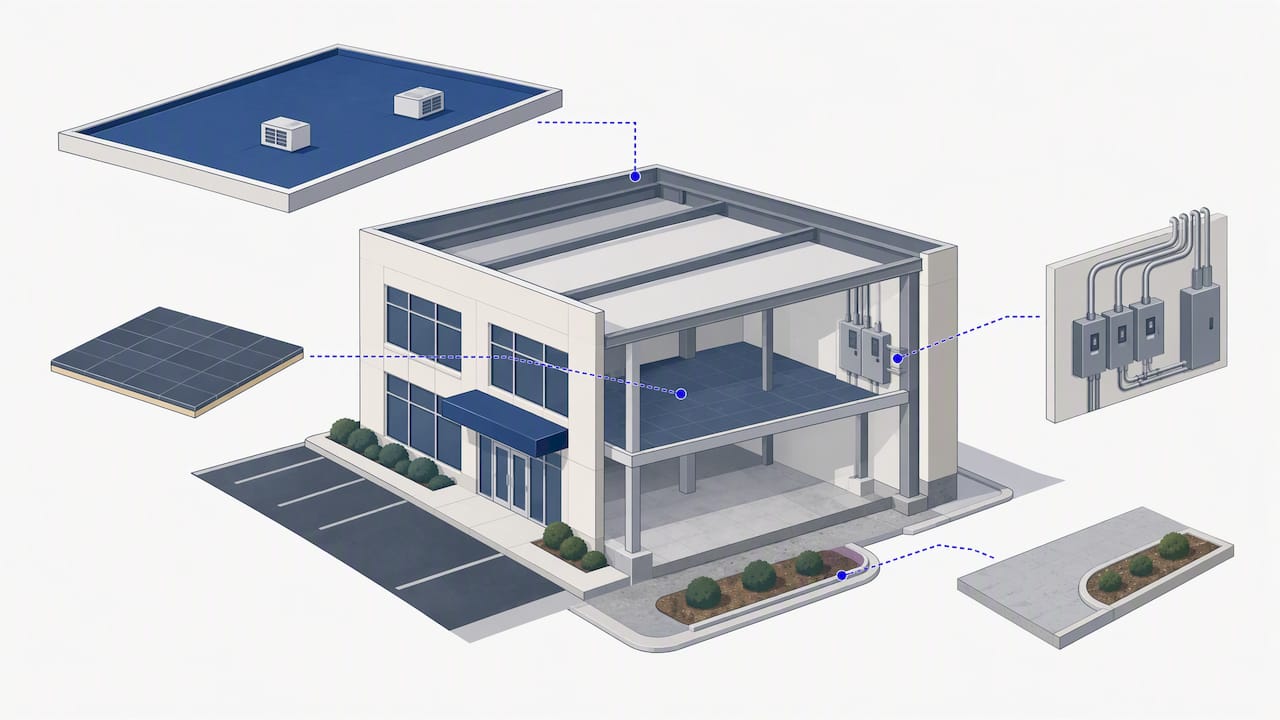
If you did not do a study at acquisition, a later study can still help you allocate basis to the components you have replaced or plan to replace. For owners who also want faster depreciation on assets that remain, our article on Section 179 and bonus depreciation for HVAC contractors shows how equipment timing works in a related setting.
Since the IRS identifies the election from your files, build a running log as projects happen, not in March. Useful records include:
Then add one line per project: component, date removed, estimated original basis, method used, and the paid invoice for the replacement. Send it to your preparer when the work finishes. It takes ten minutes and protects a deduction that can be large.
We see PAD as a data-capture problem more than a math problem. The formula is simple subtraction. What costs owners money is that nobody wrote down that the old rooftop units went to the scrap yard in July, so the basis stays on the books for 39 years.
We are a fee-only firm. We do not earn commissions on products, so when we say a PAD election is worth making, it is because the loss is real and defensible on your return. Our lead advisor holds both CPA and CFP credentials and has run a business, which shapes how we work: we ask about your capital projects during the year, not after the return is due.
Our advice is to treat every building project as a two-step decision. First, classify the work under the repair rules. Second, decide on the old component. Do both on paper at the time of the project, and keep the invoices where your preparer can find them.
— Joseph
A charitable remainder trust (CRT) is sometimes grouped with disposition strategies, but it is a different tool. It does not involve a building component or depreciation. The IRS describes CRTs as irrevocable trusts that let you donate assets to charity and draw annual income for life or a specific period.
Owners with highly appreciated property sometimes look at a CRT when they plan to sell. The tax treatment of the contribution, the payouts and the trust itself is technical, and it rests on the trust document and the specific assets involved. If you are weighing one, bring your attorney and CPA in before any sale agreement is signed, because the funding generally has to happen first. Our article on year-end tax strategies for stock portfolios covers other ways to manage gains on appreciated investments.
If you own commercial property, rentals or a building your business operates from, a PAD review is a good use of an hour. We look at your fixed-asset schedule, the projects you completed or plan to complete, and the basis support behind them, then coordinate the result with your return and your broader plan.
This fits inside tax reduction planning and business tax return preparation. If you want to understand why planning during the year beats filing after it, read our comparison of tax prep versus tax planning. To talk through a specific property, start from our business owners page.
An asset disposition is any event that takes an asset out of service for tax purposes, such as a sale, exchange, retirement, abandonment or destruction. For MACRS property, the rules are in Treas. Reg. 1.168(i)-8. A partial disposition is the same idea applied to only a portion of an asset, such as one roof on a larger building.
The ordinary election is made on the timely filed original return for the year of disposal. If you missed it, an amended return may not be the right fix. Rev. Proc. 2025-23 includes automatic method-change sections for partial dispositions and building dispositions, so a CPA should review which one applies to your facts.
No. Treasury allows reasonable, consistently applied methods, including pro-rata allocation by replacement cost. A study gives stronger support for the old component’s basis, especially for large or complex buildings, but it does not settle whether the replacement is a repair or an improvement.
No. The PAD deals only with the old component’s remaining basis. The replacement is analyzed separately under the betterment, restoration and adaptation rules, and is often capitalized and depreciated.